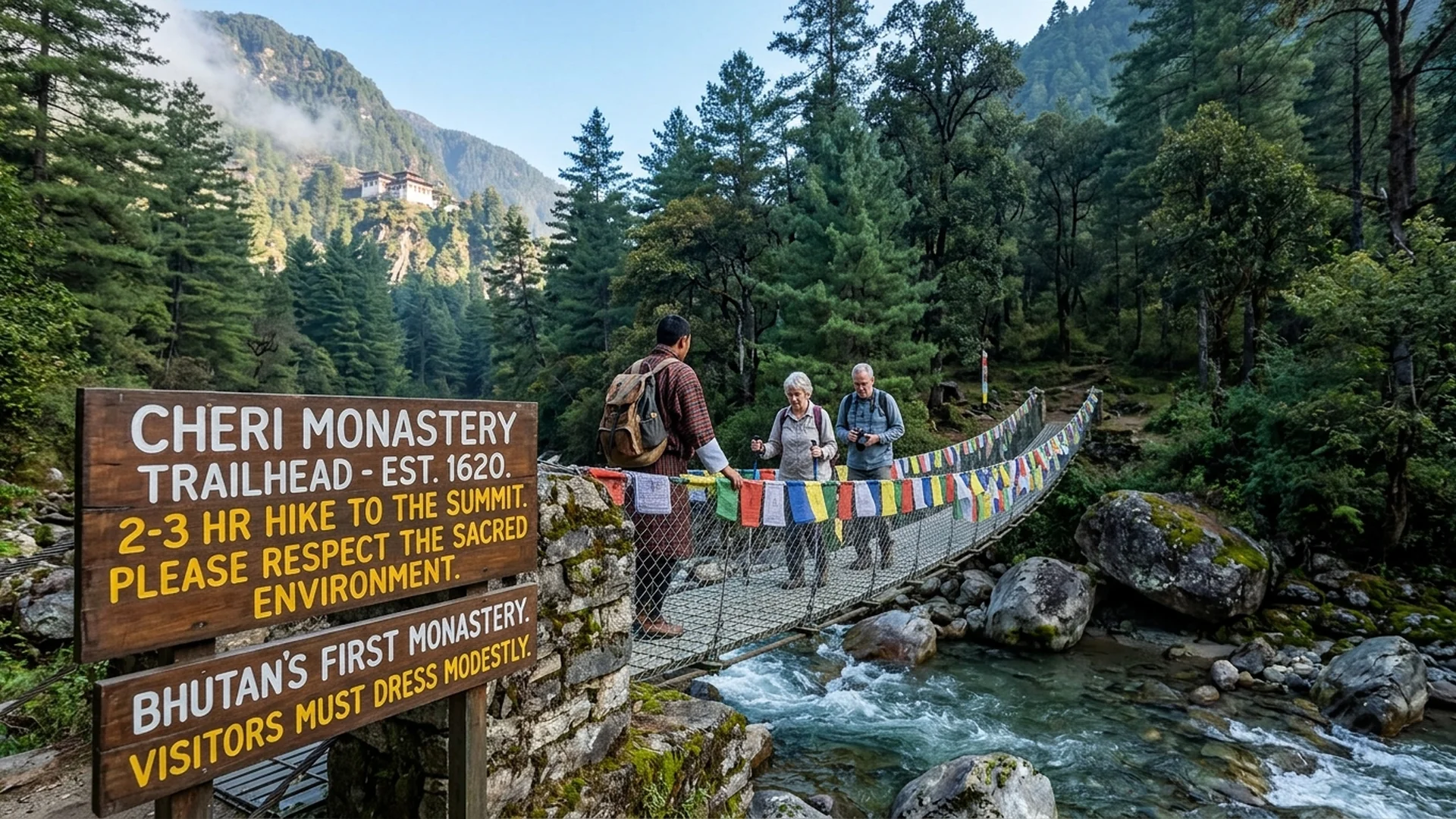
Cross the traditional wooden cantilever bridge spanning the crystalline waters of the Thimphu Chhu, and surrender to the timeless cadence of the forest. As you wind along ancient pine trails and beneath towering Himalayan crags, the world quiets down. Known historically as Chagri Dorjeden, Cheri Monastery is far more than a rewarding alpine trek; it is the inaugural monastic seat of the realm, established in 1620 by the great unifier of Bhutan, Shabdrung Ngawang Namgyal, laying the bedrock for the nation’s spiritual and temporal governance.
Enveloped in high-altitude mist and pristine wilderness, a pilgrimage to Cheri is an evocative journey of both body and soul. For the discerning global traveler seeking profound cultural resonance far beyond conventional tourism, this sanctuary serves as an initiation into the resolute spirit of the Thunder Dragon Kingdom. Here, ancient architecture, deeply preserved history, and an unhurried, meditative stillness converge to create an atmosphere found nowhere else on earth.
Roots of the Thunder Dragon: The Illustrious Legacy of Cheri
In the opening decades of the seventeenth century, when the visionary Shabdrung Ngawang Namgyal arrived to consolidate the fractured valleys of Bhutan, he chose a dramatic, precipitous cliffside at the northern extremity of the Thimphu Valley to construct Chagri Dorjeden in 1620. This was never conceived merely as a place of worship; it was the architectural cornerstone of a unified polity, blending spiritual authority with temporal rule. Here, the Shabdrung spent years in deep meditation, formalizing the Drukpa Kagyu lineage that would forever define the cultural identity of the nation.
Stepping across the threshold of the monastery is an exercise in time travel. Weathered stone walls and masterfully carved timber lintels echo the sophisticated craftsmanship of ancient royal artisans. Every alcove is saturated with the living memory of spiritual perseverance and the unification of a people under a banner of profound compassion.
The Pilgrimage Trail: Ascending Through Ancient Forests to Skyline Solitude
The pilgrimage to Cheri begins at the road’s end near the valley floor, where travelers cross a traditional timber bridge over the icy, rushing torrent of the Thimphu Chhu (river). Before you lies a shaded forest path that gently—and at times steeply—climbs through a dense canopy of ancient pines, gnarled oaks, and Himalayan rhododendrons that flush with color according to the turning seasons.
Spanning roughly an hour to ninety minutes of mindful walking, the ascent is accompanied only by the whispering wind in the pine needles, birdsong, and the occasional sighting of Himalayan goral grazing along the sheer rock faces. Any exertion from the elevation is swiftly dissolved by the crisp, oxygen-rich mountain air and the pristine purity of the Jigme Dorji National Park, a sanctuary vigilantly protected for future generations.
Dimensions of Liberation: The Sanctuary of Retreats and Sacred Relics
Upon reaching the monastery plateau, the most striking sensation is the absolute, profound silence—a stillness wholly detached from the modern cadence of the world. Cheri continues to serve as an active crucible for advanced spiritual practice. Venerable monks and accomplished lamas frequently select this isolated retreat center to undergo intensive three-year, three-month, and three-day meditation cycles, refining their consciousness in the footsteps of ancient masters.
Within the main prayer hall, priceless murals and sacred statues command quiet reverence. At the heart of the sanctuary rests the revered silver stupa, housing the sacred relics of Tempe Nima, the father of the Shabdrung. The gentle amber glow of butter lamps and the profound serenity of the inner sanctum evoke an enduring sense of grace and unyielding devotion.