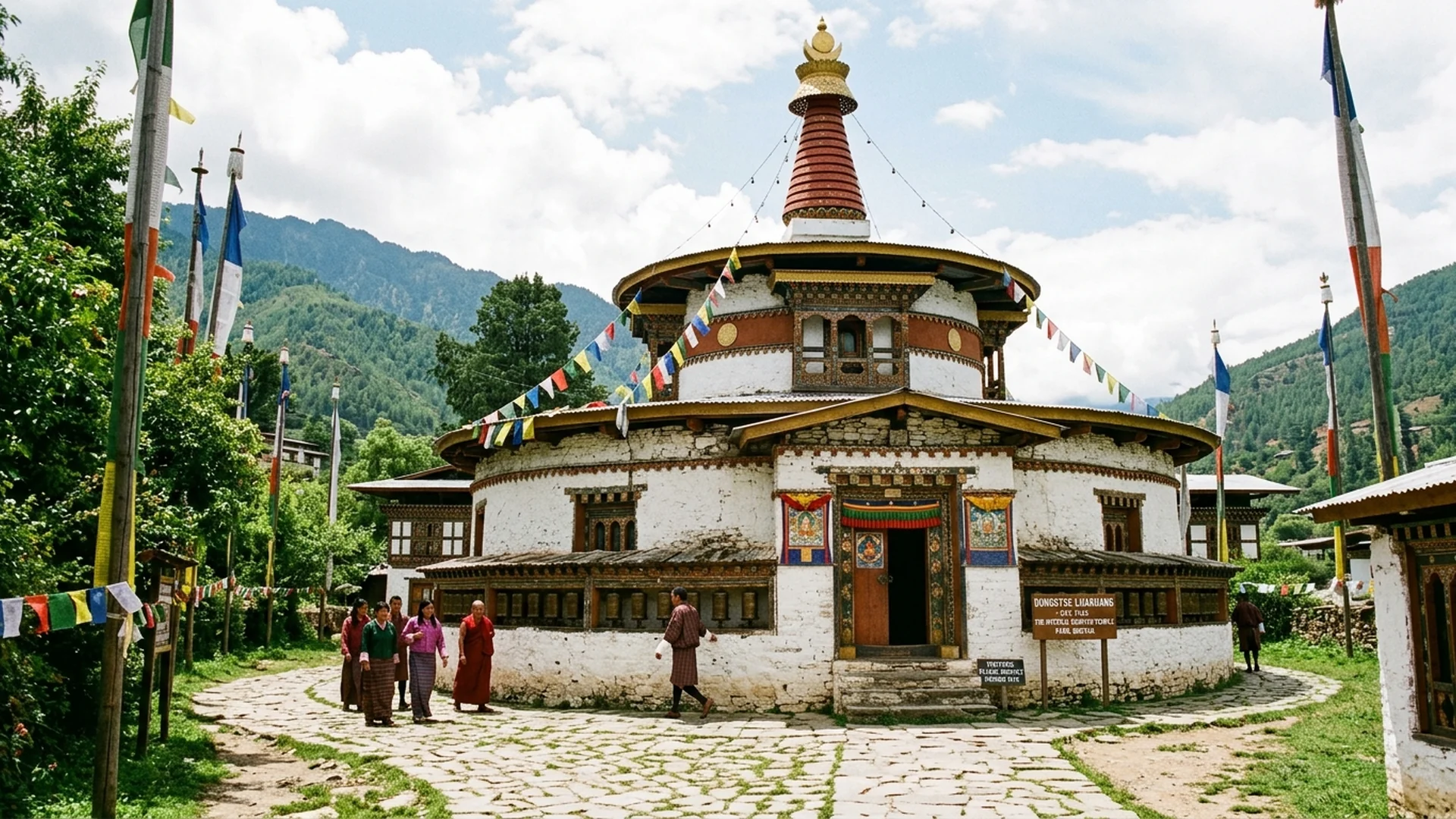
Amidst the verdant sweeps of the Paro Valley and its lingering veil of mountain mist, a singular architectural marvel stands in quiet defiance of time. Unlike conventional Himalayan monasteries crafted from timber beams and whitewashed assembly halls, Dungtse Lhakhang is an ancient chorten—a sacred stupa-temple—that uniquely invites the faithful to step directly into its hollow, meditative core. The moment you cross its stone threshold and leave the daylight behind, absolute darkness and centuries of distilled stillness envelop you.
To journey through Dungtse Lhakhang is not merely to sightsee; it is an intimate spiritual pilgrimage. Armed with only a small pocket torch and navigating steep, trembling wooden ladders, travelers descend and ascend through the profound cosmological layers of Buddhist philosophy. Within these three shadowed tiers lie some of the most exquisite, intact tantric murals in the Himalayan realm—sacred testaments to Bhutan’s mystical heritage, ancient lore, and deep inner devotion.
Architectural Stupas and the Iron-Bound Legends of Thangtong Gyalpo
Dungtse Lhakhang was erected in the 15th century by the venerable saint Thangtong Gyalpo, affectionately known as the ‘Iron Chain Bridge Builder.’ A polymath, engineer, and visionary yogi, he spanned turbulent Himalayan rivers with over a hundred iron-link suspensions. According to local lore, he constructed this sanctuary atop the resting body of a supine demoness to subdue subterranean malevolent forces and protect the nascent Paro Valley. Its physical form was deliberately cast as a grand chorten—a stupa featuring a broad base tapering upward into a soaring spire, symbolizing the Five Dhyani Buddhas.
So potent was the spiritual energy imbued within the structure that locals whispered the chorten was alive, vibrating with an urge to lift off and return to its spiritual origin in Tibet. To tether it permanently to the soil, Thangtong Gyalpo famously bound the summit to its base with heavy iron chains—relics that remain visible to this day as a tangible bridge between myth and physical reality.
Navigating the Three Realms: From Darkness to Liberation
The interior layout of Dungtse Lhakhang is a physical manifestation of the Three Realms (Traipushya) and the graduated path of Vajrayana spiritual evolution. The ground floor represents the earthly realm or the underworld, laden with remnants of worldly delusion. Shrouded in dim shadows and ancient incense, visitors use handheld torches to illuminate fierce protective deities and Dharmapalas whose wrathful gazes neutralize negative energies.
Climbing the nearly vertical wooden ladder to the second tier brings one to the human realm—a domain dedicated to active purification and study. Here, soft light filters through modest window slits, revealing murals of benevolent Bodhisattvas and revered lineage masters. The uppermost third tier symbolizes the pure realm of enlightenment. Though spatially intimate, it feels transcendent, housing the main sanctum and intricate depictions of cosmic Buddhas reflecting boundless wisdom. Traversing these sacred levels offers a profound inward meditation for the discerning traveler.
Ancient Mural Masterpieces: A Living Himalayan Museum
For connoisseurs of sacred art, Dungtse Lhakhang is an unmatched treasury. Every square inch of the interior walls serves as a living codex, recording the profound cosmological views, esoteric rituals, and philosophical depths of tantric Buddhism without compromise. The pigments are entirely mineral-based, sourced directly from the surrounding landscape, allowing the hues to retain their astonishing richness and dimensional depth across more than six centuries of time.
Though softened by centuries of butter-lamp soot, the delicate brushwork depicting deities locked in Yab-Yum—the sacred union of wisdom and compassion—radiates an unmistakable spiritual authority rarely encountered in contemporary temples, which are frequently restored with modern synthetic pigments.