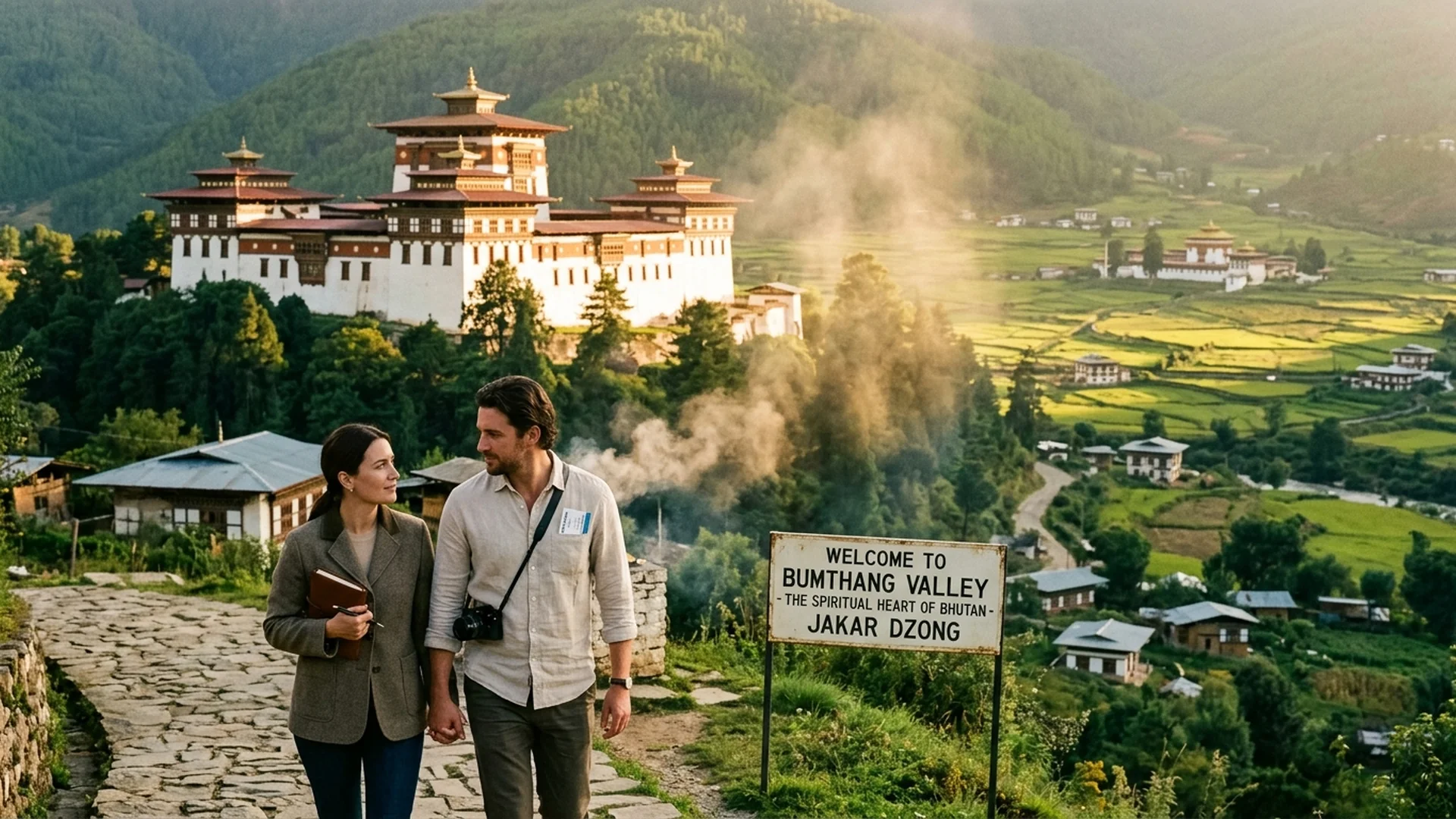
As the morning mist gradually dissipates above the pine-clad Himalayan slopes, the gentle chime of monastery wind chimes and the crystal waters of the Chokhor Valley evoke the timeless allure of Jakar. Serving as the cultural epicentre of the Bumthang Valley, this remarkable region is affectionately celebrated as the Switzerland of Bhutan, defined by its alpine topography, expansive pastures, and crisp, pristine mountain air.
Yet, the true essence of Jakar extends far beyond its picturesque vistas. It lies in the profound resonance of Vajrayana Buddhism, where daily life, masterclass sacred architecture, and unhurried tranquility converge in seamless harmony. For the discerning traveller seeking an elevated slow-life immersion amidst pristine natural beauty and world-class hospitality, Jakar remains an invaluable sanctuary waiting to be discovered with intention and reverence.
Architecture of Faith: Behind Ancient Stone Walls and Fortress Strongholds
Journeying through Jakar is akin to turning the pages of a living chronicle. The Bumthang Valley harbours some of the oldest sacred sanctuaries in the Himalayan kingdom. The voyage begins at Jakar Dzong, famously known as the Castle of the White Bird, perched dramatically upon a ridge since the sixteenth century. Legend dictates that as monastic leaders sought an auspicious foundation for their sanctuary, a great white bird soared across the valley and settled upon the crest of this hill, inspiring its auspicious name. Beyond functioning as the administrative and monastic hub of the region, the fortress showcases exquisite traditional Bhutanese woodworking executed entirely without the use of a single iron nail.
Venturing deeper into the valley reveals Jambay Lhakhang, one of the one hundred and eight border-taming temples miraculously erected in a single night by the Tibetan Emperor Songtsen Gampo in the seventh century. The interior breathes an atmosphere of ancient sandalwood incense and butter lamps, where golden light plays across centuries-old murals, whispering tales of unwavering devotion. Nearby stands Kurjey Lhakhang, the sacred sanctuary where Guru Rinpoche meditated during his monumental introduction of Tantric Buddhism to Bhutan. Within its hallowed cave, the master’s bodily imprint remains etched into the rock face, sheltered by a ring of one hundred and eight pristine white chortens that guard this holy geography.
Swiss Echoes in the Himalayas: Alpine Heritage and Distinctive Flavours
One of Jakar’s most enchanting paradoxes is its unexpected cultural synergy. During the 1970s, Swiss agricultural specialists collaborated with local visionaries to introduce advanced farming and livestock practices to the Bumthang Valley. This visionary partnership transformed Jakar into Bhutan’s premier producer of European-style artisanal cheeses, wild forest honey, and preserved mountain fruits.
Discerning travellers can visit local creameries before savouring a refreshing bottle of Red Panda Beer, Bhutan’s original craft brew crafted in the country’s first microbrewery nestled quietly among pine forests and sprawling pastures. Enjoying a chilled brew while watching yaks graze peacefully against a backdrop of crisp mountain air eloquently reinforces Jakar’s reputation as an exquisitely tranquil and exclusive Eastern Switzerland.
Aesthetics of Repose: Ultra-Luxury Sanctuaries Amidst Pristine Wilderness
For those experiencing Jakar through the lens of luxury, accommodation reaches world-class standards at ultra-exclusive retreats such as Amankora Bumthang, discretely tucked away in the pine forests near the historic Wangduechhoeling Palace, or Six Senses Bumthang, thoughtfully engineered around the ethos of forest bathing with panoramic glass vistas framing the encompassing woodlands.
Architectural palettes honour regional integrity by featuring local pine, traditional bukhari wood-stoves for crisp alpine evenings, and holistic wellness therapies rooted in traditional Bhutanese medicine. Every fleeting moment spent in Jakar is thus transformed into an unhurried, deeply restorative journey of renewal.