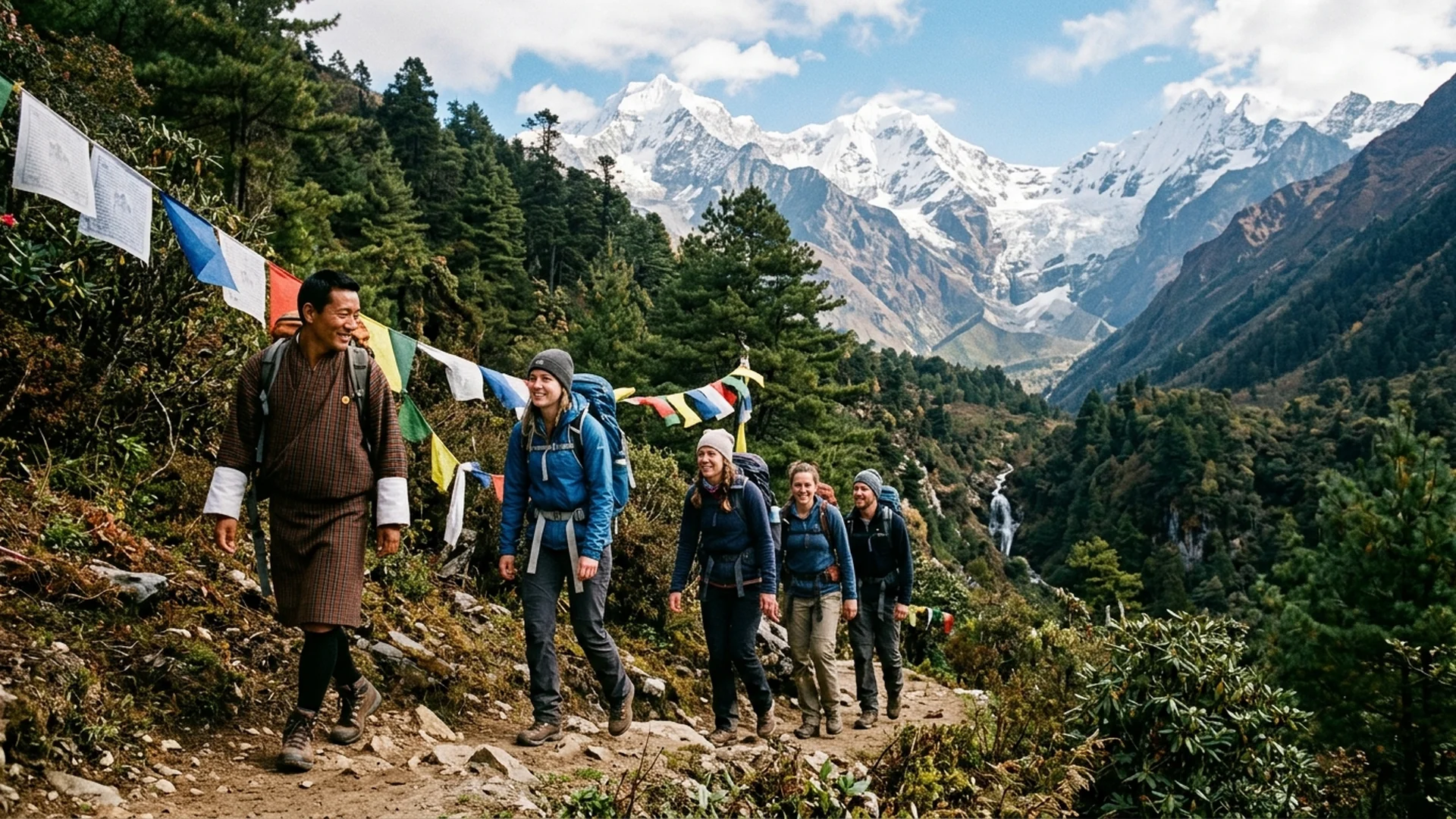
As the morning mist slowly uncurls across the snow-capped summits of the high Himalayas, the gentle chime of brass bells from a caravan of yaks picking their way along narrow mountain tracks evokes a silence unknown anywhere else on Earth. This is a magnificent wilderness where raw, untamed majesty and sacred purity fuse flawlessly within Jigme Dorji National Park, an unspoiled sanctuary spanning over 4,300 square kilometers across the Kingdom of Bhutan.
More than merely the nation’s second-largest protected area, this is the singular ecosystem on the planet where Bengal tigers and elusive snow leopards share overlapping territories. Here, discerning travelers are invited on an exclusive expedition that bridges body, soul, and pristine nature in profound alignment with Bhutan’s founding philosophy of Gross National Happiness.
Crossing the threshold into Jigme Dorji National Park is akin to stepping into another dimension—one where time unfurls unhurriedly and every stride along the trail is a pilgrimage to the beating heart of nature, untouched by the modern world.
A Frontier of Extremes: Where Snow Leopards and Tigers Converge
The ecological marvel of Jigme Dorji National Park lies in its dramatic vertical topography, sweeping from humid subtropical river valleys up to alpine meadows and perennial snowfields. This extreme range in elevation creates a thriving sanctuary for endangered global species, from red pandas and blue sheep to the mythical Takin—a sturdy, enigmatic creature resembling a blend of goat and antelope.
Most astonishing to naturalists and researchers is the park’s rare ecological overlap. Lowland Bengal tigers occasionally ascend into higher altitudes, while snow leopards patrol the frigid upper ridges, sharing an integrated domain. This flourishing coexistence is a testament to Bhutan’s uncompromising conservation ethics, rooted in an ancient worldview that regards humanity and the wilderness as inseparable kin.
Adventure-Luxe Trekking: The Laya Gasa Route and Life on the Roof of the World
For high-net-worth adventure travelers, legendary alpine routes such as the Laya Gasa Trek or the Jomolhari Trek present both an exhilarating physical challenge and a peerless reward. The trails weave through deep gorges, beside crystalline glacial streams, and into rarefied atmospheres above the clouds. Today, these expeditions are elevated with bespoke comforts, featuring professional support teams, private luxury tented camps, and private culinary artists crafting warming meals amid crisp mountain air.
The journey leads ultimately to the homeland of the Layap people, an ethnic minority settled high upon the slopes of Laya at over 3,800 meters above sea level. Clad in distinctive conical bamboo hats adorned with yak hair, they preserve an ancient semi-nomadic pastoral lifestyle. Sharing herbal tea and stories around a glowing hearth beneath a vast, starlit Himalayan sky offers a cultural dimension of immeasurable value.
Gasa Tsachhu: Royal-Grade Thermal Healing in the Shadow of the Fortress
Following weeks of mindful endurance along remote mountain trails, nature offers its ultimate restorative prize: Gasa Tsachhu, Bhutan’s most venerated natural hot springs, resting quietly beneath the ancient foundations of Gasa Dzong.
Structured across multiple terraced stone pools of varying temperatures, these mineral-rich waters are prized for soothing weary muscles, releasing tension, and restoring vitality in accordance with traditional Himalayan medicine. Soaking in these steaming pools while alpine mists drift past frozen crags, with sweeping vistas of the mighty peaks unfolding before you, constitutes an ultra-luxury wellness experience authored entirely by the elements.