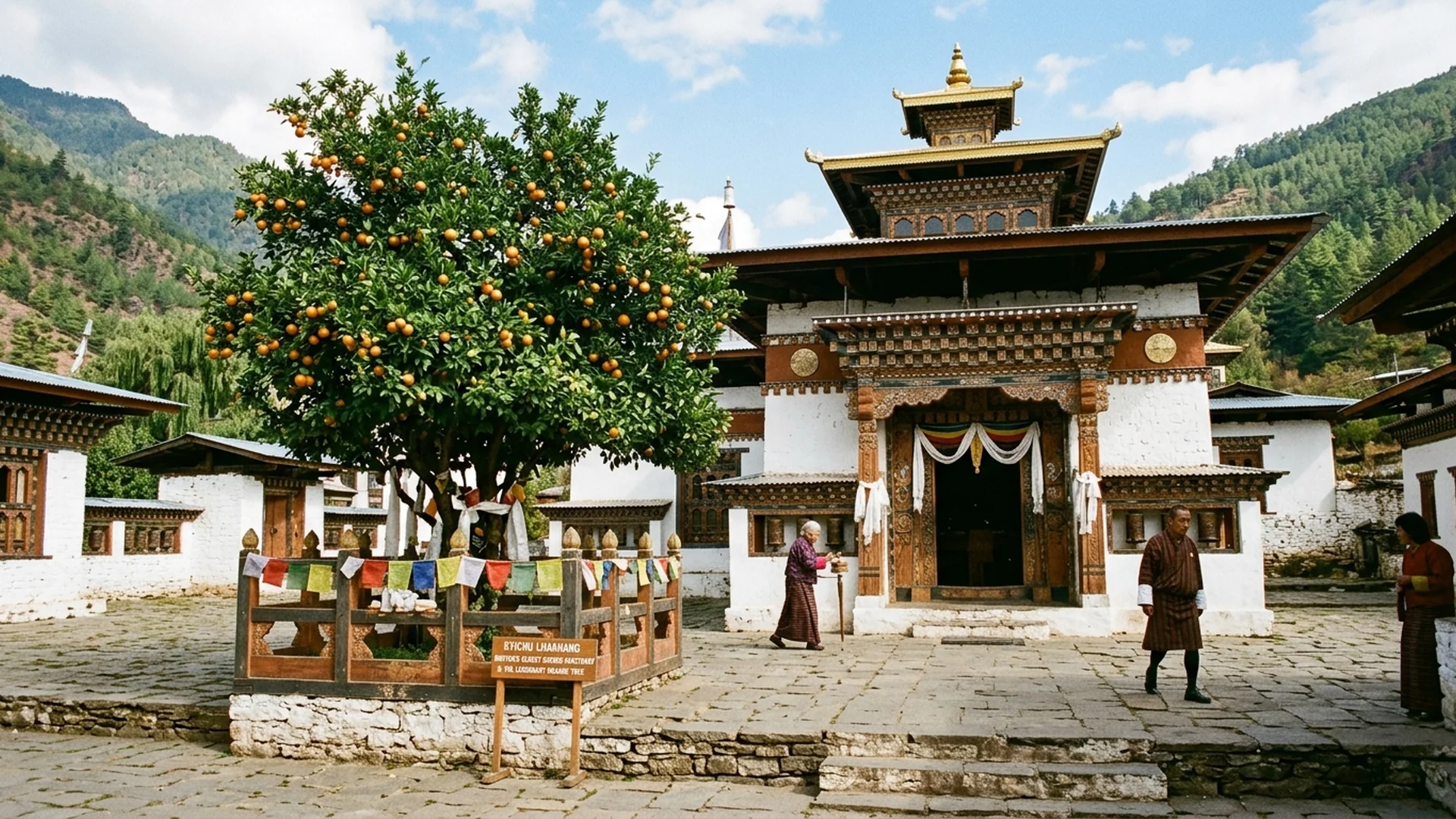
Crossing the threshold of the ancient timber doorway into the courtyard of Kyichu Lhakhang in the Paro Valley, one feels as though time itself has paused since the seventh century. This revered sanctuary is not merely one of the oldest religious structures in the Himalayas; it marks the very genesis of Vajrayana Buddhist civilization in Bhutan. Visiting this sacred ground transcends ordinary sightseeing, inviting discerning travelers into a mindful sanctuary where profound silence stills the restless mind.
Beneath the shelter of venerable trees, visitors encounter master woodcarvings and polished temple floors worn deep by the footsteps and prostrations of countless faithful over a thousand years. Nearby, the mystical presence of the legendary ‘eternal orange tree’ graces the central courtyard, bearing golden fruit through every season as a timeless emblem of enduring spiritual vitality.
An Anchor of Faith: The Ogress Legend and the Genesis of Kyichu Lhakhang
In the seventh century, the Himalayan landscape was shrouded in untamed wilderness and adversarial spiritual forces. According to Vajrayana mythology, a colossal ogress lay supine across the region, obstructing the dissemination of the Dharma. To subdue her and pacify the terrain, the thirty-third Tibetan king, Songtsen Gampo, commanded the construction of 108 temples overnight across the Himalayan expanse.
Kyichu Lhakhang in the Paro Valley was meticulously pinned upon the ‘left ankle’ of the reclining ogress—while Jambay Lhakhang in Bumthang secured her left knee. This monumental undertaking established the formal inception of Buddhism within Bhutanese soil, centuries before Guru Rinpoche, the Precious Master Padmasambhava, arrived in the eighth century to meditate and conceal profound spiritual treasures, known as Terma, within its sacred precincts.
Jowo Lhakhang: The Heart of Devotion and a Millennium of Prostrations
Stepping into the inner sanctum of Jowo Lhakhang, one is immediately enveloped in the soothing fragrance of butter lamps and an overwhelming, palpable stillness. At the spiritual core of this sanctuary rests the venerable Jowo Jampa statue, depicting Lord Buddha as a young prince—a sacred sibling in faith to the celebrated Jowo image within Lhasa’s Jokhang Temple.
Perhaps the most moving artifact within the temple is not enshrined behind glass, but lies exposed beneath the feet: the ancient timber floorboards before the main altar, worn away into deep, sweeping depressions. These hollows were not shaped by artisans’ tools, but by the knees and palms of countless monks, lamas, and devoted pilgrims who have knelt in complete prostration across the centuries. This worn timber stands as a living testament to unyielding devotion.
The Enigmatic Orange Tree and the Later Sanctum of Guru Lhakhang
In the stone courtyard nestled between the twin sanctuaries stands the miraculous orange tree. According to local lore, these trees continually blossom and bear vibrant golden citrus fruits throughout the year, untouched by the natural dormancy of seasonal cycles. The Bhutanese regard this botanical anomaly as a blessing bestowed by Guru Rinpoche, representing unbroken life force and eternal spiritual abundance. Northeast of the ancient core stands Guru Lhakhang, erected in 1968 by Her Royal Highness Ashi Kesang Choden Wangchuck, the Queen Grand Mother. This sanctuary enshrines an imposing five-meter-tall statue of Guru Rinpoche and serves as the final resting place for the sacred relics of Kyabje Dilgo Khyentse Rinpoche, harmonizing archaic Himalayan antiquity with living contemporary heritage.