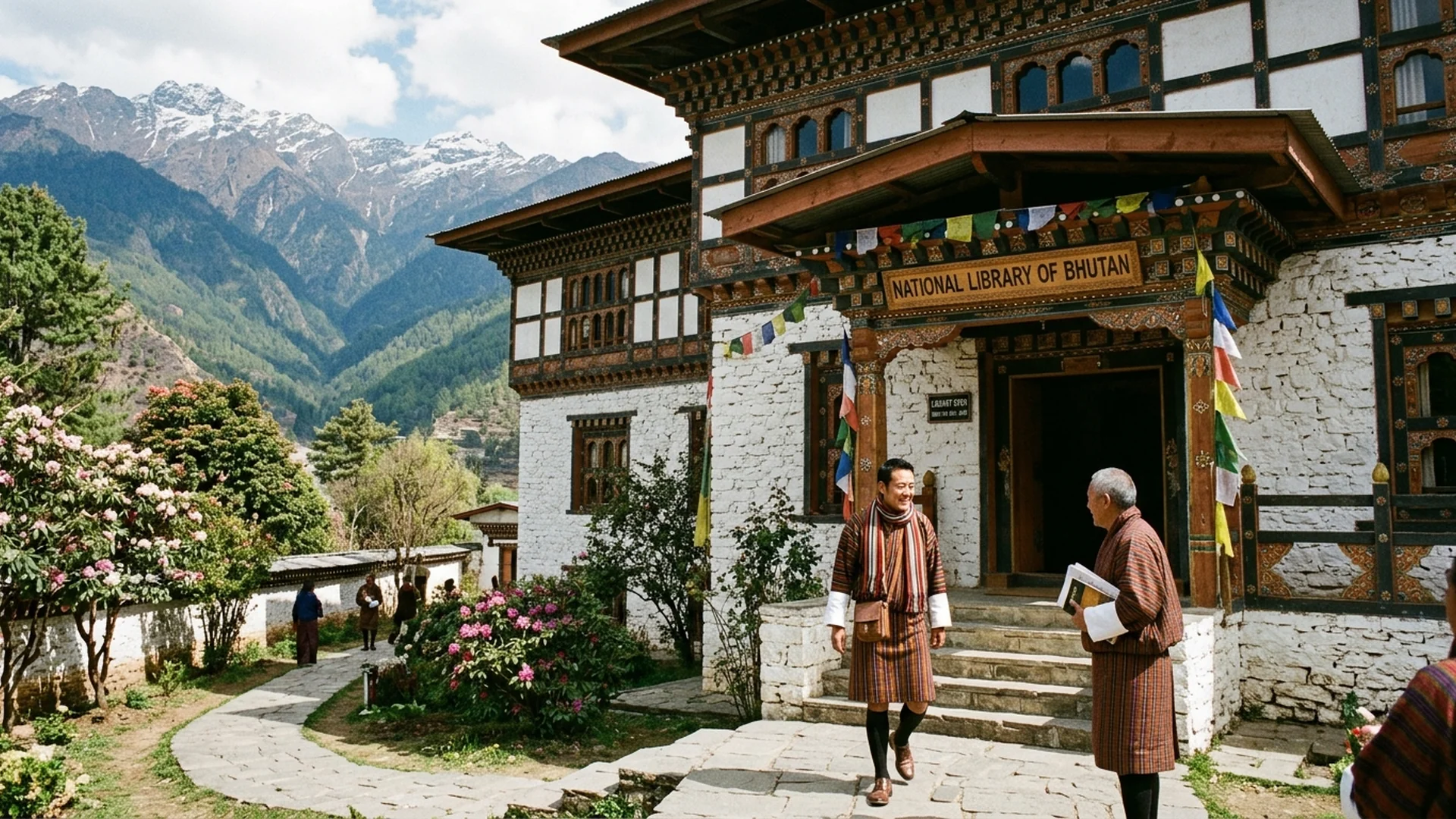
Transcending conventional travel to touch the beating heart of Vajrayana Buddhism begins at the National Library of Bhutan, a magnificent four-story edifice designed in the classical dzong style. This is far more than a mere repository of volumes; it is a sacred archive of historical consciousness, safeguarding priceless ancient manuscripts hand-in-scribed on natural Lokta bark paper alongside masterworks of indigenous craftsmanship.
Crossing the threshold of intricately carved timber doors, the contemplative aroma of ancient parchment and drifting incense invites visitors into a profound stillness. Here, amidst an intellectual sanctuary that reflects the deep philosophical undercurrents of the Thunder Dragon Kingdom, ancient literary heritage merges seamlessly with exquisite architectural grace, offering an essential pilgrimage for the culturally curious traveler.
Architecture of Devotion: A Fortress of Wisdom in Thimphu
Perched with quiet dignity in the Kawajangsa district of Thimphu, the National Library of Bhutan is intentionally designed to echo the aesthetic of a traditional dzong—the fortress-monasteries that define the nation’s architectural soul. Constructed entirely through the vision and funding of the Bhutanese government and formally inaugurated in late 1984, this four-story structure serves as the central bastion for collecting, preserving, and perpetuating the country’s literary treasures.
The exterior is enveloped by tranquil mountain scenery, showcasing the mastery of the Zorig Chusum (the thirteen traditional arts and crafts of Bhutan). Intricate floral and auspicious animal motifs adorn the timber balconies, while natural mineral-pigment wall murals whisper ancient Buddhist parables. This striking physical beauty is not mere ornamentation, but a protective vessel for the profound intellectual and spiritual devotion housed within.
Ancient Scriptural Vaults and the Alchemy of Lokta Paper
In the upper chambers of the library, the air grows cool and hushed. Slanted daylight cuts across towering pine shelving units divided into immaculate grids, where countless xylographs—ancient woodblock prints on palm-leaf and traditional mulberry paper—rest in orderly peace. Each volume is swathed in jewel-toned silks and secured with expertly woven braided cords.
A cornerstone of this exceptional preservation is the use of dezo, or Lokta paper, harvested from the daphne shrubs clinging to the Himalayan slopes. Featuring exceptionally long, resilient fibers and natural insect-repelling properties, this indigenous paper has allowed centuries-old Buddhist sutras and traditional medical treatises to retain their pristine legibility. It stands as a testament to an enduring ecological wisdom that harmonizes human craft with natural sustainability.
A Monumental Scale: Witnessing a Publishing Marvel
The ground-floor hall houses one of the library’s most celebrated modern marvels, drawing discerning travelers from across the globe: ‘Bhutan: A Visual Odyssey Across the Last Himalayan Kingdom’. This monumental photographic masterwork was once crowned by the Guinness Book of World Records as the largest published book on Earth.
Born from four exhaustive expeditions undertaken by a dedicated team of scholars and global photographers led by Michael Hawley of MIT, the project captured over 40,000 images to document Bhutan’s sublime landscapes, vibrant culture, and daily life. When opened, the tome spans roughly 1.5 by 2.1 meters and weighs an impressive 60 kilograms. Library custodians gently turn its pages to reveal breathtaking, life-sized panoramic vistas of snow-capped Himalayan peaks and exuberant monastic festivals, reframing the Kingdom on a truly global scale.