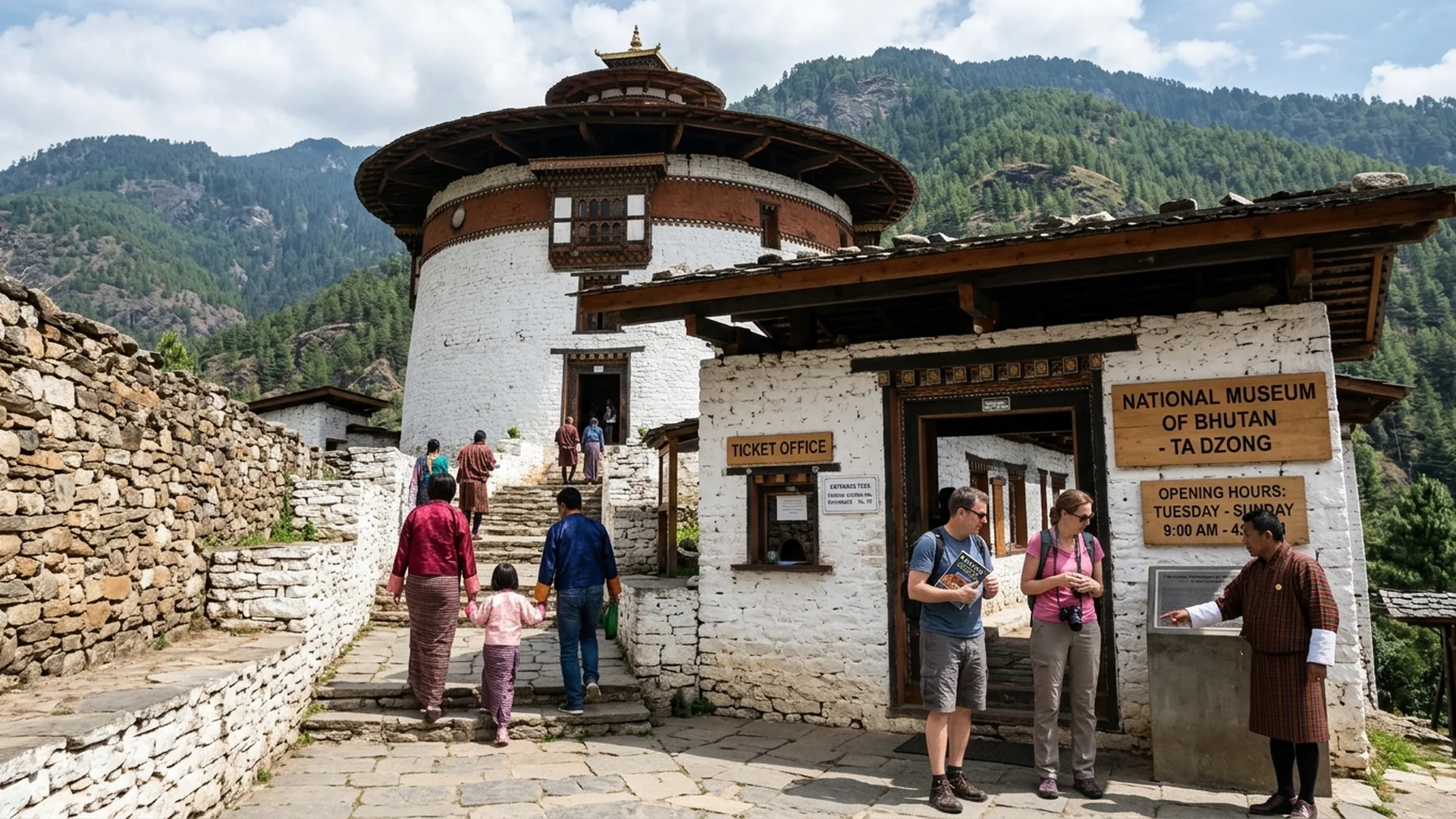
Perched upon the ridge crest overlooking the majestic Paro Rinpung Dzong stands the Ta Dzong—a striking, cylindrical fortress whose curved silhouette evokes a sacred conch shell. This ancient stone stronghold, weathering four centuries of Himalayan storms, was never merely an instrument of military defense. Rather, it serves as the ultimate threshold for discerning travelers seeking to decode the spiritual and historical tapestry of the Thunder Dragon before venturing deeper into the kingdom.
Crossing a stone threshold more than two meters thick, travelers are welcomed by the crisp mountain air into the National Museum of Bhutan. This living treasury houses over 3,000 priceless antiquities and sacred relics spanning fifteen centuries of civilization. Far from a static repository, these halls pulse with living faith, ancient wisdom, and the evolutionary spirit of a nation, ranging from prehistoric stone implements and luminous thangkas to the revered Raven Crown of the Wangchuck dynasty’s first monarch.
Beginning one’s Himalayan sojourn at Ta Dzong is therefore much more than a routine museum visit. It is an intentional spiritual priming, equipping the traveler with the contextual depth necessary to truly appreciate Bhutan’s living roots, timeless culture, and philosophy of gross national happiness.
Nail-Free Conch Architecture: From Strategic Watchtower to Sanctuary of Faith
In Dzongkha, the word ‘Ta’ signifies watching or observation. Thus, Ta Dzong was commissioned in 1649 by La Ngonpa Tenzin Drugdra, the first governor of Paro, to function as a strategic mountaintop watchtower guarding the lower Paro Rinpung Dzong against external incursions.
The architectural brilliance of Ta Dzong lies in its rounded, tapering cylindrical form, deliberately reminiscent of a conch shell—one of the eight auspicious symbols of Buddhism. The exterior walls are constructed from natural stone measuring up to 2.5 meters in thickness, interwoven with dense hardwood timbers entirely without the use of metal nails. This ingenious ancient craftsmanship imparts seismic flexibility, allowing the structure to withstand violent Himalayan earthquakes across the centuries. Historically, a secret underground tunnel even connected the watchtower directly to the Pa Chhu river, ensuring a secure water supply during sieges and exemplifying an enduring harmony between military utility and natural integration.
Genesis of the National Museum: A Royal Vision for Heritage Preservation in 1968
As global geopolitics shifted into the modern era, the military utility of the ancient watchtower gradually receded. Recognizing the urgent need to protect the nation’s cultural soul, His Majesty King Jigme Dorji Wangchuck—revered as the Father of Modern Bhutan—ordered a comprehensive restoration of Ta Dzong in 1968, transforming it into the National Museum of Bhutan.
This momentous transition from a fortress of defense to a citadel of knowledge ensured that the kingdom’s priceless spiritual relics would be preserved for posterity. Though the main conch-shaped structure sustained damage during the significant 2011 Himalayan earthquake, meticulous restoration efforts have restored the monument to its full splendor. Today, it stands ready once more to guide travelers across centuries of uninterrupted civilization.
The Himalayan Treasury: Exploring Sacred Galleries and Masterpiece Collections
Within the galleries of the National Museum, more than 3,000 artifacts are systematically curated across multiple levels. The journey begins with prehistoric stone axes and Neolithic implements unearthed in the valleys, marking the nascent human footprints in the high Himalayas. Ascending further, visitors encounter sacred repositories showcasing intricate silk thangkas alongside sublime bronze sculptures of Guru Rinpoche and various manifestations of the Buddha.
A crown jewel of the collection is the Royal Heritage Gallery, which houses the illustrious Raven Crown worn by the first monarch of the Wangchuck dynasty, alongside ancient manuscript texts and the world-renowned collection of Bhutanese philately. From silk-woven stamps to gold-foil and three-dimensional issues that revolutionized global postal design in the 1960s, the exhibits astound collectors. The tour culminates on the topmost floor, where an exquisite carved wooden mandala symbolizes the ‘Tree of Merit’.
Aesthetics of the Paro Valley: Panoramic Viewpoints and Twilight Atmosphere
Beyond the scholarly riches housed within its historic walls, Ta Dzong offers an exquisite sensory and aesthetic experience courtesy of its elevated vantage point. From the open stone plazas surrounding the museum, visitors are treated to sweeping panoramic vistas across the entire Paro valley.
Directly below, the Pa Chhu river threads its way through emerald rice paddies, while the formidable white walls and timber roofs of Paro Rinpung Dzong rise in quiet authority. In the late afternoon, as descending sunlight catches the ancient stone masonry of Ta Dzong and paints the surrounding valley in warm hues, the atmosphere settles into a profound stillness, punctuated only by distant wind chimes and murmuring prayers—an ideal setting for contemplation and inner peace.