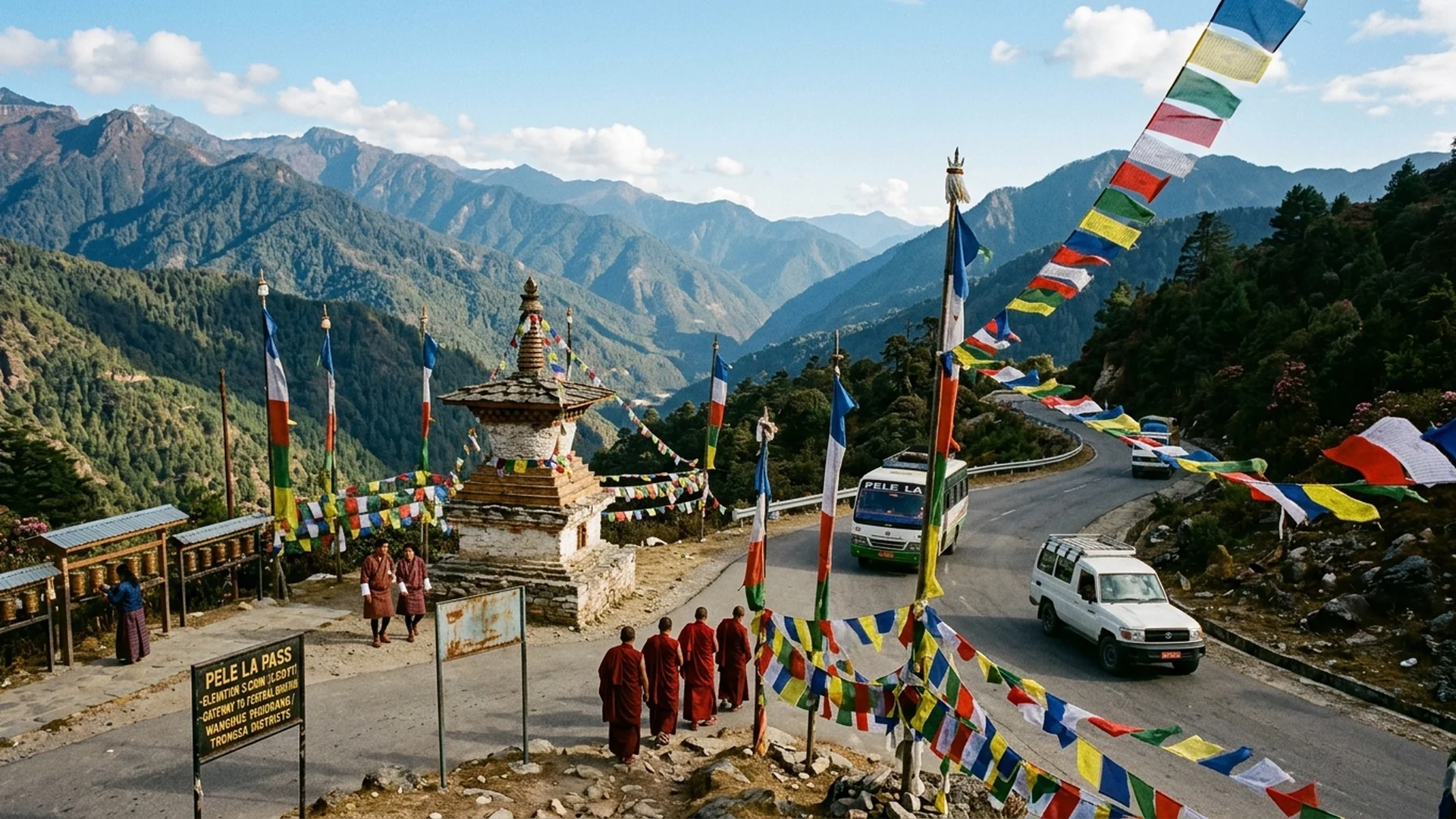
As the vehicle slowly ascends past 3,400 meters above sea level, the surrounding air turns crisp enough to render every breath a plume of white vapor. Pele La Pass emerges not merely as a transitional staging post along the winding artery connecting Wangdue Phodrang and Trongsa, but as a consecrated threshold that definitively delineates the geographic and cultural frontiers of Western and Central Bhutan. Here, mountain gales whisper ancient homilies through vibrant clusters of five-element prayer flags, snapping in rhythm against a stark backdrop of stone Tibetan-style chortens and jagged Himalayan silhouettes, anchored by the distant, timeless majesty of Mount Jomolhari.
For discerning travelers seeking resonance far beyond the superficial check-in, Pele La is a meticulously crafted suture in the earth’s tapestry. Low-hanging mists drift silently through primeval forests of hemlock and wild rhododendron, evoking the atmospheric weight of forgotten folklore, while the quiet resilience of nomadic yak herders clinging to these high-altitude pastures captures an increasingly rare harmony between humanity and the untamed wild.
Frontiers of Devotion: Where Topography Meets Transcendence
In the cosmological worldview of Bhutan, the natural world is far from inert; it pulses in profound communion with sacred forces. Thus, Pele La Pass functions as an open-air sanctuary where the breath of the mountains articulates silent litanies on behalf of humanity. Thousands of prayer flags—dyed in the five elemental hues of blue, white, red, green, and yellow—are strung across the jagged ridgelines, consecrated to disperse blessings and compassion to all sentient existence. With every gust of wind sweeping over the crest, these silent petitions are cast outward into the ether anew. To step upon the earth at Pele La is to transcend mere physical transit, entering a suspended temporal sanctuary where the wandering mind finds profound stillness.
Biodiversity and the Forest of the Threshold
One of the most striking phenomena of Pele La Pass is its sudden ecological metamorphosis. The sweeping pine and broadleaf forests of the lower valleys abruptly give way to an alpine landscape dominated by dwarf bamboo, providing vital nourishment for wild and domestic yaks alike. During the brief window of spring, the surrounding woodlands ignite with the vivid crimsons and pinks of wild rhododendron blossoms, creating a fierce chromatic contrast against the lingering snowcaps above. This rich biological tapestry renders Pele La an open-air botanical laboratory, where naturalists and photographers encounter raw, unmanicured wilderness at its most evocative.
Life Behind the Mist: The Resonance of High-Altitude Bells
Amidst the heavy mountain mists that frequently cloak the pass, the resonant chime of brass bells worn by grazing yaks provides an auditory landscape rooted deeply in tradition. Semi-nomadic herders continue their ancestral rhythms, guiding herds up to graze the rich alpine pastures of summer before retreating to lower elevations with the onset of first winter frosts. Observing this unhurried pastoral existence grants profound insight into the resilience, unwavering faith, and minimalist grace that have long sustained Bhutanese society away from the frantic pace of the modern world.