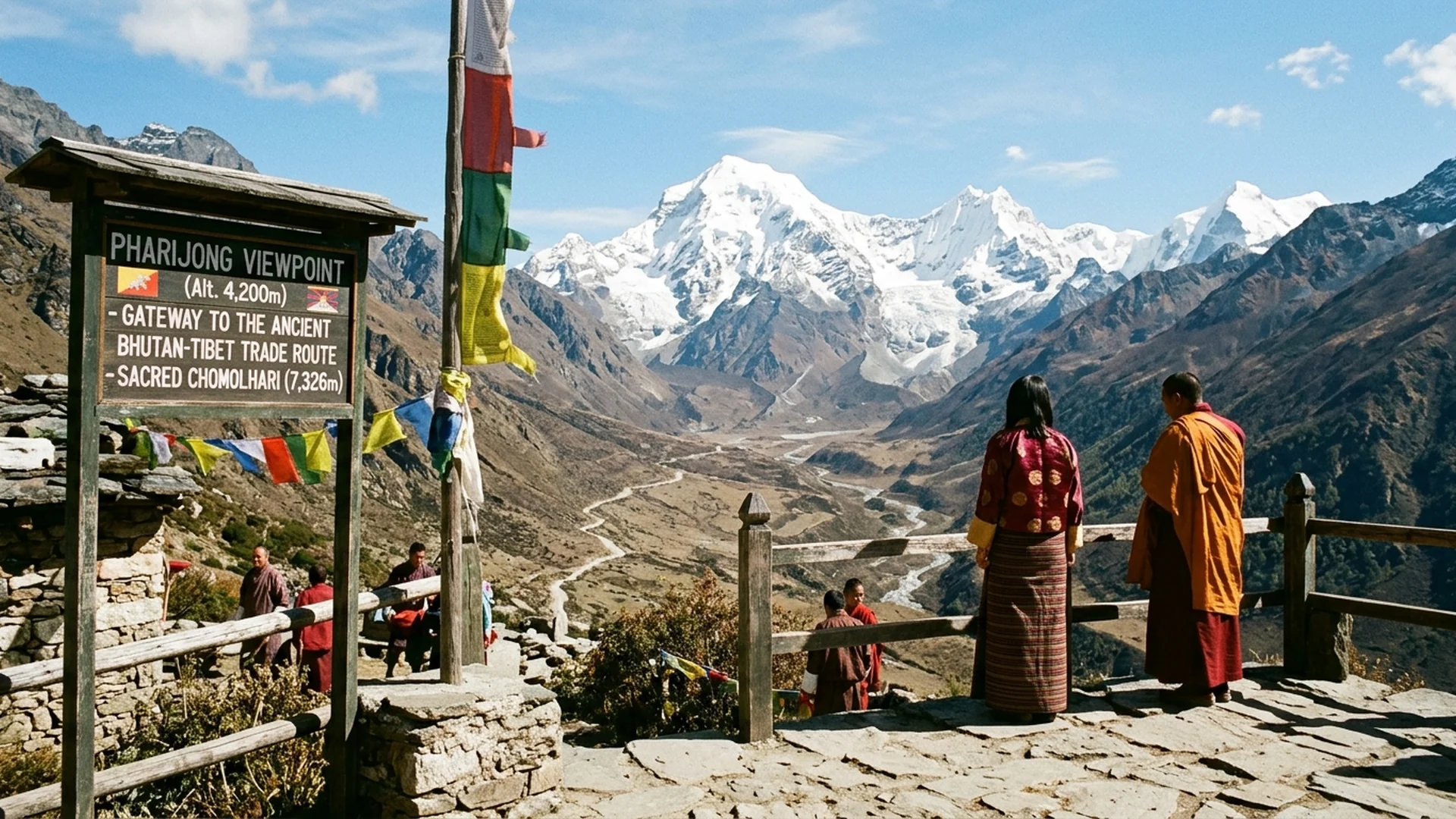
When the high-altitude winter wind sweeps across mountain saddles, the soaring valleys of the Thunder Dragon Kingdom reveal themselves as more than mere scenic landscapes. They are living tapestried canvases woven from centuries of trans-Himalayan commerce, nomadic journeys, and esoteric reverence. Standing at the Pharijong Viewpoint, travelers are met with the majestic presence of Mount Chomolhari, piercing the deep indigo sky like a natural cathedral hewn by the elements to guard this sacred realm.
Yet, few outsiders realize that this tranquil expanse once served as the pulse of an ancient trade highway. Here, courageous caravans braved biting gales and dizzying elevations to bridge two distinct worlds: Bhutan and Tibet. Ascending to Pharijong is not merely an exercise in sightseeing; it is an invitation to step backward in time, breathing in the storied echoes of the Tremo La pass where camel bells and yak-driver call-and-response once echoed through the glacial air.
The Legacy of Tremo La: The Forgotten Caravan Highway
Long before modern geopolitics mapped borders with treaties and coordinates, Bhutan’s precipitous high valleys thrummed with the vital energy of ancient trading arteries. These tracks linked the fertile basins of Paro and Punakha northward to Phari in Tibet via the formidable Tremo La pass. The Pharijong Viewpoint occupies a strategic perch that once functioned as an advance outpost and vital waystation for rugged merchant caravans. These hardy souls transported vital commodities—rice, natural dyes, and agrarian produce from Bhutan—in exchange for salt, wool, and pressed tea from the Tibetan plateau. Traversing this route demanded immense resilience against capricious weather and numbing cold, yet it remained the vital economic and cultural lifeline of the Eastern Himalaya for centuries. To stand at this viewpoint today is to occupy a silent stage of history, heavy with the enduring weight of trans-Himalayan civilization.
Chomolhari: Cathedral of Faith and Himalayan Mirror
Undoubtedly, the gravitational pull drawing discerning global travelers to this remote frontier is the immaculate presence of Mount Chomolhari, soaring 7,314 meters above sea level. With its statuesque, snow-draped rock pyramids, this titan is rightfully honored as the ‘Bride of Kangchenjunga’ or the queen of the local ranges. Within Vajrayana Buddhist cosmology, Chomolhari transcends mere geographical wonder; it is a revered sanctuary where Jomo, the divine protective deity of the region, abides. Witnessing the peak catch the first alpenglow of dawn, or watching the evening light set its sheer glacial walls ablaze from the vantage of Pharijong, is a sublime encounter that lingers indelibly in memory.
Breath of the High Frontier: The Life of Himalayan Yak Herders
Beyond its historical and geological grandeur, the landscape surrounding the viewpoint sustains one of the last remaining communities of nomadic yak herders in the high Himalaya. These families exist in profound harmony with a severe wilderness, inhabiting woven yak-hair tents known as brogpa and following seasonal grazing migrations across alpine pastures. For these pastoralists, the yak is far more than a beast of burden or sustenance; it is the cornerstone of their spiritual and material existence. Engaging with these communities offers discerning visitors a rare, humbling perspective on human adaptability, revealing a quiet contentment rooted not in material accumulation, but in radical simplicity and reverence for the elements.