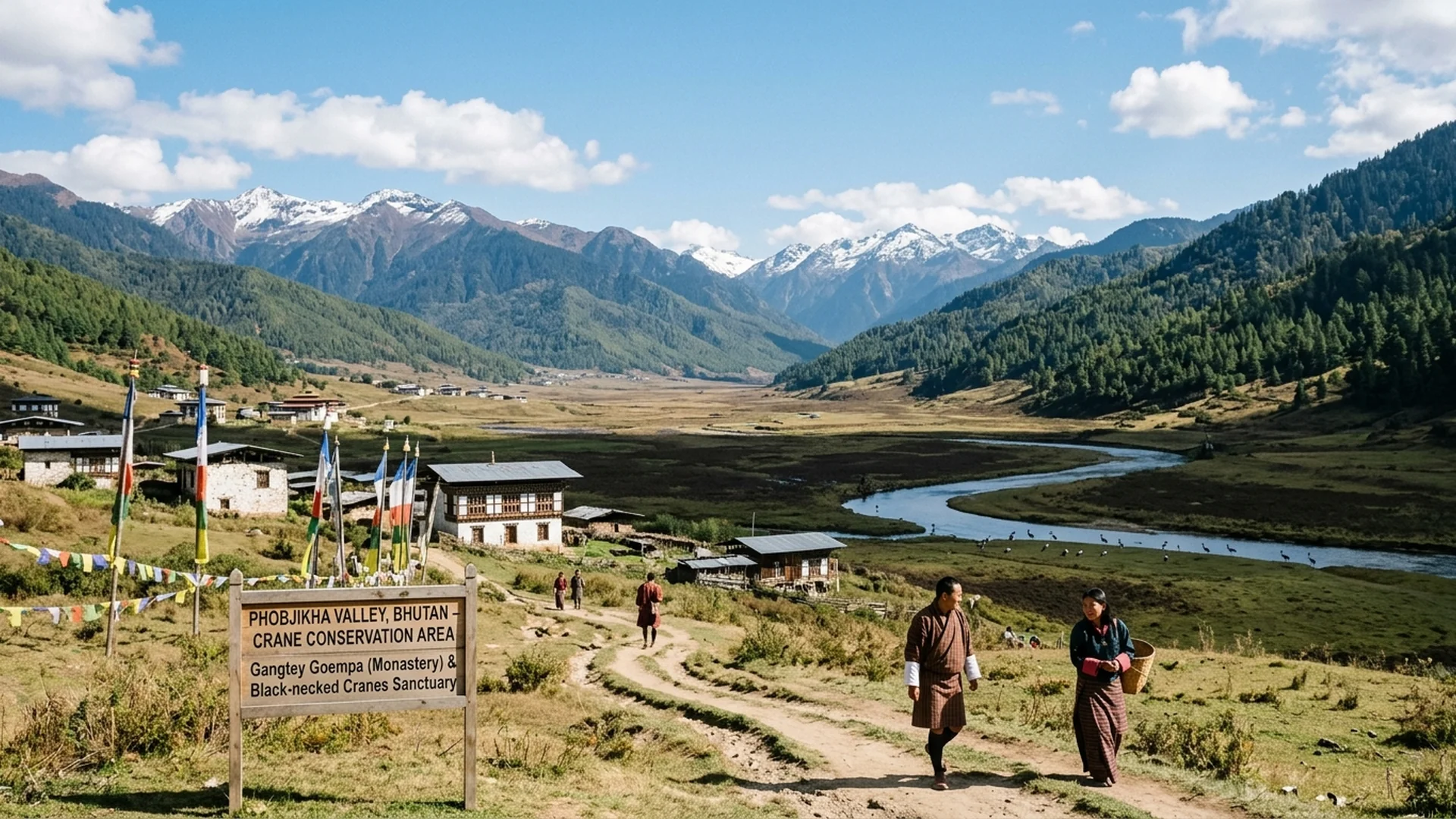
When morning mists unfurl slowly across vast, amber-hued meadows framed by towering Himalayan peaks at over 3,000 meters above sea level, Phobjikha Valley emerges like a realm untouched by time. This is far more than a protected sanctuary within the Jigme Singye Wangchuck National Park; it is a profound oasis of stillness where pristine nature, ancient Buddhist spirituality, and sustainable ultra-luxury entwine in absolute harmony.
Every November, as the crisp winter winds descend, the skies above Phobjikha grow lively with the arrival of black-necked cranes—sacred avian pilgrims flying across the formidable Himalayas from the Tibetan plateau. Local folklore whispers that these graceful visitors circle the revered Gangtey Goenpa monastery three times before alighting into the marshlands below, paying silent homage to the sacred guardians of the valley. Their resonant calls echo as the timeless heartbeat of a community that has lived in reverent coexistence with nature for centuries.
For discerning global travelers seeking genuine refuge from the clamor of the modern world, Phobjikha offers an unblemished paradigm of eco-luxury. From meditative ambles along the alpine Gangtey Nature Trail and ancient mineral hot stone baths to secluded sanctuaries like Amankora Gangtey and Gangtey Lodge framing panoramic valley views through expansive glass, every moment here is an invitation to profound stillness.
Spiritual Resonance: The Black-Necked Cranes and Gangtey Goenpa
Geographically, Phobjikha Valley is one of Bhutan’s most vital alpine wetlands, but spiritually, it is a sacred mandala guarded equally by ecology and Vajrayana Buddhism. Annually from late October through February, hundreds of endangered black-necked cranes migrate away from the harsh Tibetan winters to winter in the valley. Most mesmerizing is their arrival ritual: upon reaching the valley, the flocks circle the 17th-century Gangtey Goenpa—a monumental Nyingma monastery—precisely three times before descending into the wetlands. In spring, they repeat the triple circumambulation as a farewell.
This profound interspecies reverence culminates in the annual Black-necked Crane Festival held on the monastery courtyard every November 11th. Local villagers and children don carved wooden crane masks and vibrant garments, performing traditional dances that honor the delicate covenant between humanity and the natural world, perfectly reflecting Bhutan’s foundational philosophy of Gross National Happiness (GNH).
The Slow Rhythm of the Gangtey Nature Trail
The truest way to grasp the soul of Phobjikha is on foot along the Gangtey Nature Trail. This gentle 5.5-kilometer route winds through morning mist and fragrant blue pine forests, descending from the edge of Gangtey Goenpa toward the wide, dwarf-bamboo-carpeted marshlands favored by the cranes.
For two uninterrupted hours, the soundtrack is composed entirely of whispering pines, distant murmuring brooks, and the occasional clarion call of a crane echoing across the basin. The trail is flat and accessible, designed for unhurried contemplation. It terminates near Khewa Lhakhang and quiet farming settlements where woodsmoke drifts lazily into the afternoon air, leaving an indelible imprint of pastoral serenity.
Redefining Eco-Luxury in a Misty Sanctuary
Phobjikha stands as proof that ecological preservation and world-class luxury can coexist in perfect equilibrium. To safeguard the cranes’ fragile habitat, the valley eschews unsightly overhead power lines, relying instead on subterranean electrical grids and clean energy. This meticulous commitment to conservation extends directly into elite sanctuaries such as Amankora Gangtey and Gangtey Lodge.
Amankora Gangtey presents a masterclass in minimalist design, pairing rich timber and native stone upon a forested knoll overlooking the panoramic valley. Each of its eight suites features a traditional wood-burning Bukhari stove and floor-to-ceiling windows. Nearby, Gangtey Lodge is celebrated globally for its refined farmhouse aesthetic, complete with freestanding copper bathtubs angled toward the crane-frequented wetlands. Sipping hot butter tea while watching frost melt through panoramic glass is a rare, transcendent luxury.
Menchu: The Ancient Heritage of Bhutanese Hot Stone Baths
After a day traversing alpine paths, nothing restores body and spirit quite like a traditional Bhutanese Menchu, or hot stone bath—a therapeutic ritual refined over centuries.
River stones are roasted in open wood fires until glowing crimson, then dropped into traditional wooden tubs filled with water. The intense thermal energy releases rich minerals from the stones, infusing the water alongside freshly harvested local Artemisia leaves. Immersing oneself in the mineral-rich warmth melts away every trace of travel fatigue, while the botanical aromatics calm the respiratory system. Leading luxury properties elevate this healing art by arranging private bathhouses nestled right among the meadows against the backdrop of a fading alpine sunset.