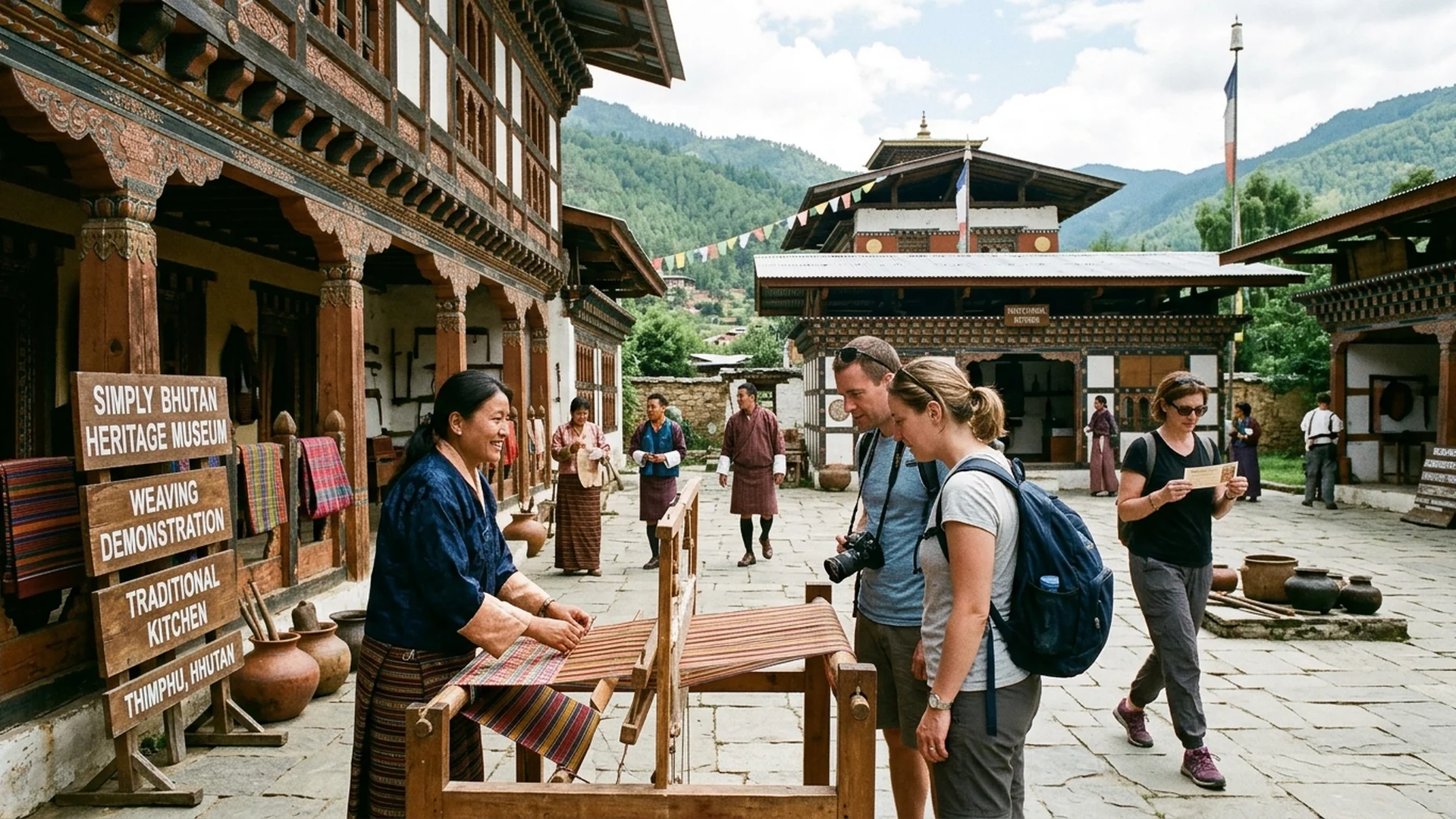
If the traditional concept of a museum evokes silent glass cabinets and austere ‘Do Not Touch’ notices, the Simply Bhutan Heritage Museum in the heart of Thimphu offers a radical, beautiful departure. Here, history is never imprisoned behind glass; instead, the heartbeat of the Thunder Dragon Kingdom pulses through the resonant notes of folk melodies, the rich tactile weave of handloomed textiles, and the warming aromas of indigenous hearthside beverages.
From the moment one passes beneath the delicately carved wooden lintels, an immersive cultural journey begins. Travelers are not mere spectators, but welcomed participants in daily Bhutanese life—welcomed first with a ceremonial cup of ‘Ara’, the traditional fermented rice spirit, before stepping into the vibrant folds of the national dress: the ‘Gho’ for men and the ‘Kira’ for women, whose intricate geometric patterns represent a living national pride.
Beyond its aesthetic charm, Simply Bhutan stands as a tangible expression of the nation’s Gross National Happiness (GNH) philosophy. By serving as a nurturing hub for local youth and master artisans, the museum fosters sustainable livelihoods and artistic continuity. A visit here transcends conventional tourism, offering an intimate communion with the living soul of Bhutan.
Entering the Living Museum: A Welcome of Tradition, Taste, and Textiles
The initial greeting at Simply Bhutan embodies the legendary hospitality of the Himalayas. Visitors are offered a warming pour of ‘Ara’, the clear, distilled grain spirit, or ‘Suja’, rich yak-butter tea that instantly counters the crisp mountain chill of Thimphu’s high-altitude air.
From there, guests embark on one of the visit’s most delightful transformations: robing in the national dress. Wrapping oneself in the heavy, finely woven folds of a ‘Kira’ or the structured drape of a ‘Gho’ offers an immediate, visceral connection to Bhutanese heritage. These garments, woven on backstrap looms with ancient motifs, transform the traveler from outsider to participant, fostering an unspoken harmony with the rhythm of local life.
Melodies and Archery: Engaging the National Sport and Living Arts
The museum’s sunlit central courtyard operates as a dynamic stage where heritage is actively performed rather than passively displayed. Guests are invited to test their focus at traditional bamboo archery—Bhutan’s revered national sport—and try ‘Khuru’, a spirited game of heavy wooden darts played amid encouraging laughter and banter.
Equally captivating are the live vocal performances, particularly the traditional ‘rammed-earth building songs’. Sung by local women as they rhythmically compact earth for traditional construction, these harmonious chants turn architecture from a dry academic subject into a living, breathing symphony of communal labor and shared history.
Earth and Timber Wisdom: Sustainable Architecture Rooted in Reverence
The physical structure of Simply Bhutan is an artifact in its own right. Built in strict accordance with ancestral Bhutanese architectural codes, the complex utilizes reclaimed timber, intricately carved window frames, and heavy lintels salvaged from traditional homes that have yielded to time.
The massive rammed-earth walls provide natural thermal mass, ensuring cozy interiors during winter’s frost and refreshing coolness through the summer months. Adorned with auspicious Buddhist symbols—from protective dragons to unfolding lotus blossoms—every structural beam reflects a worldview where spiritual devotion and daily existence remain inextricably bound.
Beyond Tourism: Social Mission and the Heart of Gross National Happiness
The profound beauty of Simply Bhutan extends deep into its social mandate. Developed in collaboration with the Nazhoean Pelri Youth Center, proceeds from admissions and artisan workshops directly fund scholarships, vocational training, and dignified employment for local youth.
Furthermore, the sanctuary provides a vital platform for disabled artisans to showcase exceptional craftsmanship, such as woodcarvers who effortlessly shape fine timber using their feet. Supporting these artisans imbues every journey with profound ethical resonance, perfectly mirroring the ideals of Gross National Happiness: a collective prosperity rooted in shared joy and mutual elevation.