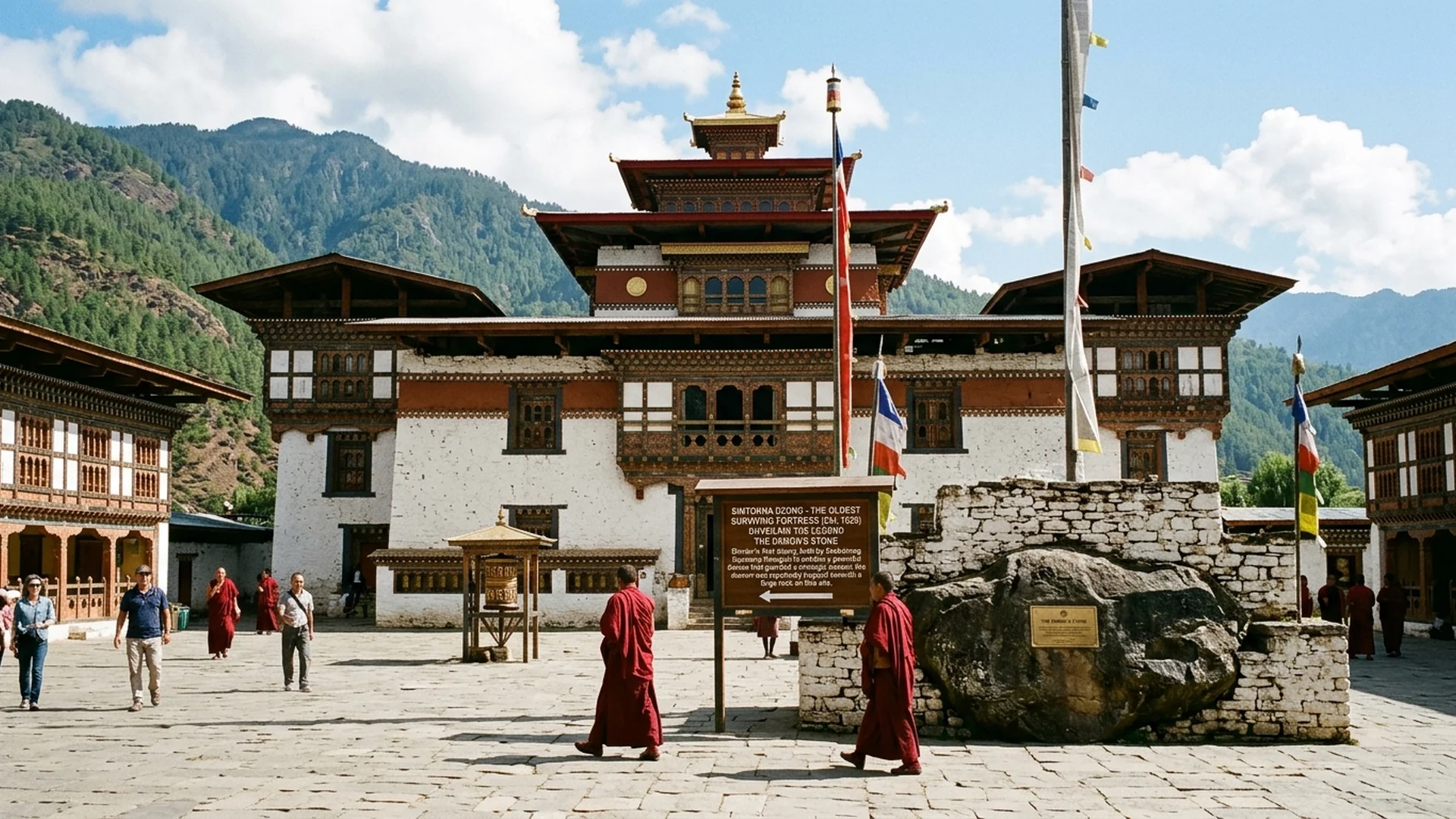
Cast your gaze along the southern ridge of the verdant Thimphu Valley, where the crisp Himalayan winds sweep past tiered timber eaves and pristine white chortens standing in quiet vigil. Simtokha Dzong—known formally as Sangak Zabdhon Phodrang, or the Palace of Profound Meaning of Secret Mantras—may appear compact compared to the sprawling majesty of the Punakha or Paro dzongs, yet it represents the foundational cornerstone of Bhutan’s national unity and spiritual sovereignty.
Constructed in 1629 by Zhabdrung Ngawang Namgyal, the visionary statesman who unified the Dragon Kingdom, this fortress is far more than an ancient assembly of stone and mortar. It stands as the very first dzong: a revolutionary architectural synthesis of monastic sanctuary and administrative citadel that has endured largely unblemished across four centuries. To cross its threshold is to step backward into the genesis of Bhutanese faith, strategic defense, and mystical lore deeply anchored into the bedrock beneath the sanctuary.
For the discerning traveler attuned to cultural nuance, Simtokha Dzong functions as a living repository of esoteric Buddhist art and history. Encircled by hundreds of ancient slate bas-reliefs and somber, centuries-old murals, it remains a sublime sanctuary far removed from conventional tourist pathways—waiting patiently for those who seek to read the foundational chapters of Bhutan’s rich heritage.
The Genesis of Dzong Architecture: Bhutan’s First Fortified Sanctuary
In the early decades of the 17th century, amidst factional strife among rival clerical houses and regional lords, Zhabdrung Ngawang Namgyal arrived from Tibet to forge a unified realm. He revolutionized local spatial design by establishing the very first dzong at Simtokha, merging the temporal administrative administration with the monastic body under one unified roof.
The architectural layout of Simtokha Dzong established the definitive prototype for all subsequent fortresses across the kingdom. At its center rises the utse—a towering three-story central administrative tower—encircling a quiet flagstone courtyard bounded by thick defensive stone walls and monastic quarters. This ingenious geometry allowed the garrison to withstand repeated sieges by Tibetan forces and allied factions. Passing through its sole southern gateway offers a profound encounter with the austere elegance and defensive majesty of a truly miraculous era.
Deciphering the Demon’s Stone: Etymology and Esoteric Faith
The name Simtokha stems from classical roots: Simmo translates to demoness, and do signifies stone, collectively translating to “the fortress upon the stone of the subdued demon.” According to regional oral history, the ridge was once a treacherous mountain pass haunted by a malicious spirit that preyed upon travelers and merchants.
Upon his arrival, the Zhabdrung famously manifested his spiritual prowess by subjugating the entity, imprisoning its volatile essence beneath a colossal boulder on the mountaintop. To ensure the malevolence could never rise again, he commanded that the central sanctum be constructed directly over the stone. Consequently, the foundations of the main temple act as a spiritual peg holding chaos at bay—a profound architectural metaphor transforming fear and darkness into an enduring beacon of sanctuary.
The Three Hundred Slate Carvings: Timeless Vault of Vajrayana Art
Among its most culturally significant treasures is the extraordinary gallery of over 300 ancient slate carvings lining the exterior veranda of the central utse tower, immediately behind the rhythmic procession of prayer wheels.
Executed with extraordinary precision during the tenure of the third Desi, Mingyur Tenpa, in the 17th century, these dark slate reliefs portray buddhas, bodhisattvas, yogis, and lineage masters such as Guru Rinpoche and the Zhabdrung. The carved lines possess an arresting depth and fluidity. Inside the primary lhakhang (temple sanctuary), visitors encounter richly patinated original murals—some of the oldest surviving frescoes in the country—depicting the Four Guardian Kings alongside intricate sacred geometry.
A Sacred Geopolitical Crossroads and Crucible of the Dzongkha Language
Strategically positioned, Simtokha Dzong historically controlled the natural transit nexus linking Bhutan’s three principal western valleys: Paro to the west, Thimphu to the north, and Punakha and Wangdue Phodrang to the east. Command over this ridge ensured absolute authority over the kingdom’s interior security.
Today, the fortress has gracefully transitioned from a martial stronghold into a vibrant sanctuary of learning. It serves as an esteemed institute for the study of the Dzongkha language, classical literature, and Buddhist philosophy. The gentle murmur of young monks reciting sacred texts across the ancient courtyards imbues this historical monument with an enduring, breathing vitality as a living heritage site.