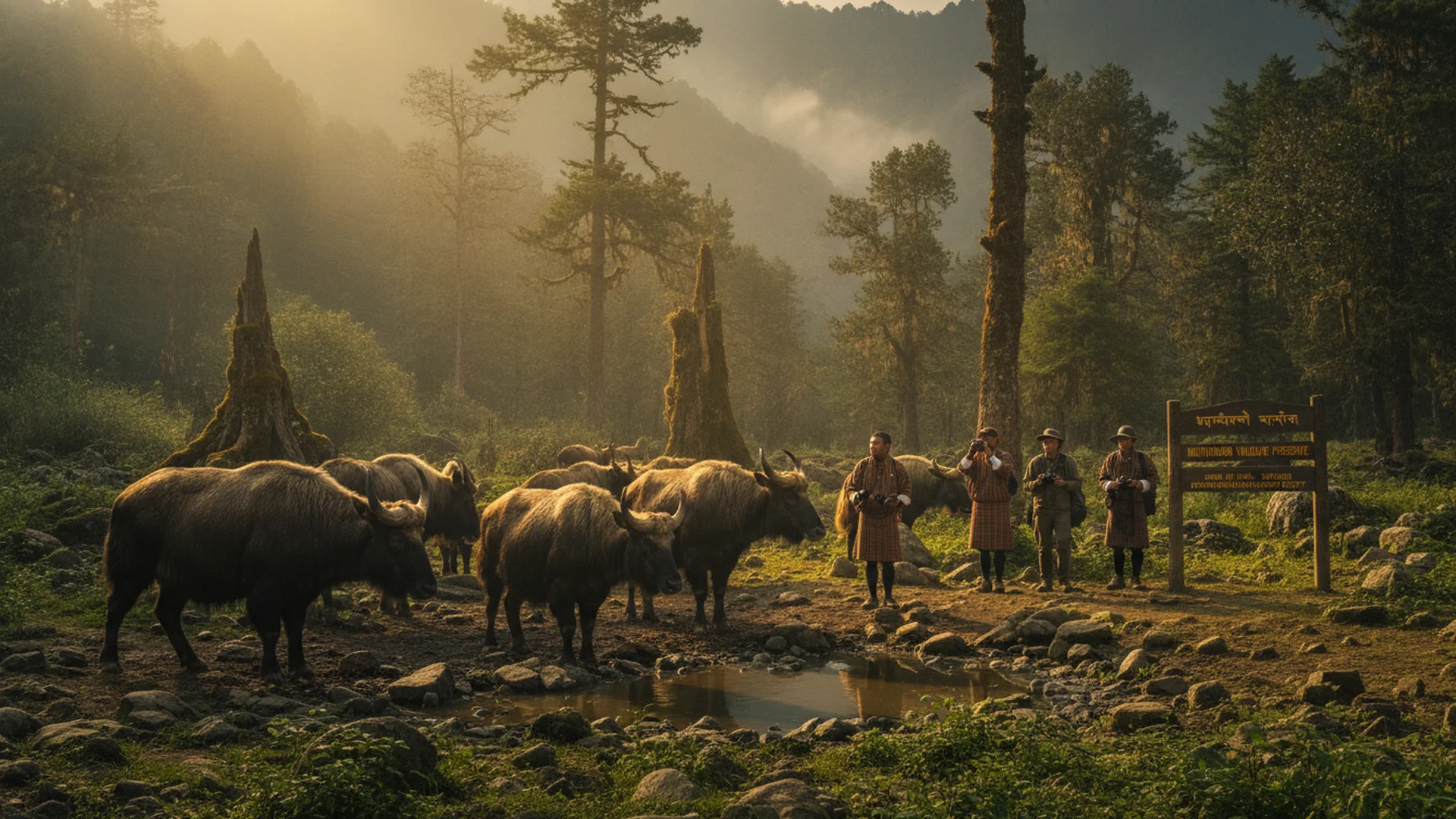
As the morning mist rolls across the cedar and oak forests soaring more than two thousand meters above sea level in the Thimphu valley, the soft thud of hooves against the damp earth and the gentle breathing of a massive creature herald a quiet awakening. This is the realm of the takin, a creature whose bizarre morphology evokes the fevered dream of a surrealist artist—possessing the horned head of a wild goat fused with the heavy, muscular torso of a sturdy ox. Yet beneath this peculiar exterior lies a physical form steeped in miracle, philosophical legend, and boundless compassion, woven deeply into the spiritual consciousness of the Bhutanese for centuries.
In a kingdom where societal progress is measured by Gross National Happiness (GNH), the relationship between humanity, fauna, and the untamed wilderness is never treated as compartmentalized. The takin is far more than a rare and endangered species; it is a living symbol reflecting deep-rooted historical ties and profound Buddhist philosophy. To journey into their sanctuary is not merely to observe an ecological curiosity, but to step into an open-air classroom where nature and spirit entwine in quiet harmony.
The Wrath of the Divine Madman: The Mythological Genesis of the Takin
The origin of the takin is intimately bound to the legacy of Lama Drukpa Kunley, revered throughout the Himalayas as the ‘Divine Madman,’ a 15th-century saint who utilized unconventional, unorthodox methods to propagate Buddhist teachings. Legend holds that during a grand religious gathering, amidst throngs of eager devotees seeking spiritual discourse, the accomplished master was entreated to perform a miracle as tangible proof of his realization.
Endowed with a keen sense of humor and utterly unbound by conventional dogmas, the lama instructed the villagers to present him with the skeletal remains of a cow and a goat. Having consumed their flesh, he arranged the bare bones upon the earth, placing the skull of the goat upon the spine of the ox. With a sharp snap of his fingers and a resounding roar that echoed through the crags, the skeletal framework instantaneously stirred with breath and muscle, lunging forward into the high alpine pastures before vanishing into the mountain mists. That mythical creature was the takin. Since that day, the Himalayan highlands have served as their sanctuary, and their striking synthesis of bovine fortitude and caprine agility remains an enduring testament to the miraculous harmony of the natural world.
From Iron Bars to Open Forests: The Evolution of Motithang Takin Preserve
On the northern periphery of Thimphu, this verdant enclave once served as a modest zoological park, confining various regional wildlife species behind iron bars for human entertainment. Yet, the sobering spectacle of majestic animals stripped of their liberty and imprisoned in confined enclosures generated a profound moral dissonance within a Buddhist society that reveres every sentient life.
Through the enlightened royal decree of Bhutan’s monarch, it was recognized that caging wild animals violated both spiritual principles and the inherent rights of nature. The royal menagerie was promptly decommissioned, and its captive residents were returned to the wilderness where possible. However, the takin—having grown accustomed to human proximity and unable to forage effectively in dense, high-altitude forests—faced a precarious fate. In response, a sprawling expanse of open pine woodland on the Motithang slopes was designated as a semi-open sanctuary. Here, the animals could roam freely across their natural habitat, contained only by discreet fencing that allows observant travelers to witness their behaviors without infringing upon their sovereign freedom.
The Breath of the Himalayas: Environmental Policy Beyond Rhetoric
The safeguarding of the takin represents merely a single facet of Bhutan’s uncompromising conservation mandate. Under the nation’s constitution, legal imperatives mandate that forest coverage must be maintained across a minimum of sixty percent of the country’s landmass in perpetuity—a threshold comfortably surpassed by current figures exceeding seventy percent.
This steadfast commitment positions Bhutan not only as the world’s sole carbon-negative nation, but also establishes unbroken ‘biological corridors’ allowing rare species such as the Himalayan tiger, snow leopard, Asiatic black bear, and takin to migrate, breed, and roam according to ancestral instincts. The Motithang Takin Preserve functions as a potent symbolic milestone, reminding the global community that economic development and ecological preservation can coexist harmoniously when humanity regards non-human life with equal dignity.