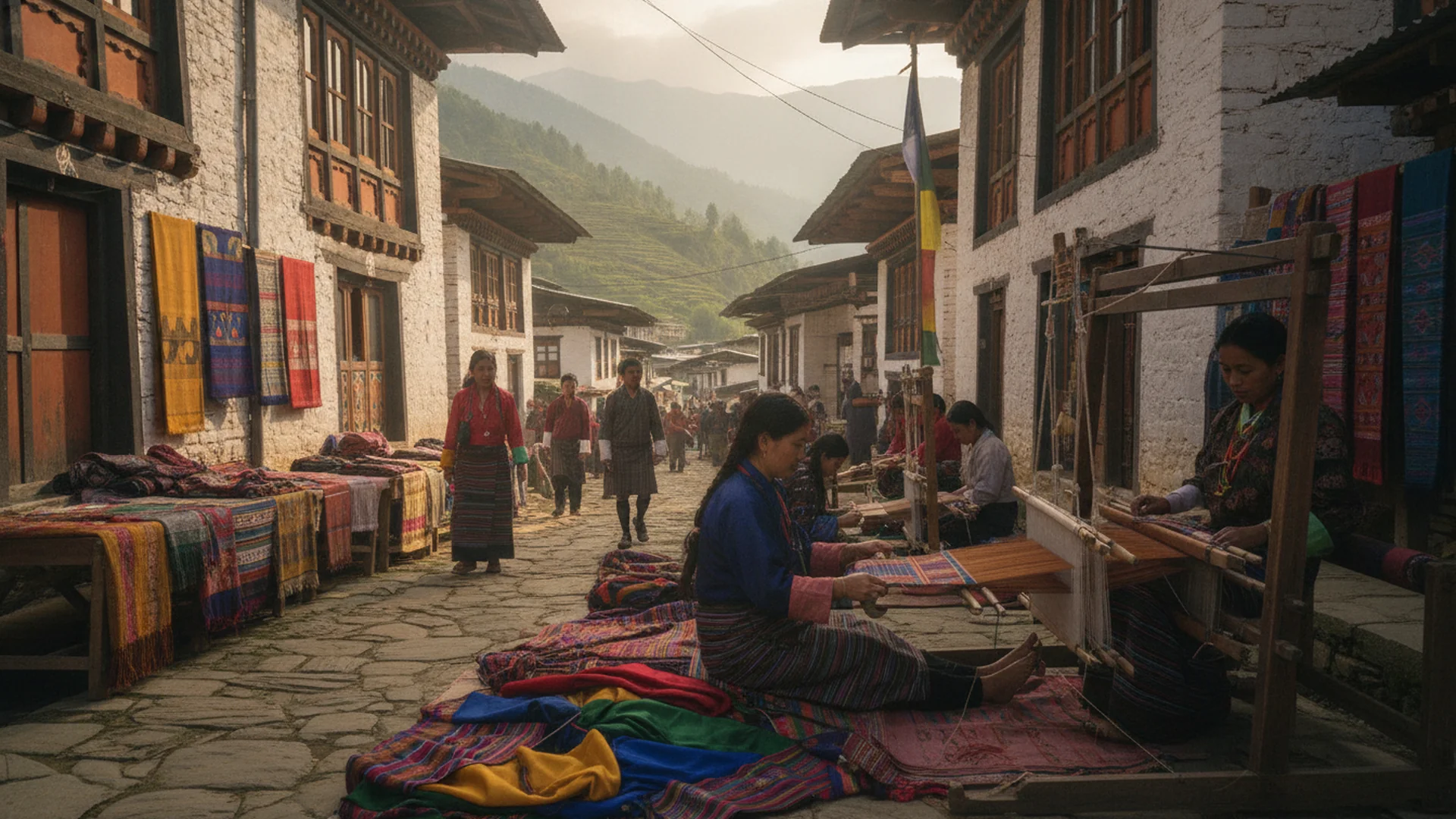
When the morning mists gently lift across the serene Himalayan valleys, the delicate chime of metal meeting hammer and the earthy fragrance of crushed minerals and natural pigments speak of a lineage older than time itself. In the Land of the Thunder Dragon, artistic creation is never merely ornamental; it is an act of moving meditation, a living breath inextricably bound to the spiritual rhythms of Mahayana Buddhism. Every finely spun thread, every chisel mark in fragrant timber, and every precise stroke upon a canvas conceals layers of esoteric philosophy.
Thus, acquiring a keepsake from Bhutan transcends conventional commerce, evolving into a meditative act of cultural stewardship. To collect within the framework of Zorig Chusum—the thirteen canonical arts and crafts steadfastly preserved by the Bhutanese state—is to hold a fragment of living heritage, ensuring that ancient ancestral wisdom continues to radiate brilliantly in our modern era.
Zorig Chusum: The Spiritual Foundation of Thirteen Sacred Disciplines
The philosophy of Zorig Chusum was formally codified in the seventeenth century by Zhabdrung Ngawang Namgyal, the visionary spiritual leader who unified Bhutan. These thirteen distinct disciplines were never conceived merely as commercial handicrafts, but rather as a form of somatic yoga requiring artisans to purify their minds before bringing creation into physical form. The curriculum spans sacred painting (Lhadri), sculpting in clay and plaster (Jinzo), wood and stone carving (Shingzo and Dozo), metal casting (Troko), weaving (Thagzo), alongside traditional basketry and ancient papermaking.
Remarkably, master practitioners dedicate years of rigorous study within specialized institutes, adhering strictly to the sacred canon of iconometry outlined in ancient sacred texts. There is no room for fleeting whim or unstructured impulse; every line laid down represents an act of absolute devotion to Buddhist principles and timeless aesthetics.
Masterpieces Worthy of a Collection: Thangkas and Kishuthara Textiles
For the discerning collector, the sacred scroll painting known as a Thangka remains the ultimate aspiration. Rendered in natural mineral pigments bound with animal skin glue and embellished with genuine gold leaf upon fine cotton or silk, these depictions of Buddhas and protective deities often require months or even years of painstaking labor. What elevates a Bhutanese Thangka is the absolute fidelity to consecration rituals, transforming the artwork from a mere wall hanging into a vibrant vessel of spiritual energy.
Concurrently, Kishuthara—the masterfully complex silk-weaving tradition hailing from the Kurtoe region—stands as a pinnacle of Eastern textile artistry. The meticulous fusion of multicolored silk threads with intricate supplementary-weft techniques transforms a woman’s traditional scarf or kira into wearable art of peerless refinement, silently communicating lineage, social standing, and patrician taste.
Miniature Architecture: Architectural Woodcarving and Heirloom Silverware
Delving into the intricate joinery of timber pillars within ancient fortress-monasteries (Dzongs) and ancestral homes reveals the fluid mastery of Shingzo, or woodcarving. Swirling clouds, protective dragons, and blooming lotus blossoms emerge dynamically from seasoned cedar and pine. Connoisseurs frequently collect refined, portable iterations of these motifs, such as aromatic wooden offering bowls or intricately folding meditation tables (Choktse) finished with hand-applied lacquer and gold leaf.
In the realm of metallurgy and silverwork (Troko), Bhutanese metalsmiths demonstrate extraordinary mastery in fashioning betel nut containers (Pangchung), ceremonial daggers (Dapa), and sterling silver jewelry embellished with turquoise and red coral. The repoussé and chasing techniques applied to these silver pieces articulate profound cosmological narratives and the auspicious animals of Himalayan lore.