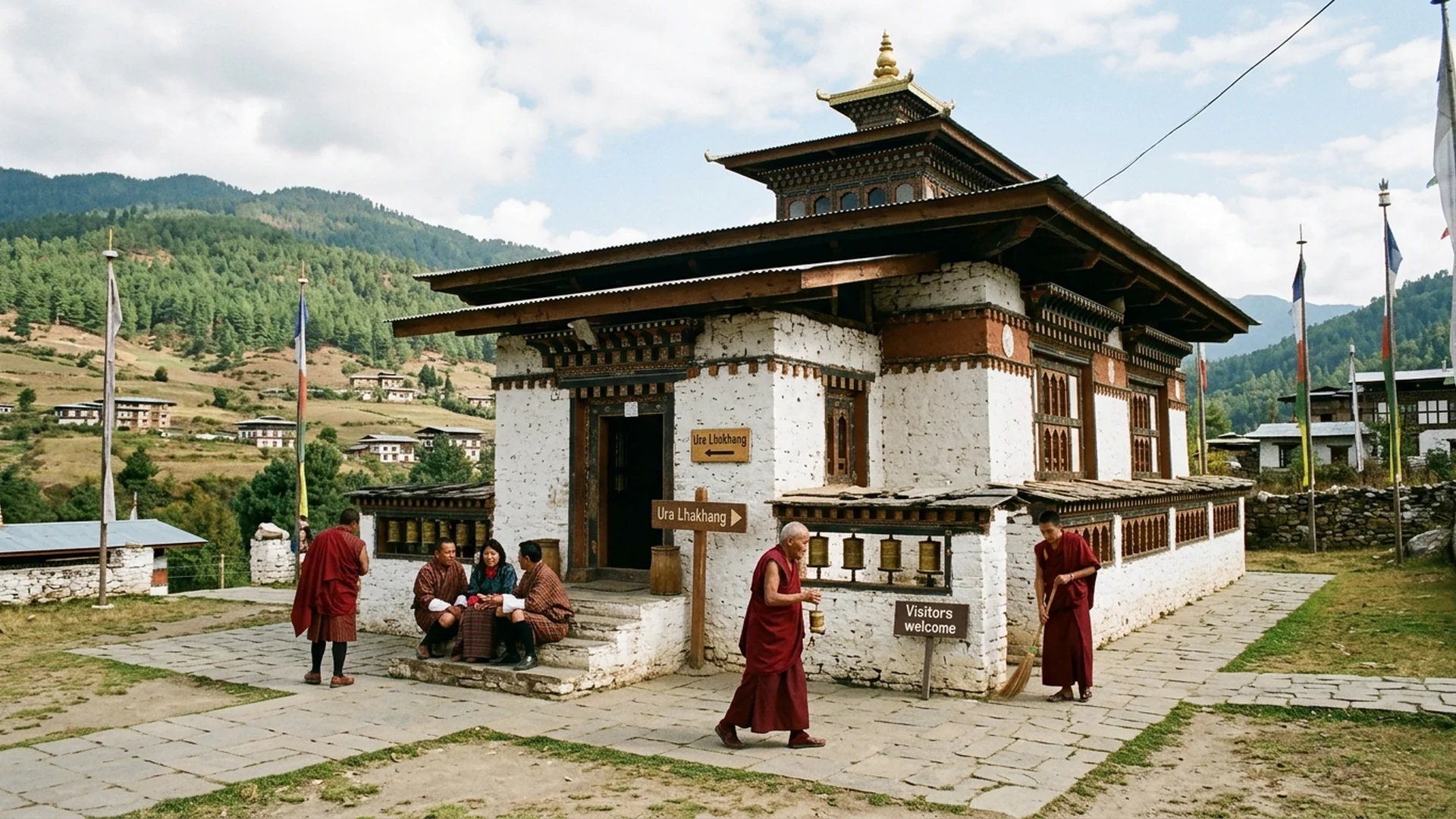
When morning mists linger among ancient blue pines at over 3,100 meters above sea level, the Ura Valley in Bumthang resembles a watercolor painting untouched by the hurried passage of time. This is far removed from the well-trodden tourist circuits; it is a secluded enclave tucked away in the eastern reaches of the Land of the Thunder Dragon, where the whisper of Himalayan winds still carries ancient legends and unadorned devotion.
Visiting Ura Lhakhang (the temple of Ura) is akin to stepping across a dimensional threshold from the modern world into the beating heart of Bhutan’s ancient highlanders. Surrounded by timeless stone-flagged roofs and intricately carved timber dwellings, the temple stands as a powerful spiritual anchor. Here, profound silence is never merely emptiness, but rather a sacred vessel where the soul communes with the unyielding majesty of nature.
Architecture and Sacred Art of Ura Lhakhang: Devotion Carved into the Earth
The sanctuary of Ura Lhakhang rises quietly amidst terraced agricultural fields and broad pastures in the center of Ura village. Its exterior architecture reflects the quintessential vernacular style of central Bhutan, pairing robust hardwood framing with rammed-earth walls constructed according to ancestral wisdom. Within the main hall, the air is thick with the soothing scent of incense and burning yak butter offerings placed before the central deities.
The interior walls are adorned with priceless historical murals depicting Buddhist narratives and Jataka tales, rendered in natural earth pigments that have weathered the centuries. These paintings are far more than mere artistic achievements; they function as living scriptures, imparting foundational moral teachings to the community. The interior atmosphere is steeped in meditative gravity, inviting the traveler to pause and contemplate the elegance of simple, unpretentious living.
The Legend of Vajrapani and the Genesis of Ura Yakchoe
The Ura Valley is as rich in myth as it is in breathtaking vistas. Its most powerful foundational narrative centers upon Vajrapani, the bodhisattva embodying supreme spiritual power and protection, who according to lore descended to aid the villagers in the form of a sacred relic miraculously discovered within an elderly woman’s basket of wool.
This ancient miracle birthed the Ura Yakchoe, one of Bhutan’s most sacred and rarely witnessed religious masked-dance festivals. Every spring, villagers gather to perform sacred rituals celebrating the relic and invoking agricultural abundance. The resonant echoes of long horns and crashing cymbals reverberate across the high valley, bearing witness to an unbroken lineage of faith connecting humanity to the divine.
Life in the Ura Valley: When Time Slows Down at High Altitude
Entering the Ura Valley in Bumthang is an invitation to step outside the frantic cadence of contemporary existence. Life here moves strictly in tune with natural rhythms, centered around the cultivation of hardy buckwheat and potatoes alongside high-altitude yak herding.
Traditional homes cluster closely together along cobblestone paths to buffer against biting Himalayan gales. Bunches of drying corn and brilliant red chilies drape from wooden balconies as universal symbols of domestic prosperity. A warm welcome awaits travelers offered a cup of butter tea (Sura) by hosts attired in traditional Gho and Kira, instantly dispelling the mountain chill and embodying the living philosophy of Gross National Happiness.