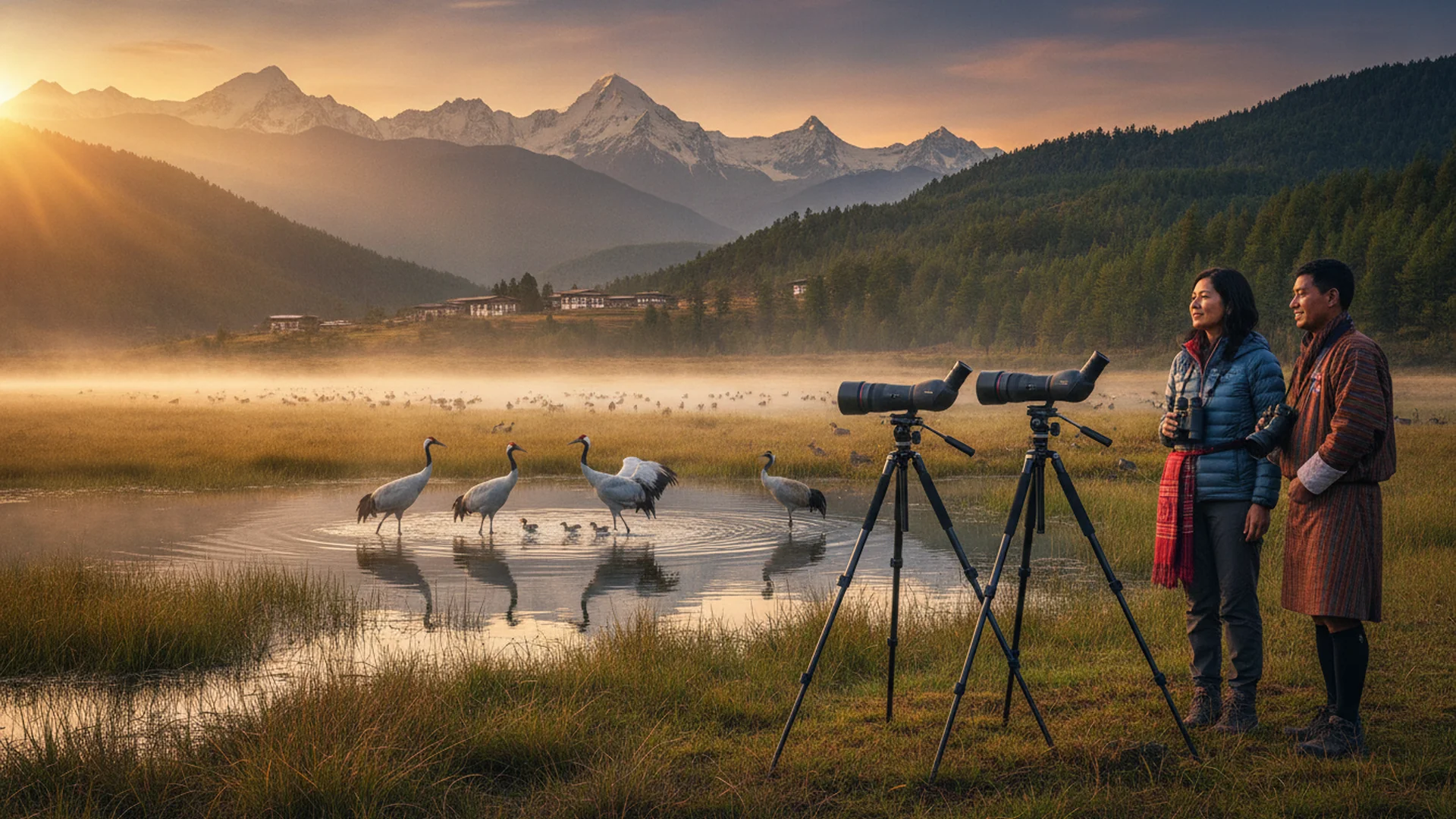
The quiet beating of wings above glacial valley mists at dawn is a familiar cadence for those who have tuned their hearts to the rhythm of the Kingdom of Bhutan. Rising thousands of meters above sea level, this sanctuary shielded by the eastern Himalayas is far more than a pilgrimage site for sages and seekers; it is one of the most pristine and biologically intact ecosystems on Earth. With natural forest cover spanning over seventy percent of the nation and a pioneering carbon-negative commitment, Bhutan stands as humanity’s final frontier in safeguarding some of the planet’s most endangered lineages.
For the discerning traveler and wildlife photographer seeking profound connection over simple sightseeing, a journey into Bhutan offers privileged access to species rarely encountered anywhere else on the globe. Whether tracking the graceful, deliberate movements of the black-necked crane traversing the high Himalayan passes from Tibet, or quietly observing the elusive white-bellied heron—a sacred avian species with fewer than sixty individuals remaining worldwide—every moment is framed by heartfelt hospitality and sophisticated five-star lodges that tread lightly upon the earth.
Four Himalayan Sanctuaries: From Alpine Passes to Sacred River Valleys
Embarking on a natural history expedition through Bhutan feels akin to turning the pages of a living naturalist’s manuscript. The journey begins at Chele La Pass, the highest vehicular mountain pass in the kingdom at 3,988 meters above sea level. Here, amidst ethereal banks of cloud forest, the iridescent plumage of the Himalayan Monal and the shy blood pheasant frequently reveal themselves in the crisp morning mist. Descending toward Dochula Pass—a contemplative high-altitude saddle adorned with 108 memorial chortens and framed by panoramic snow-capped summits—the temperate woodlands teem with the brilliant flashes of the fire-tailed myzornis and the rare ward’s trogon.
Lower down in the fertile basin of the Pho Chhu River in Punakha, the glacial waters serve as a crucial frontier for sighting the critically endangered white-bellied heron, a species for which Bhutan remains a primary global stronghold. The expedition culminates in the expansive, sweeping meadows of the Phobjikha Valley, a glacial trough of sublime beauty that offers a cherished winter haven for the majestic black-necked cranes arriving from the Tibetan Plateau.
Five Holy Grail Species: Encounters with Himalayan Masterpieces
Among the remarkable fauna of the Eastern Himalayas, Bhutan is celebrated for maintaining exceptionally undisturbed habitats. The first among these crown jewels is the black-necked crane, revered locally as a celestial symbol of longevity, peace, and fidelity. Following closely is the white-bellied heron, a monumental riverine species with a global wild population hovering beneath sixty individuals, requiring meticulous fieldcraft and silent tracking by expert naturalists to observe without disturbance.
Beyond its avifauna, the mid-elevation broadleaf forests harbor the radiant Gee’s Golden Langur, an arboreal primate with rich amber fur found exclusively in this narrow trans-border pocket between Bhutan and India. Meanwhile, the steep bamboo thickets shelter the elusive red panda, while the craggy, windswept limestone cliffs above serve as the domain of the dazzling Himalayan Monal. Witnessing these sentient beings thrive in an unfragmented landscape offers an incomparable reward for true wilderness connoisseurs.
Luxury-Eco Travel: The True Convergence of Conservation and Comfort
In Bhutan, true luxury is not defined by material excess, but by the ultimate privilege of intimate access and harmonious integration with the natural world. High-end eco-tourism here is thoughtfully curated to bridge the gap between world-class ultra-luxury lodges—whose stone-and-timber architecture melts seamlessly into the forested slopes—and deep-wilderness exploration.
Each morning unfolds with a private excursion alongside dedicated ornithologists and conservation researchers possessing encyclopedic knowledge of local animal behavior and secret migratory corridors. Top-tier optical equipment and high-magnification spotting scopes are meticulously provisioned, complemented by refined touches such as fireside artisanal teas in the forest or gourmet picnics served beside rushing glacial streams. This methodology ensures an immersive, intellectually rich encounter with nature that leaves the delicate forest ecosystems entirely unburdened.
The Crane Festival and the Golden Seasons of Wilderness Travel
The ideal temporal windows for wildlife tracking and ornithology in Bhutan are divided into two distinct, spectacular seasons. Spring, spanning from March to May, presents a landscape ablaze with wild rhododendrons carpeting the mountain slopes. Forest canopies resound with the complex melodies of resident and migratory songbirds, providing exceptional conditions for nature photography bathed in crystalline light.
Conversely, autumn and early winter—from October through November—bring crisp, diamond-clear skies that reveal the soaring Himalayan peaks in sharp relief, coinciding with the arrival of the black-necked cranes in Phobjikha. A definitive highlight of this season is the annual Black-necked Crane Festival held on November 11th within the courtyard of Gangtey Goenpa. Here, villagers and school children perform graceful, choreographed crane dances to celebrate the return of these sacred birds, reflecting a profound, living harmony between Buddhist spirituality and environmental stewardship.