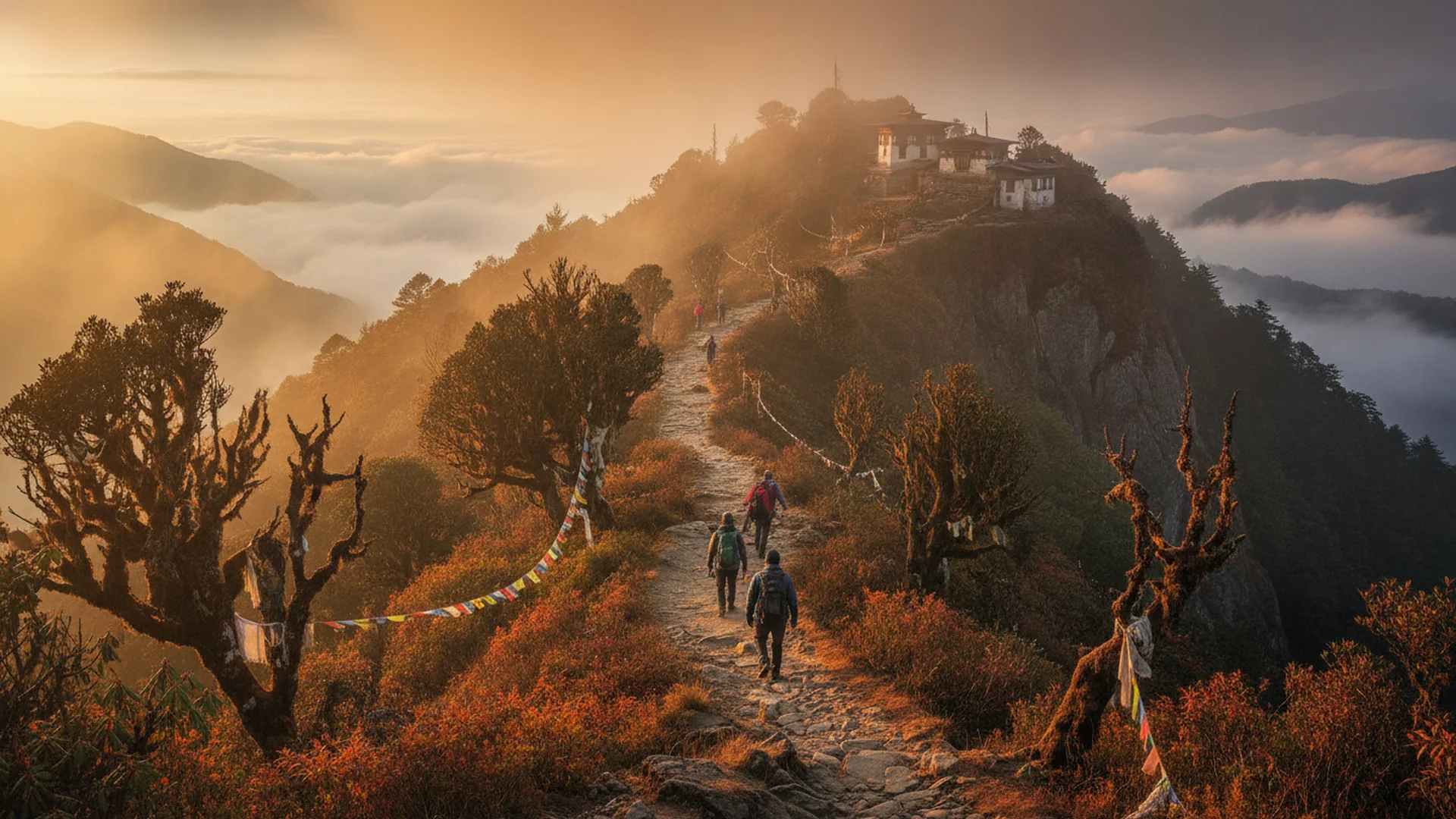
At nearly 4,000 meters above sea level, where the fierce Himalayan winds set endless rows of five-colored prayer flags fluttering against the blue, Chele La Pass stands as the highest vehicular mountain pass in the Kingdom of Bhutan. This dramatic saddle of land acts as an ancient atmospheric portal between the fertile Paro Valley and the secluded Haa Valley. Yet, few travelers step beyond the paved roadside viewpoint to discover the silent, mist-veiled footpaths that cradle the neighboring ridges.
Your destination along this ethereal trail is Kila Goempa, one of the oldest nunneries in the Paro district, clinging with gravity-defying grace to a sheer vertical precipice. The timeworn timber structures blend so seamlessly into the weathered stone cliffs that they rival the iconic Tiger’s Nest in visual drama, while remaining entirely hidden from the modern world amidst thick stands of gnarled hemlock and rust-red juniper.
Walking this high-altitude trail is far more than a physical excursion; it is an immersive, meditative pilgrimage. It invites you to absorb sweeping, uninterrupted vistas of sacred Mount Jomolhari, breathe in the crisp resinous scent of ancient rhododendron forests, and witness the serene, contemplative devotion of nuns who have dedicated their lives to spiritual solitude among the clouds.
Departing Chele La Pass: The First Steps Above the Sea of Clouds
The journey begins at Chele La Pass, a breathtaking viewpoint perched at 3,988 meters above sea level. On a clear morning, the Eastern Himalayas unfold in all their majestic glory, crowned by Mount Jomolhari—a 7,326-meter giant piercing the far horizon. The biting mountain air carries the resonant, rhythmic snap of prayer flags dancing in the wind.
Stepping away from the vehicles, the Kila Goempa trail climbs gently northward along the open ridge, threading through stunted alpine conifers and hardy mountain shrubs. The path ascends briefly to a crest of roughly 4,230 meters—the absolute zenith of the trek—before beginning a gradual, undulating descent along the spine of the mountain. From this lofty vantage point, your gaze sweeps effortlessly across both the Paro and Haa valleys simultaneously, capturing a panorama of breathtaking duality.
Himalayan Flora and Secluded Forest Sanctuaries
The character of the landscape shifts with the seasons. If you walk this path during spring (March through May), the hillsides burst into vivid color with blooming rhododendrons in shades of crimson, rose, and ivory, interspersed with delicate alpine wildflowers and rare blue poppies.
Descending deeper into the shelter of the mountain, the open ridge gives way to deep pine and hemlock forests imbued with a profound, cathedral-like quiet. Along the trail, you may occasionally spot weathered stone meditation huts—solitary cells once utilized by wandering monks and ascetic practitioners seeking utter isolation. Overhead, the distinctive calls of blood pheasants or Himalayan monals echo through the canopy, underscoring the untouched purity of the wilderness.
Kila Goempa: Ancient Nunnery on Sacred Stone
Emerging from the dense forest cover into an ancient chorten-dusted clearing, the sight of Kila Goempa reveals itself like a mirage. The traditional Bhutanese monastic structures and residential quarters cling tenaciously to the rock face below, appearing to float effortlessly between earth and sky high above the Paro Valley.
The word ‘Kila’ in Sanskrit and Dzongkha signifies a sacred ritual dagger, or ‘Phurba’, symbolizing the subjugation of spiritual obstacles and defilements. The origins of this sacred sanctuary date back to the 9th century, beginning as meditation caves utilized by esoteric masters. Today, the nunnery serves as a vibrant spiritual home and study center for roughly 30 to 50 nuns who practice a life of austere simplicity, scriptural study, and silent contemplation.
Embracing Stillness and the Spirit of Pilgrimage
Crossing the threshold into the nunnery grounds, the distractions and noise of the modern world dissolve entirely. The air is thick with the soothing aroma of burning juniper incense and the low, resonant hum of morning chanting. The resident nuns welcome visitors with gentle smiles and eyes reflecting deep inner peace.
The main sanctuary houses exquisite statues of Avalokiteshvara—the Bodhisattva of Compassion—alongside depictions of revered lineage masters. Sitting in quiet meditation within the cool, butter-lamp-lit interior after hours of trekking offers a profound spiritual reward unique to Bhutanese travel. The journey concludes as you descend further along a stone staircase to the valley road below, where your transport awaits.