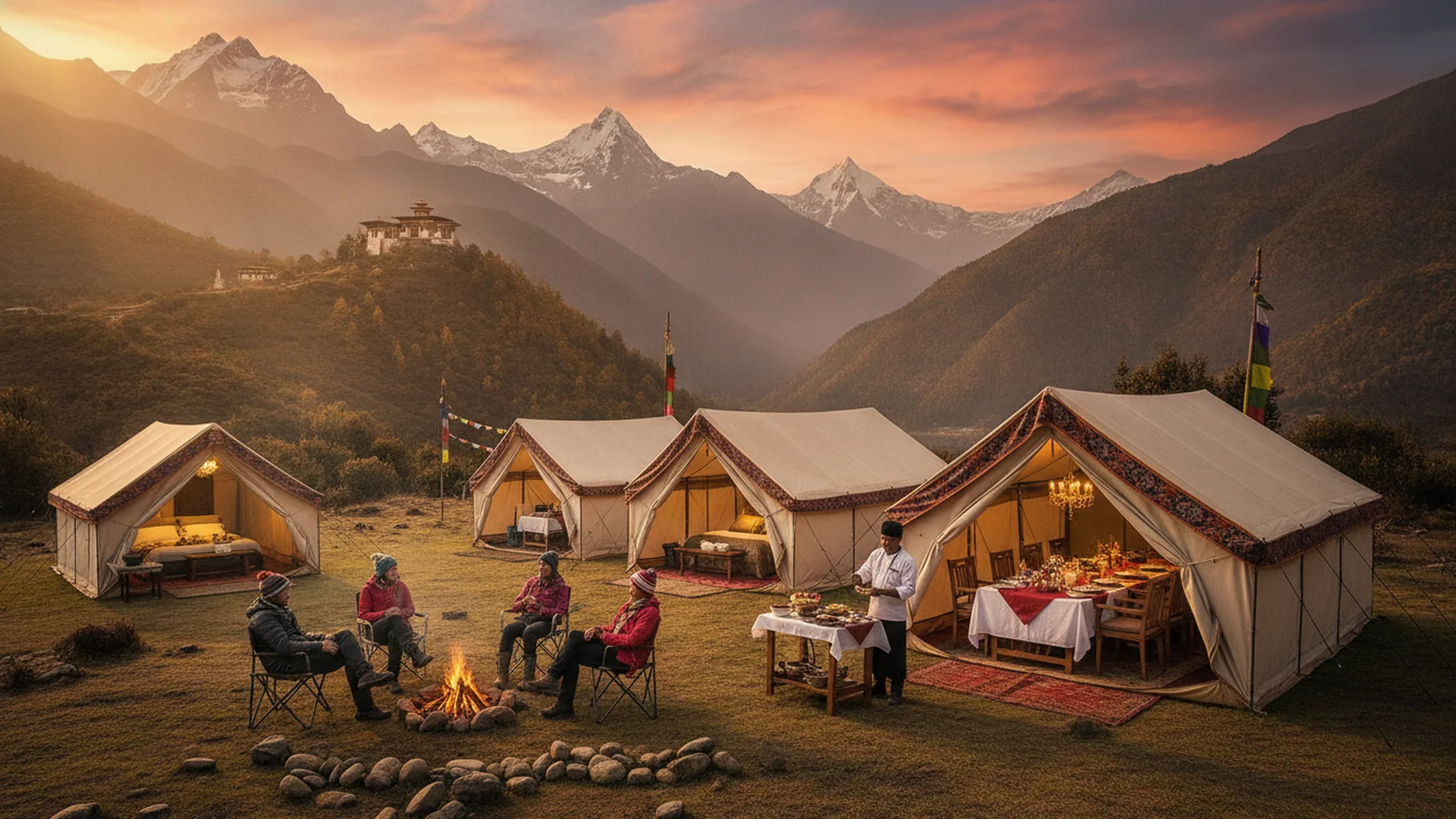
When the crisp Himalayan wind sweeps across ancient valleys, carrying the scent of dry straw and blue pine through the morning mist, the traditional narrative of grueling, austere mountain expeditions dissolves entirely. Along the legendary Druk Path Trek—a historic 54-kilometer caravan route that has long linked the valleys of Paro and Thimphu—crossing high ridgelines soaring past 4,000 meters above sea level has been reimagined as an exquisite, refined adventure. Physical challenge now pairs seamlessly with uncompromising aesthetic grace.
Encircled by snow-clad sacred peaks and mirror-like alpine lakes revered in local lore, modern luxury glamping transforms the wilderness night into a mobile five-star sanctuary. Spacious dome tents outfitted with plush mattresses and premium down sleeping bags await travelers after each day’s mindful trek. Meanwhile, warm, inviting dining tents glow softly under the light of lanterns, filled with the savory aromas of fusion cuisine freshly prepared by a dedicated private culinary team.
This is far more than a simple mountain trek; it is a spiritual and sensory pilgrimage designed to let you deeply absorb the profound silence of the Himalayas without unnecessary hardship. The gentle rhythm of prayer flags fluttering in the alpine breeze, the distant chime of monastic bells, and star-studded midnight skies unite to forge an unforgettable chapter of quiet luxury travel.
From Ancient Caravan Trail to Himalayan Glamping Sanctuary
The Druk Path Trek stands as one of the most storied walking journeys in the Kingdom of Bhutan. Historically, this footpath served as the primary artery connecting the western valley of Paro to the capital of Thimphu, traversed by merchants, monks, and royal entourages over centuries. Wandering along this undulating horseshoe ridge immerses travelers in dense forests of blue pine, towering rhododendrons, and wild Himalayan roses that burst into vivid bloom during the spring months.
With the introduction of luxury trekking, this heritage route has been elevated to an immaculate glamping experience. Each day, the expedition’s pack animals and handlers forge ahead to establish camp before the travelers arrive. Upon stepping into the campsite after four to five hours on the trail, you are greeted not by standard field tents, but by spacious canvas pavilions complete with raised cots, thick mattresses, sub-zero rated sleeping bags warmed by hot water bottles, and private, eco-conscious mobile restrooms.
A Realm of Alpine Tarns and Ridge-Top Monastic Heritage
The Druk Path ascends from Paro’s verdant floor at roughly 2,400 meters, peaking at the Labana La pass at an elevation exceeding 4,235 meters. Beyond the sweeping panoramas of distant snow peaks and the elusive, unclimbed majesty of Gangkar Puensum, the journey’s true soul lies in its chain of pristine alpine lakes.
Jimilang Tsho and Simkotra Tsho serve as the route’s most enchanting overnight anchor points. According to Bhutanese belief, these high-altitude waters are sacred abodes inhabited by local protective deities, their surfaces mirroring the vast skies and icy summits with mirror-like clarity. Along the trail, travelers pass architectural marvels such as Jele Dzong—a 17th-century fortress perched dramatically on a ridge—and the remote Phajoding Monastery, an architectural jewel of the Kagyu Buddhist lineage perched high above Thimphu, where chanting echoes softly across the valleys.
The Aesthetics of Taste: Fine Dining in the Deep Wilderness
A defining hallmark of the luxury Druk Path experience is its gourmet culinary dimension. A dedicated private chef and a fully equipped field kitchen transform remote wilderness into a fine-dining venue, serving freshly prepared delicacies ranging from herbal mountain breakfasts and steaming yak-butter tea (suja) to freshly brewed coffee and artisan baked goods.
Under starlit skies, candlelit dinner tents offer exquisite menus blending Western culinary techniques with indigenous Bhutanese ingredients. Imagine savoring a warming alpine vegetable soup, tender wild mushroom steak, or a refined rendition of Ema Datshi (Bhutanese chili and cheese), paired with carefully selected wines. Dining in a heated, carpeted tent amid the crisp alpine air represents the absolute pinnacle of sophisticated adventure travel.