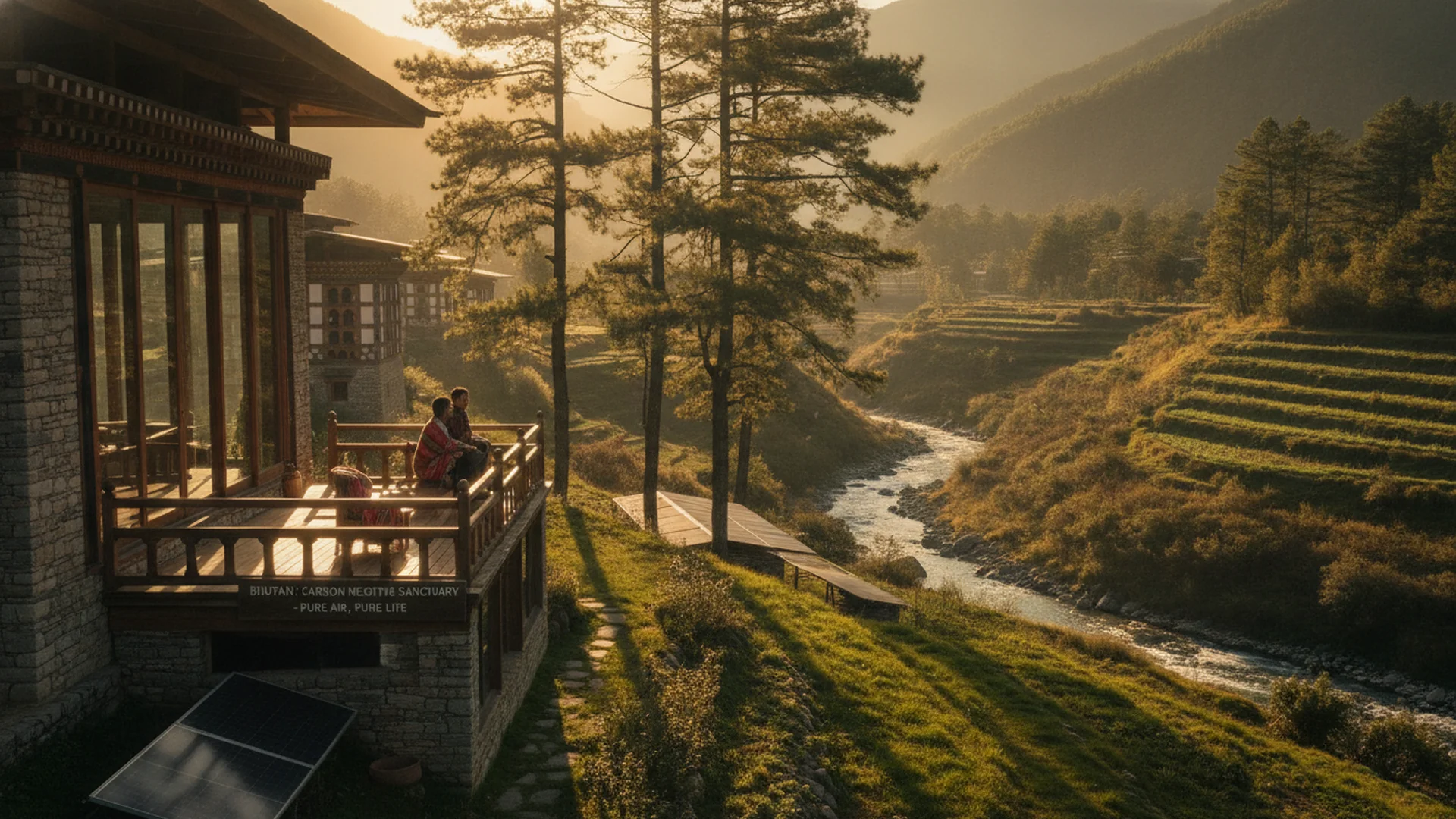
When the profound silence of the Himalayan valleys merges with crisp mountain air scented of pine, the twenty-first-century definition of luxury undergoes a profound metamorphosis. Amidst a contemporary world driven by relentless velocity and industrial clamor, the Kingdom of Bhutan has chosen an unhurried, contrarian path, establishing itself as the world’s sole carbon-negative nation. Here, vast and untamed ancient forests act as the living lungs of the earth, transforming breathable, pristine air into an asset more precious than any worldly currency.
To cross the threshold of this Himalayan realm is to embark upon more than a mere geographical journey; it is an initiation into the dimensions of regenerative travel. Governed by rigorous national legislation and a philosophical vision that honors the delicate equilibrium between humanity and the natural world, Bhutan refuses to sacrifice its ecological integrity for hollow economic expansion. Instead, nature forms the very bedrock of a sustainable, ultra-luxury paradigm that offers discerning travelers a deeply meaningful and ethically grounded escape.
Architecture of Breath: Decoding Carbon-Negative Ecology and the 72% Himalayan Canopy
Beneath the dramatic, jagged crests of the Himalayas lies a constitutional decree as steadfast as the mountains themselves: Bhutan must maintain at least 60 percent of its total land under forest cover for all eternity. In reality, lush emerald woodlands blanket more than 72 percent of the kingdom. This verdant expanse ensures that Bhutan does not merely achieve net-zero emissions, but operates firmly as a carbon-negative state, sequestering over nine million tons of carbon dioxide annually while producing a fraction of that amount.
This ecological wonder is no accident of geography; it is the direct manifestation of a national consciousness rooted deeply in Buddhist philosophy. By forbidding commercial logging, harnessing clean hydroelectric energy, and steadfastly barring heavy industry, Bhutan preserves an atmosphere untouched by smog or urban taint. Breathing in the pine-scented mountain air amidst absolute solitude has thus become the ultimate expression of wealth for elite global travelers seeking refuge from the modern world.
Philosophy Behind the Green Rampart: How the SDF Shields Nature and Culture
Another pivotal mechanism preserving Bhutan’s pristine state against the relentless tide of mass tourism is the Sustainable Development Fee (SDF), levied at $100 USD per night for international visitors. Every single cent contributed through this fee feeds directly into national development funds rather than disappearing into commercial intermediaries.
The SDF functions as a sophisticated quality filter, attracting conscientious travelers who possess a genuine respect for fragile ecosystems. Concurrently, these funds support tuition-free education, universal public healthcare, sustainable infrastructure development, and the employment of dedicated forest wardens. This guarantees that tourism enriches local livelihoods without eroding ancient traditions that have flourished undisturbed for centuries.
Sanctuary of Silence: Organic Architecture and Discreet Luxury
In the realm of hospitality, Bhutan’s ultra-luxury sanctuaries—such as Amankora and Six Senses—redefine high-end habitation through the lens of discreet, understated luxury. Distributed discreetly across legendary valleys like Punakha, Paro, and Thimphu, these properties are masterclasses in context-driven design, utilizing rammed earth, native pine, and local masonry to harmonize effortlessly with nearby agrarian villages.
A stay within these secluded sanctuaries transcends conventional accommodation; it is an immersive invitation to reconnect with the natural world. Mornings begin with silent meditation amidst rolling valley mists, followed by traditional botanical wellness therapies and exquisite dining curated from organic gardens just steps from the kitchen. This supreme quietude and absolute privacy elevate Bhutan to an incomparable haven for travelers seeking deep spiritual and mental restoration.