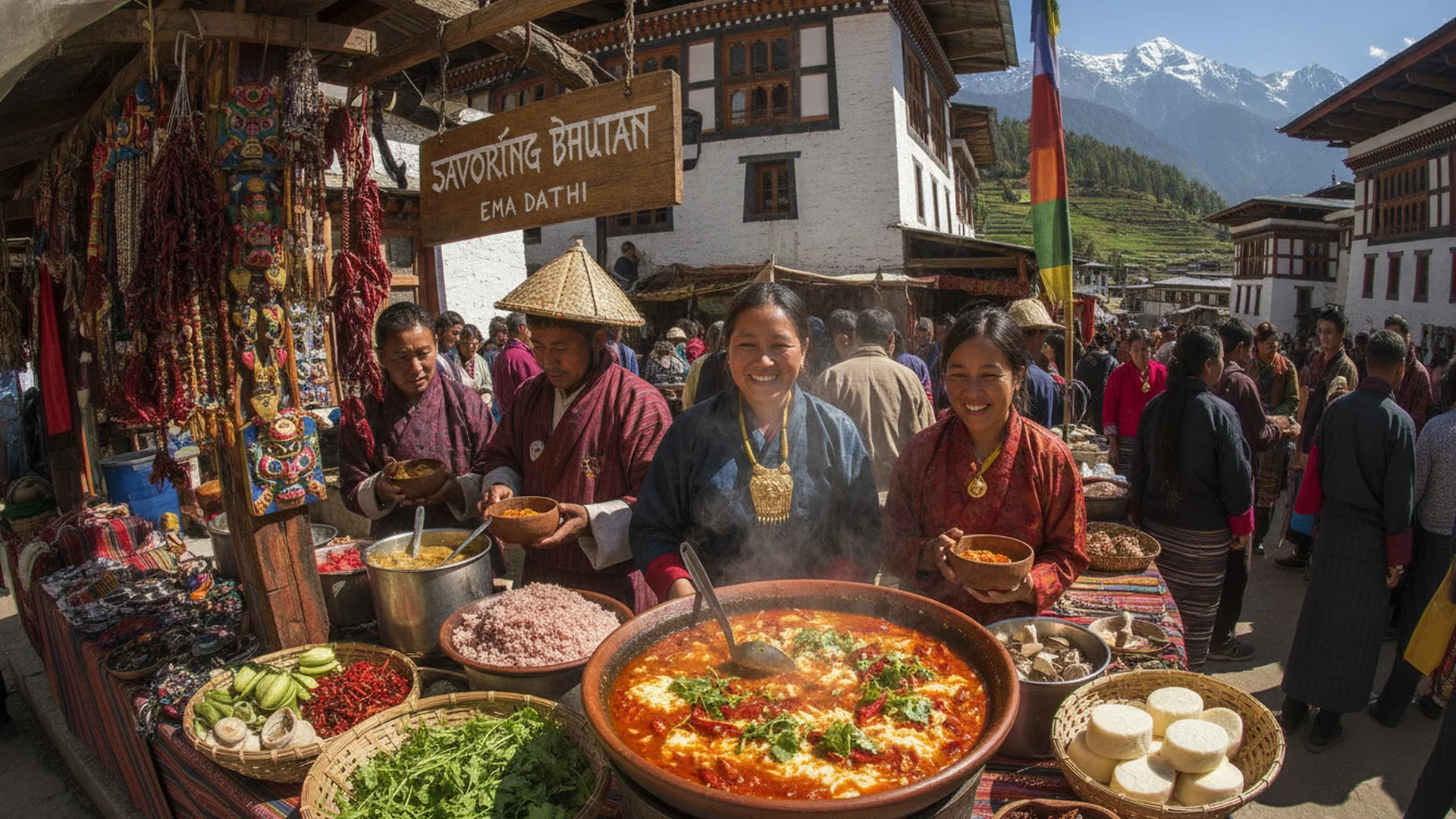
When crisp mountain winds sweep across snow-crowned Himalayan peaks, the warmth that greets travelers in the Thunder Dragon Kingdom is rarely found beside a hearth alone. Instead, it rises from the pungent, unmistakable aroma of chilies simmering gently with rich yak-milk cheese in a traditional earthenware pot. Here, gastronomy is far more than mere sustenance; it is an intimate mirror reflecting the philosophy, quiet humor, and profound harmony that the Bhutanese share with their majestic natural surroundings.
Journeying through Bhutan via its plate is akin to reading centuries of history through the palate. Ema Datshi, universally celebrated as the beating heart of Bhutanese cooking, encapsulates both the daring required to embrace fierce heat in freezing alpine air and a powerful, unpretentious elegance. For discerning global travelers and passionate cultural gourmands alike, experiencing this iconic dish at its authentic source is an essential pilgrimage into the Kingdom’s living heritage.
The Philosophy Behind the Pot: When Chili Becomes a Vegetable
While neighboring culinary traditions in India or Tibet relegate chilies to the role of a fiery seasoning, Bhutan elevates the chili (Ema) to the status of a foundational vegetable. In the Bhutanese worldview, a meal devoid of chilies is quite literally devoid of life. Ema Datshi is born from this remarkable simplicity: fresh or sun-dried chilies are gently simmered with homemade cheese (Datshi) crafted from rich cow or yak milk until they yield a sauce resembling a decadent, velvety dip. The assertive heat of the chili is gracefully tempered by the unctuous creaminess of the cheese, creating a complex, harmonious flavor profile that warms the body from within even amidst biting high-altitude chills.
The National Pantry: A Tapestry of Himalayan Flavors
Beyond Ema Datshi, the Bhutanese table abounds with variations of the ‘Datshi’ family alongside ancient preservation techniques that have endured for generations.
- Kewa Datshi: Thinly sliced potatoes gently simmered with aromatic cheese and butter, offering a profoundly comforting and velvety texture.
- Shakam Paa: Air-dried Bhutanese beef, expertly pan-fried with dried chilies and radishes. This yields a wonderfully chewy, deeply savory profile accented by a faint, rustic smokiness born of traditional farmhouse curing.
- Jasha Maru: A delicately spiced Bhutanese minced chicken stew infused generously with ginger, garlic, shallots, and fresh cilantro, offering a familiar yet intensely warming depth.
- Organic Red Rice: An indigenous heritage grain cultivated in the fertile, mineral-rich mountain waters of the Paro Valley. Once steamed, these pinkish-red grains acquire a satisfyingly nutty chew and earthy aroma, serving as the flawless canvas for the rich stews of the region.
The Evolution of Taste: From Heritage Farmhouses to World-Class Haute Cuisine
Today, the exploration of Bhutanese gastronomy transcends traditional boundaries, offering discerning travelers two distinct yet equally captivating dimensions. The first is an intimate immersion into rural life, visiting rustic timber farmhouses where a local host expertly stirs Ema Datshi over an open wood-fired hearth, accompanied by steaming cups of salted butter tea (Suja).
Concurrently, iconic sanctuary resorts such as Amankora and Six Senses Bhutan have reinterpreted these ancestral ingredients into sophisticated contemporary Bhutanese cuisine. Visionary chefs reimagine Ema Datshi as ethereal Himalayan cheese foams paired with charred organic chilies, or delicately balance local river trout with avant-garde culinary techniques—all while honoring the soul and integrity of the original recipes.