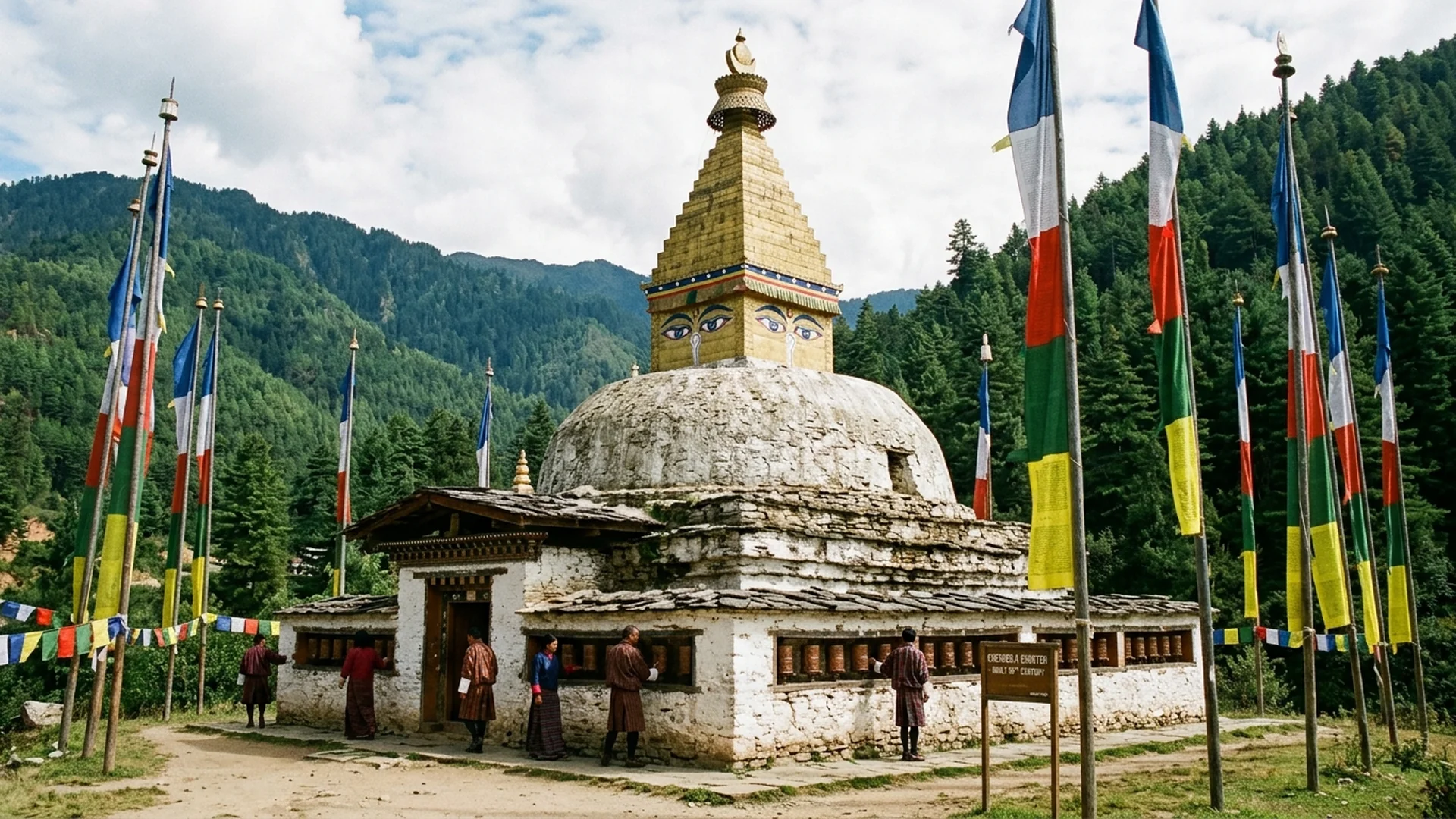
When the morning mists recede to reveal the deep-emerald pine forests of the Trongsa valley, a pristine white sanctuary rising beside a murmuring river halts the traveler in their tracks. This is not the familiar fortress-like dzong or traditional Bhutanese chorten of the western valleys, but rather Chendebji Chorten—a sacred stupa modeled with striking fidelity upon the great Boudhanath Stupa of Nepal. The all-seeing wisdom eyes painted upon its pinnacle gaze out across the cardinal directions, arresting time itself amidst a landscape steeped in quiet mystery and profound devotion.
Journeys along the winding mountain arteries connecting Punakha and Trongsa frequently lead discerning travelers to this sanctuary quite by chance. Yet for those attuned to art history and sacred geography, Chendebji Chorten stands as an invaluable landmark reflecting the remarkable cultural synthesis of the Himalayas. Beneath its gleaming whitewashed exterior lie centuries-old legends of taming ancient shadows, wrapped in a pristine atmosphere that invites modern wanderers to pause and reflect amidst the grandeur of the natural world.
Nepalese Architecture Amidst Bhutanese Valleys: A Singular Landmark
In the Kingdom of Bhutan, sacred reliquary structures conventionally adhere to solid, blocky vernacular forms known locally as chortens. Chendebji Chorten boldly departs from this norm, presenting a massive, brilliant white hemispherical dome crowned by cascading golden metal rings that catch the high-altitude sunlight. What instantly commands attention is the rendering of the Buddha Eyes—known in Nepal as Wisdom Eyes—painted across all four sides of the square harmika. These powerful eyes of dark lacquer and crimson gaze serenely over the surrounding pine forests and mountain ridges, serving as a silent testament to universal awakening and timeless awareness. This unique architectural dialogue makes Chendebji an open-air masterpiece that cultural connoisseurs and luxury insight travelers seek out to contemplate its distinct aesthetic heritage.
The Legend of Ngala Duem: An Eighteenth-Century Chronicle
Beneath its tranquil exterior, Chendebji Chorten is anchored in an evocative 18th-century narrative of spiritual subjugation. According to Himalayan chronicles, the valley was once plagued by a fearsome ogress or demoness named Ngala Duem, whose presence cast a pall of terror over local inhabitants and travelers. To liberate the populace from this suffering, the accomplished Lama Ngesup Tshering Wangchuk traveled to the auspicious confluence of two mountain streams. There, he pinned the malevolent entity deep beneath the earth, subsequently erecting the Nepalese-style stupa directly above to seal its destructive energies. This foundational myth illustrates the ancient Himalayan paradigm of transforming chaotic natural forces and internal darkness through the steadfast application of sacred dharma.
A Sacred Sanctuary of Convergence: Mani Walls and Parallel Stupas
The perimeter of Chendebji Chorten offers more than a solitary monument, encompassing a harmonious constellation of spiritual elements. Bordering the sweeping lawn is an ancient mani wall etched with countless mantras, alongside which travelers gently turn prayer wheels as they walk. Furthermore, in 1982, Her Majesty the Queen Mother commissioned a traditional square Bhutanese chorten to stand in quiet communion beside the main structure, imparting balance and renewed spiritual protection to the site. The peaceful coexistence of two radically different architectural traditions upon a single earthen terrace offers a rare and beautiful testament to cultural synthesis.