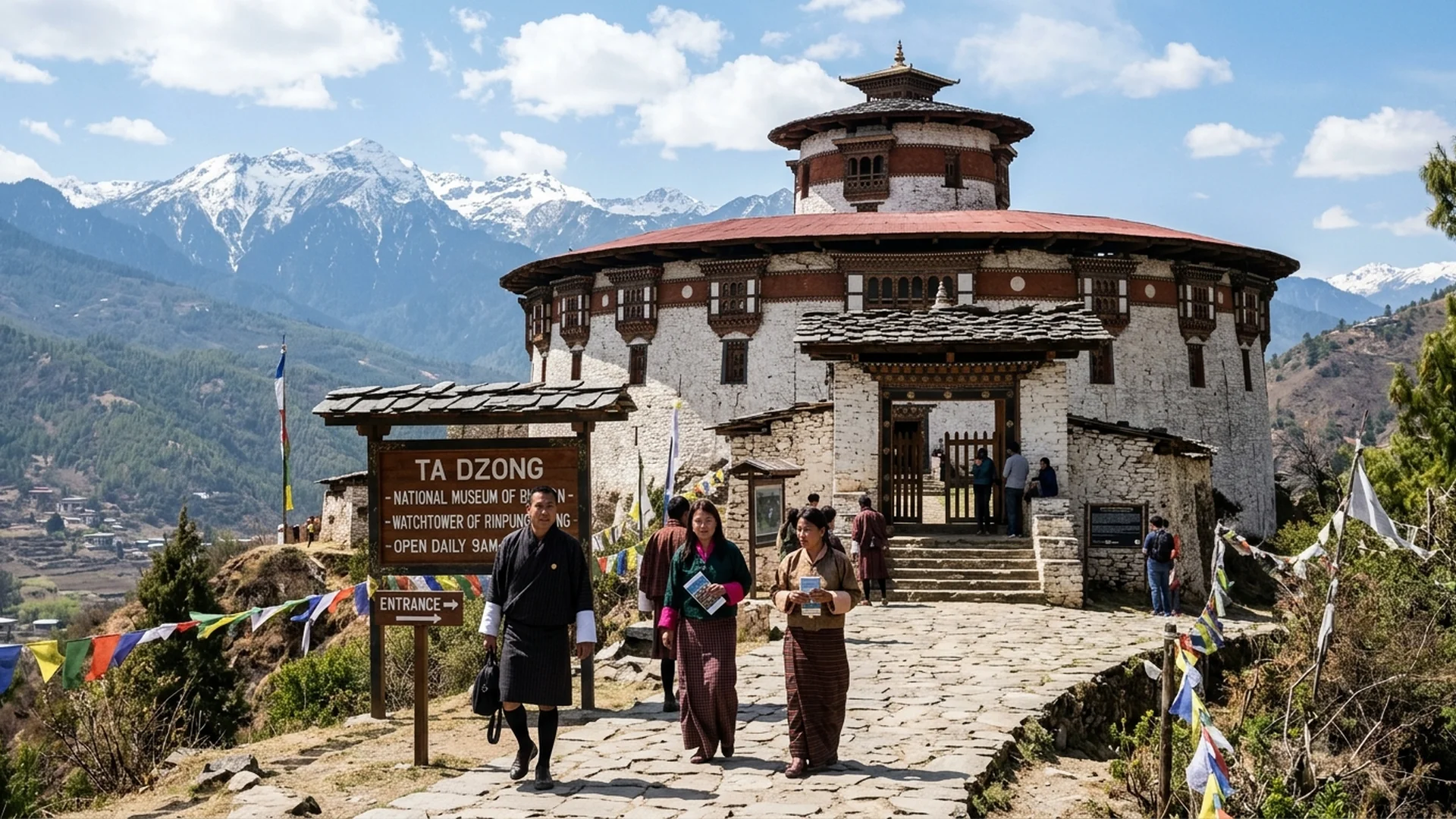
Raised two thousand five hundred meters above sea level, where the complex contours of the Paro Valley unfold in undulating shades of emerald and mist, a remarkably cylindrical structure stands in quiet majesty. This architecture of seasoned stone and thick timber, shaped with unmistakable organic curvature, is not a standard fortress. It is Ta Dzong—the ancient watchtower established in 1649 by Tenzin Drukdra, the governor of the valley, designed to serve as a vital strategic vanguard guarding the sprawling monastic fortress of Rinpung Dzong from Tibetan incursions.
The genius of Ta Dzong extends far beyond military advantage. It is a masterclass in Vajrayana Buddhist symbolism and indigenous Himalayan engineering. Designed in concentric circles that echo the auspicious proportions of a right-turned conch shell, its walls are built of stone and timber over two and a half meters thick, constructed entirely without the use of a single iron nail. This resilient geometry has weathered major seismic events through the centuries, standing as a testament to an era when sacred philosophy and structural mechanics were conceived as one.
As centuries turned, the watchtower’s mandate shifted from martial defense to the preservation of national wisdom. In 1968, His Majesty King Jigme Dorji Wangchuck, revered as the architect of modern Bhutan, decreed that the historic tower be restored and consecrated as the National Museum of Bhutan. Today, it safeguards more than three thousand pieces of priceless heritage, anchoring the nation’s spiritual continuity for discerning travelers seeking the profound underpinnings of the Thunder Dragon Kingdom.
The Conch-Shell Blueprint: Spiritual Geometry and Ancient Engineering
Within Vajrayana Buddhism, the white right-turned conch shell (dungkar) stands among the eight auspicious symbols (Ashtamangala), signifying the far-reaching resonance of the Dharma. When master builders drafted Ta Dzong in 1649, they wove this sacred iconography directly into the physical footprint of the tower. The resulting cylindrical, tapered form held profound cosmological resonance while fulfilling an urgent tactical mandate: a circular perimeter eliminated blind spots, allowing sentinels an unobstructed, panoramic view of the approaches.
The masonry walls, measuring two and a half meters in thickness, rely on intricate timber joinery and interlocking stone rather than iron spikes. This natural elasticity has proven remarkably forgiving against violent tremors, absorbing seismic shocks during major earthquakes in 1714 and 1896. Beneath the foundations, a concealed subterranean tunnel once secured a reliable water supply from the rushing Pa Chhu below, sustaining the garrison during prolonged sieges and exemplifying the sophisticated logistical foresight of early Bhutanese master builders.
From Fortress to Cultural Sanctuary: The Third Royal Vision
As historical hostilities subsided, Ta Dzong faced a quiet period of abandonment until the reign of the Third King, Jigme Dorji Wangchuck. Recognizing that the era of defending physical borders with arms had given way to a more delicate crusade—the safeguarding of national identity—the King ordained that the watchtower be reborn as a sanctuary for the nation’s treasures.
This metamorphosis from sentinel of war to archive of wisdom marked a profound turning point in Bhutan’s modern journey. By placing cultural preservation at the center of national life, the institution laid intellectual groundwork for the philosophy of Gross National Happiness (GNH), wherein spiritual heritage is recognized as essential to holistic societal flourishing.
Six Tiers of Antiquity: Exploring the Royal Treasury
The museum’s interior layout distributes its vast collection across six vertical levels, charting over fifteen hundred years of Himalayan history. Among the most arresting masterworks are centuries-old thangkas—intricate sacred scroll paintings rendered in natural mineral pigments and pure gold leaf that depict complex cosmic mandalas and pivotal narratives from the life of the Buddha.
Visitors also encounter galleries housing tenth-century Kadam stupas, rare bronze masterworks, and profound symbols of statehood such as the Raven Crown worn by Bhutan’s monarchs. The collection extends to ancient weaponry belonging to early governors like Jigme Namgyal and historical armillary spheres used in traditional Himalayan astronomy, sciences that continue to inform daily rhythms across the kingdom.
Ridge-Top Perspectives: The Living Landscape of Paro
Stepping out onto the paved stone courtyards surrounding the tower yields one of the most sublime vistas in the Himalayas. Far below, Rinpung Dzong commands the valley floor, its white walls and golden eaves framed by the silvery ribbon of the Pa Chhu river and orderly tiers of terraced agricultural fields.
Observing the valley from this elevated vantage point reveals the intentionality of Bhutanese sacred geography. The relationship between the watchtower and the fortress below is not merely architectural, but a living dialogue between protection and sanctuary, offering travelers an immersive encounter with the soul of the Paro Valley.