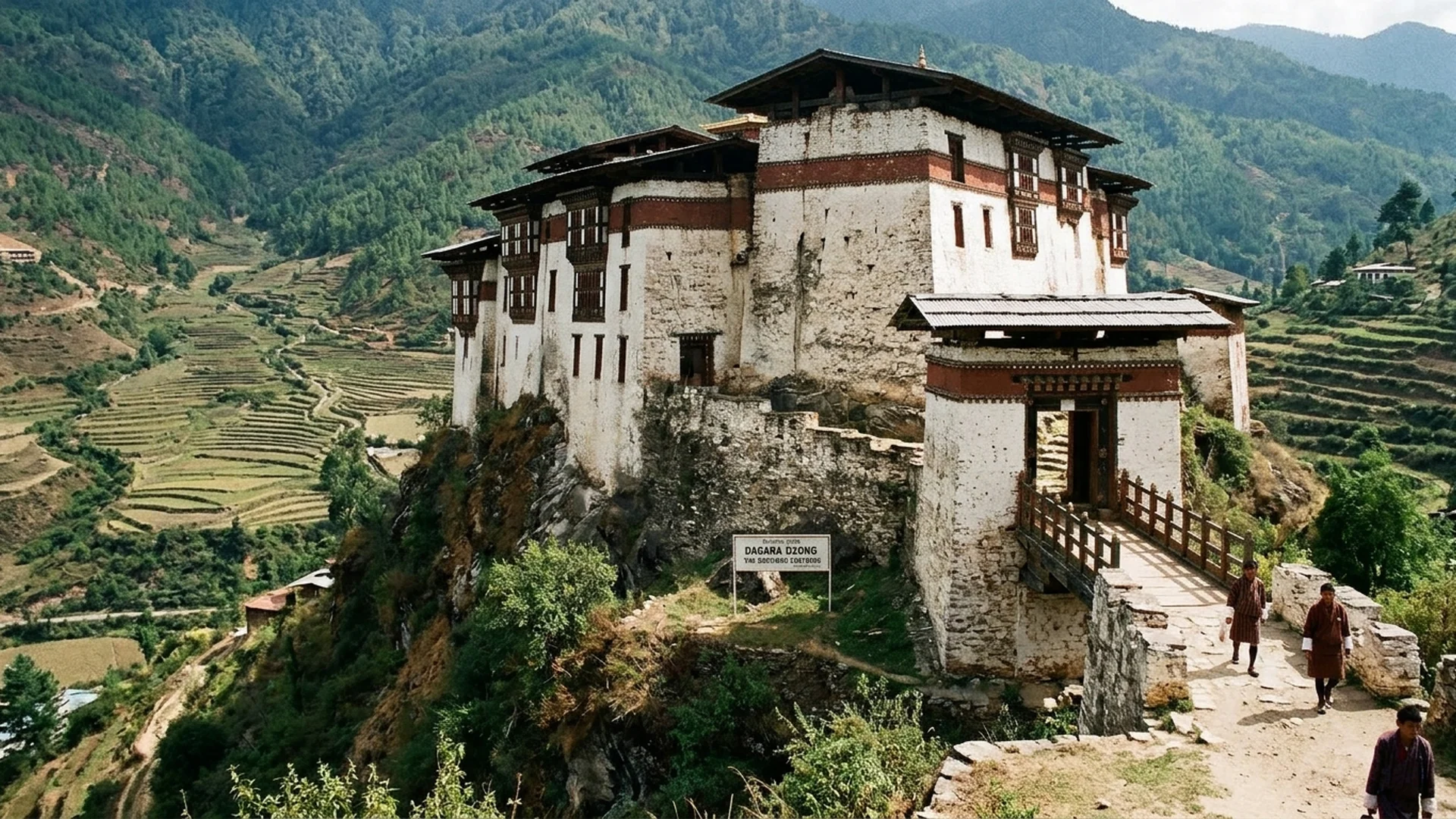
As morning mist weaves through the undulating ridges of southern Bhutan, the chime of sacred bells and curling wisps of juniper incense awaken centuries of uninterrupted time. Dagana Dzong—historically known as Daga Trashiyangtse Dzong—emerges from the verdant slopes with the quiet majesty of an ancient mountain guardian. Far removed from the heavily trodden corridors of the western valleys, this sanctuary serves as both a historic administrative bastion and a profoundly spiritual nexus, binding the visionary legacy of the seventeenth century with enduring myths carved into stone and timber.
Commissioned in 1651 by Zhabdrung Ngawang Namgyel, the founding statesman who unified the Himalayan kingdom, the fortress was strategically positioned to anchor Bhutan’s southern marches against external incursions while extending the sheltering shade of Buddhist philosophy. Perched upon a dramatic promontory overlooking sweeping river valleys, the site exemplifies masterful historical geopolitics wedded to sacred geography. Yet, what elevates Dagana Dzong beyond a conventional defensive outpost are the enduring indigenous legends of primordial stone pillars that predate the fortress itself, weaving a tapestry of mystery that continues to captivate discerning seekers of authentic cultural heritage.
Seventeenth-Century Genesis: The Strategic Architecture of Dagana
Approaching Dagana Dzong is akin to stepping backward into the foundational era of Bhutanese nationhood. In the mid-seventeenth century, Zhabdrung Ngawang Namgyel dispatched trusted commanders southward to demarcate borders and cement sovereignty over newly unified territories. Thus, Daga Trashiyangtse Dzong arose at the convergence of ancient trans-Himalayan trade routes. The architecture is a testament to indigenous master builders who utilized load-bearing rammed earth walls and massive stone foundations without the use of a single iron nail, marrying structural fortitude with the delicate artistry of polychrome woodcarvings rooted in Tantric Buddhist iconography. At its heart, the central utse tower functions as the spiritual axis, enshrining sacred statues and centuries-old mural paintings that depict protective deities and lineage masters. Within these venerable corridors, the heavy aroma of melted butter lamps and Tibetan incense creates an atmosphere of timeless devotion that has remained undisturbed for generations.
Megalithic Mysteries and the Giant Horn: Living Folklore
The enduring fascination of Dagana Dzong lies not merely in its physical scale, but in the veiled dimensions of its folklore. Oral traditions speak reverently of ‘Tha Namkhai Dzong,’ a sacred monolithic stone pillar standing steadfast near the precinct—believed by locals to be a cosmic axis holding heaven and earth in balance, and serving as the cosmological limit past which human construction could not reach. Furthermore, the dzong safeguards an extraordinary heirloom: a gigantic ancient yak horn exceeding four and a half feet in length. According to local chronicle, this relic stands as a symbolic tribute linked to ancient chieftains and legendary protectors of the southern realm. Meticulously preserved by the monastic community, the artifact is brought forth during consequential annual rituals, serving as a tangible bridge where myth and historical reality converge seamlessly.
The Dagana Valley: Untouched Ecosystems and Highland Life
Beyond the fortress walls, the Dagana district presents an unfiltered perspective of rural Bhutan, sheltered from modern industrial transformation. The surrounding landscape is an uninterrupted sweep of subtropical broadleaf forests and dense pine woodlands, harboring rare endemic flora and elusive wildlife. Daily existence here remains intimately attuned to terraced agriculture and traditional pastoralism. Travelers who venture into these emerald valleys are welcomed by the genuine hospitality of villagers proudly clad in their everyday gho and kira. Amidst the profound quietude of the southern peaks and the pristine alpine air, Dagana offers an invaluable sanctuary for travelers seeking to transcend conventional tourism and engage with the living soul of Bhutanese culture.