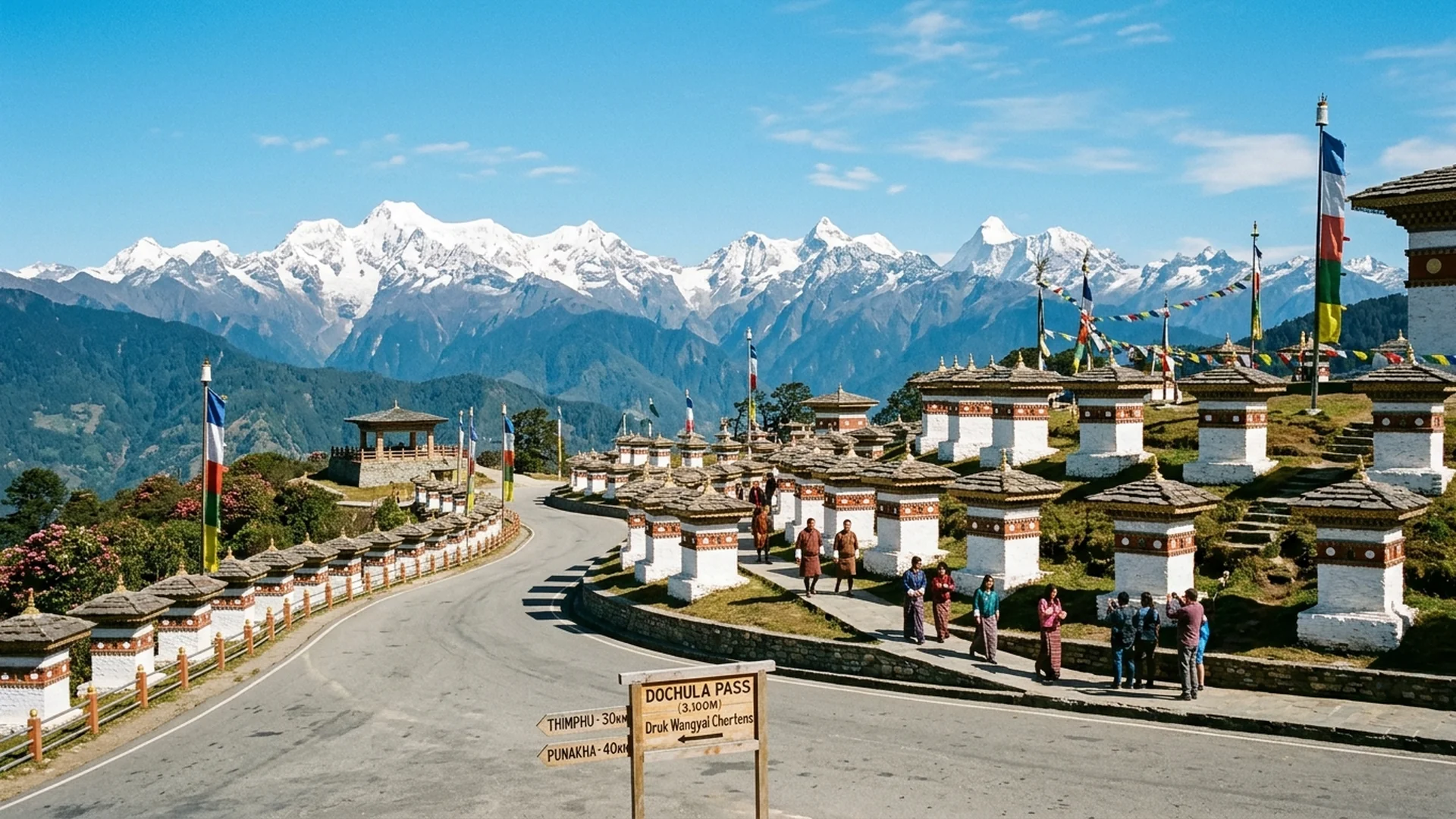
For the discerning traveler traversing the arterial highway connecting the tranquil capital of Thimphu with the fertile, sun-warmed valley of Punakha, Dochula Pass is rarely a mere transit point. Perched at an elevation of 3,100 meters above sea level, the pass invites a profound spiritual pause—a sanctuary where raw alpine nature, dramatic royal history, and profound Buddhist devotion converge in absolute harmony.
Amidst the drifting veils of mountain mist that caress the Eastern Himalayan range, colorful prayer flags snap in the crisp wind, carrying silent invocations across soaring ridges. Here, 108 pristine white chortens crowned with gilded spires rise in cascading tiers across the natural hillside. This architectural masterpiece does more than punctuate the skyline; it serves as a tangible monument to collective memory, mindfulness, and an enduring prayer for global peace.
To visit Dochula Pass is to step beyond the fleeting impulses of modern tourism and into a timeless realm of contemplation. It is an invitation to absorb the majestic scale of the world’s highest mountain ranges while intimately engaging with the inner peace that defines the Kingdom of Bhutan.
A Monument to Peace: The Story Behind the 108 Druk Wangyal Chortens
Across the high plateau of Dochula Pass, one hundred and eight classic white chortens—Buddhist reliquary monuments—sweep downward in orderly tiers along the contour of the slope. Known formally as the Druk Wangyal Khang Zhang Chortens, these structures were consecrated in 2004 under the royal patronage of Her Majesty Queen Mother Ashi Dorji Wangmo Wangchuck.
Beneath their serene whitewashed exteriors lies a chapter of resolute national history. In late 2003, Bhutan faced a critical security challenge along its southern borders. His Majesty the Fourth King, Jigme Singye Wangchuck, personally led operations to restore sovereignty and peace. The 108 chortens were subsequently established not only to honor the Bhutanese soldiers who made the ultimate sacrifice, but also as an eternal prayer invoking divine protection and universal harmony.
The number 108 holds profound sacred significance within Vajrayana Buddhism, representing the 108 earthly defilements that seekers must transcend to attain spiritual clarity. Walking clockwise in ritual circumambulation (Kora) around these sacred spires amid the high-altitude silence offers travelers an authentic encounter with pure devotion.
Alpine Horizons: Witnessing Gangkhar Puensum in 360 Degrees
The physical majesty of Dochula Pass lies in its position as a natural amphitheatre offering unbroken 360-degree vistas across the rugged Eastern Himalayas. On crisp, cloudless days, the first rays of dawn ignite the surrounding snowfields in hues of molten gold, casting a dramatic silhouette against the white chortens.
The crowning glory of this horizon is Gangkhar Puensum. Rising 7,570 meters above sea level, this colossal peak is not only Bhutan’s highest mountain but also holds the distinction of being the highest unclimbed mountain in the world. Out of deep respect for indigenous spiritual beliefs—which view high peaks as sacred sanctuaries for local deities and nature spirits—the Bhutanese government prohibits mountaineering above 6,000 meters.
Beyond Gangkhar Puensum, the gaze sweeps across towering glacial giants such as Masanggang and Tsendagang. Sitting quietly as these monumental peaks shift colors under changing sunlight is a humbling experience that restores perspective and deepens one’s reverence for the natural world.
Where Ancient Tradition Meets Modernity: Inside Druk Wangyal Lhakhang
Perched on a green knoll adjacent to the chortens stands Druk Wangyal Lhakhang, a temple completed in 2008 to honor the Fourth King and commemorate a century of the Wangchuck dynasty.
While its exterior proudly exhibits classical Bhutanese architectural mastery, the true revelation waits within its sanctum. The temple’s interior walls are adorned with some of the most extraordinary contemporary Buddhist mural art in the kingdom. Rather than strictly adhering to ancient motifs, the artists wove modern historical narratives into sacred iconography.
A discerning glance across the murals reveals intricate depictions of monks operating laptop computers, Drukair aircraft banking gracefully between cloud-veiled peaks, and modern defense forces working alongside traditional guardians. These details eloquently articulate Bhutan’s national philosophy: that embracing technological progress and global connectivity need not come at the expense of cultural heritage and spiritual grounding.
Ancient Rhododendron Forests and Slow-Travel Charm
The allure of Dochula Pass extends far beyond its religious monuments into the surrounding pristine ecology. The pass sits directly adjacent to the Royal Botanical Park, Lamperi, a protected sanctuary celebrated for its native rhododendron forests.
During the spring months of April and May, the alpine woodlands erupt into vibrant displays of pink, crimson, and ivory blossoms, contrasting sharply with the deep emerald needles of ancient pines and towering ferns. The mountain breeze carries the subtle, sweet fragrance of high-altitude flora across the slopes.
To complete the contemplative experience, a warm, inviting café sits near the overlook. Travelers can settle beside expansive glass windows with a steaming cup of traditional butter tea (Suja) or locally roasted artisan coffee, paired with freshly baked goods, while watching the endless ridge lines roll toward the horizon. It is a masterclass in the art of slow, mindful travel.