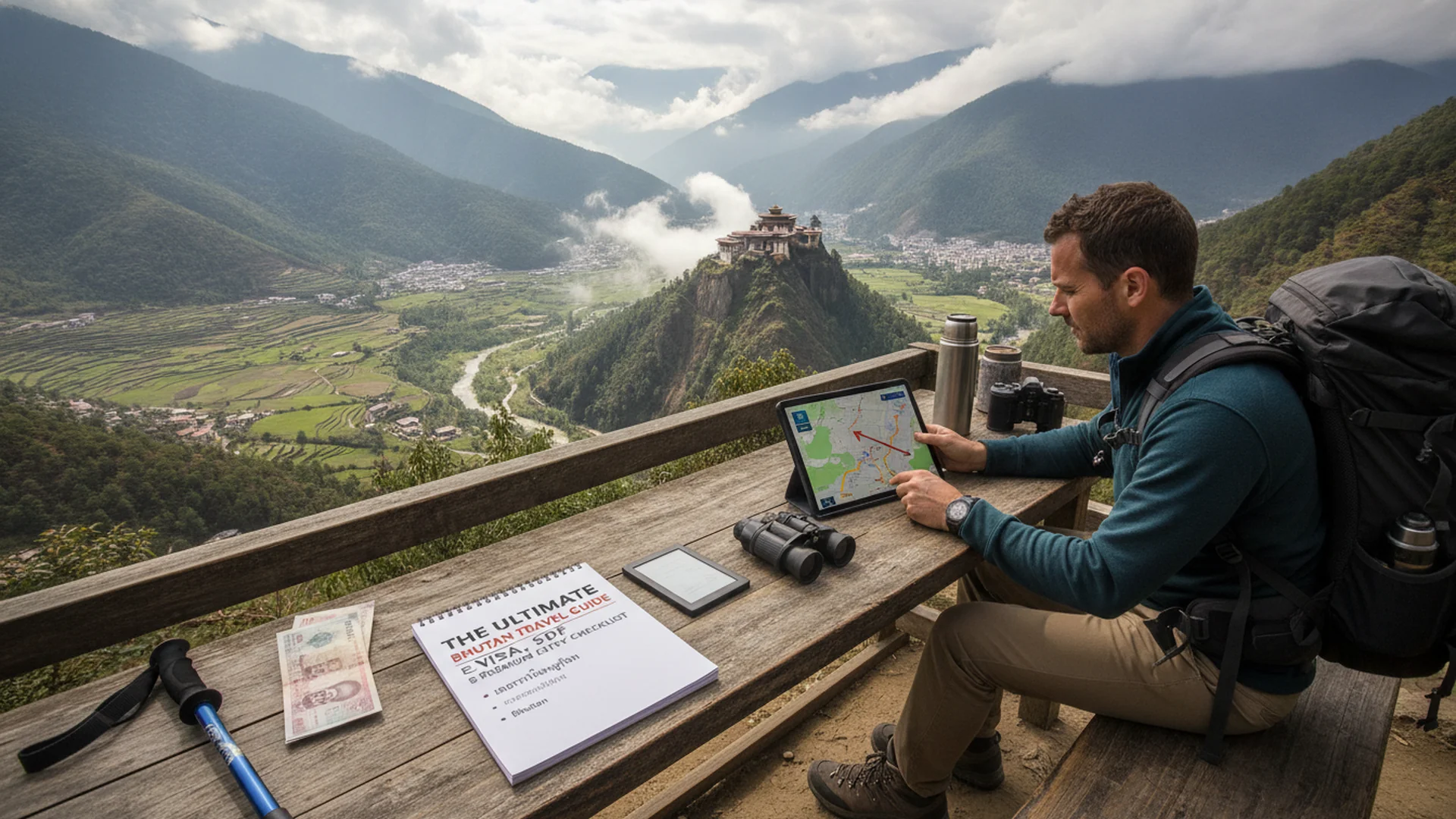
Amidst an era of relentless global hyper-tourism, the Kingdom of Bhutan stands as a resolute bastion of conscious sanctuary. Guided by the radical philosophy of Gross National Happiness, its long-standing ‘High Value, Low Volume’ tourism mandate is far from a mere fiscal barrier or bureaucratic safeguard—it is a sacred mantle designed to protect the pristine ecology and ancient heritage of the Eastern Himalayas from the attrition of time. Crossing into this sovereign realm is not a trivial booking of flights; it is a deliberate, reverence-filled ritual that begins long before one touches down among the clouds.
For the discerning traveler, comprehending the architecture of Bhutan’s entry protocols is an indispensable prelude to aligning with the kingdom’s unhurried rhythm. From the streamlined digital e-Visa platform to the foundational Sustainable Development Fee (SDF), every regulatory requirement is curated to attract guardians rather than mere sightseers. This comprehensive guide unravels the nuances of Bhutanese travel documentation, ensuring your passage into the Land of the Thunder Dragon unfolds with seamless grace.
Decoding High Value, Low Volume and the Sustainable Development Fee
Bhutan’s approach to travel remains a global exemplar of progressive, eco-centric heritage management. At the heart of this model lies the Sustainable Development Fee (SDF), currently fixed at $100 USD per adult per night. Far from an arbitrary tariff, these funds are channeled directly into the kingdom’s social and ecological bedrock—funding free universal healthcare, tuition-free education, green infrastructure, and the painstaking restoration of ancient dzongs and lhakhangs.
To view the SDF merely as an added expense is to miss its deeper philosophical resonance. Every night spent beneath the Himalayan stars represents an active contribution to preserving the last Mahayana Buddhist kingdom on Earth. Travelers are elevated from passive observers to active stewards, underwriting the preservation of carbon-negative forests and vibrant monastic traditions for generations to come.
The Digital Portal: e-Visa Mechanics and Entry Dossier
In alignment with modern luxury expectations, Bhutan has digitized its entry protocols through a centralized platform managed by the Department of Immigration. While the digital interface offers clarity, compliance demands absolute precision. Your travel dossier must contain four key components:
- Passport Integrity: A valid passport with a minimum of six months’ remaining validity beyond your departure date, complete with blank pages for entry stamps.
- Official Visa Clearance Letter: Issued by Thimphu upon regulatory approval, this official document must be presented to airline agents at check-in and to immigration officials upon arrival in Paro.
- Comprehensive Travel & Medical Insurance: Mandatory policies must explicitly cover emergency medical treatment, high-altitude illness, and air evacuation.
- Verified Travel Arrangements: Flight confirmations with designated carriers (Drukair or Bhutan Airlines) alongside verified luxury accommodations approved by the Department of Tourism.
Note that internal travel itineraries and regional excursions can be reviewed via /en/travel-planning for seamless regional planning.
Arrival in Paro: The Drama and Grace of Descent
Surrounded by jagged 18,000-foot peaks, Paro International Airport (PBH) is nestled in a narrow river valley at an elevation of 2,235 meters. Negotiating this dramatic approach requires specialized airmanship, offering passengers extraordinary aerial vistas of pine-forested ridges and terraced paddy fields.
Upon landing, the terminal’s sloping whitewashed walls, intricate timber joinery, and gilded rooflines welcome travelers with quiet majesty. Guests traveling under bespoke itineraries experience an effortless transition through immigration, where attentive hospitality ensures swift verification of the Visa Clearance Letter before ushering you into the crisp mountain air.