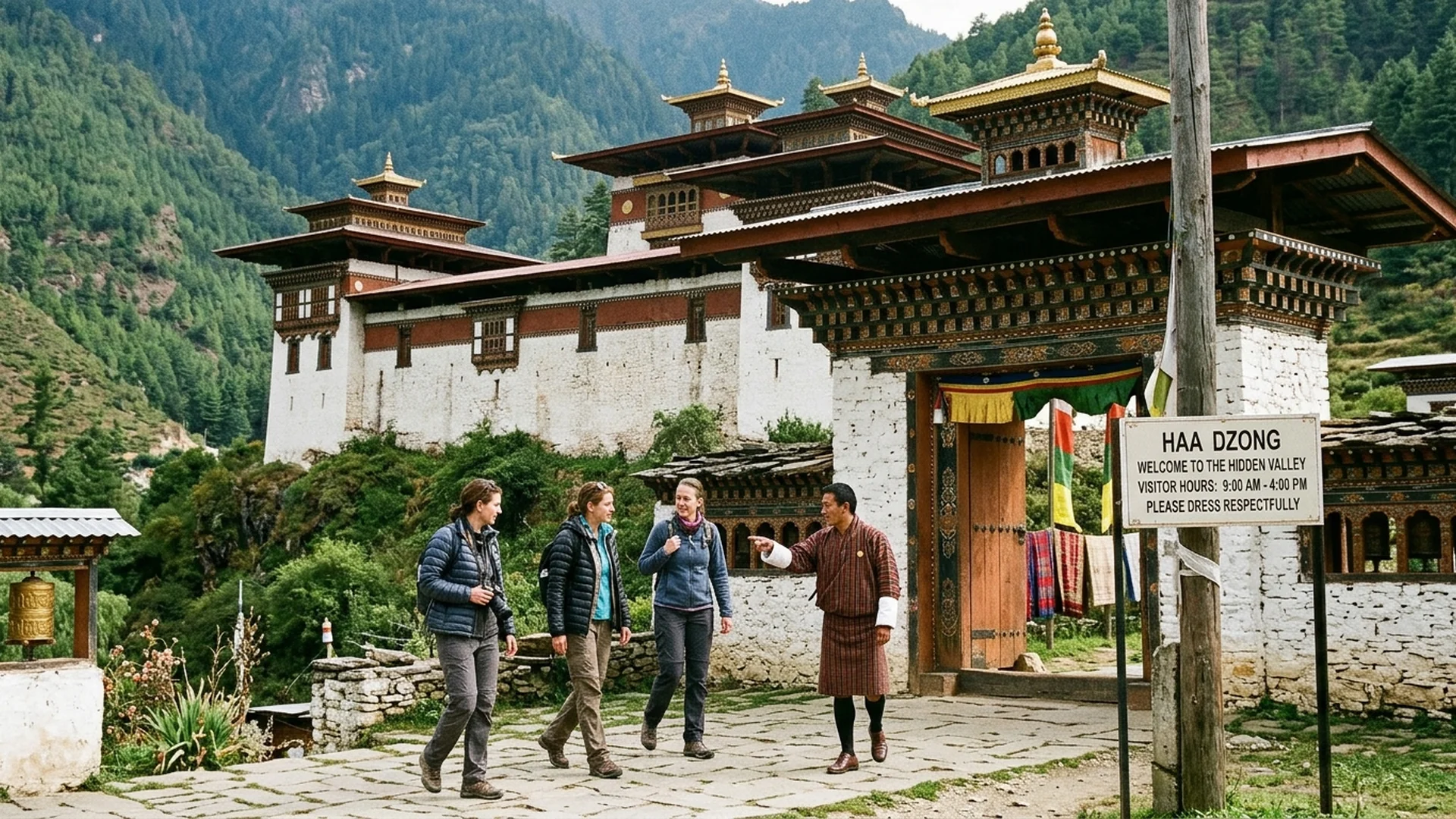
As the morning mist gradually lifts above the snow-crowned Himalayan peaks, the Haa Valley—affectionately known as the hidden sanctuary embraced by mountains—reveals an untouched beauty largely untouched by the passage of time. As one of the kingdom’s final valleys to open its doors to the wider world, Haa has successfully elided the rapid commercialization of mainstream tourist tracks, preserving a profound stillness where the ancient spirit of Bhutan endures in its purest form.
Behind this veil of mist and dense pine forests, which blanket nearly seventy-eight percent of the valley floor, stands Haa Dzong. Formally christened Wangchuk Lo Dzong, this venerable fortress-monastery commands the landscape with historical resonance. Unlike administrative dzongs scattered across bustling urban hubs, Haa Dzong weaves together a compelling narrative of frontier security and bilateral heritage. It leaves travelers seeking the authentic essence of the Land of the Thunder Dragon with an atmosphere that is simultaneously austere, deeply powerful, and transcendent.
Wangchuk Lo Dzong: Gateway of Authority and Fellowship in a Sealed Realm
Perched gracefully along the banks of the Haa River, Wangchuk Lo Dzong was erected in 1913 to replace an earlier, decaying fortress. Its architectural anatomy embodies classic Bhutanese design principles: monolithic rammed-earth walls, intricately carved fenestrations of timber, and tranquil, immaculately swept interior courtyards. What distinguishes Haa Dzong from counterparts in Thimphu or Paro is its distinct contemporary utility and strategic disposition. With a portion of the enclave functioning in coordination with the Indian Military Training Team (IMTRAT), the surrounding atmosphere balances strict disciplined order with a visible testimony to enduring international diplomacy, all while preserving the sanctuary’s sacred monastic heart. Crossing the heavy timber threshold into the inner courtyard feels akin to slipping backward through centuries, touching the foundational roots of sovereignty and spiritual stewardship in the Bhutanese highlands.
The Allure of Haa Valley: Untamed Wilderness and Life Beyond the Clock
Approaching the Haa Valley requires traversing the Chele La Pass, the highest vehicular mountain road in Bhutan, cresting at an elevation of nearly 3,988 meters above sea level. The moment one’s carriage descends the pass, an immense, sweeping valley unfolds, enclosed by jagged alpine ridges, dense conifer forests, and wandering yak pastures. Material modernity casts virtually no shadow here. Local villagers continue to don traditional garments—the gho and the kira—dedicating their days to terraced agriculture and yak husbandry. The air possesses a crisp, pristine vitality with every intake, making the quietude of Haa an incomparable psychological restorative. It invites the discerning traveler to pause, step away from the clamor of the contemporary epoch, and commune with nature in its rawest, most reverent state.
Legend of the Twin Sacred Sanctuaries: Lhakhang Karpo and Lhakhang Nagpo
Deep within the Haa Valley near the settlement of Narisnak rest twin religious monuments of profound historical importance to Himalayan Buddhism: Lhakhang Karpo (the White Temple) and Lhakhang Nagpo (the Black Temple). Commissioned during the seventh century by the Tibetan monarch Songtsen Gampo, lore dictates that the king released a white dove and a black dove to select propitiatory sites for subduing malevolent spirits obstructing the spread of the Dharma. Lhakhang Karpo stands resolute against the backdrop of the sacred peak Meri Puensum, celebrated for its brilliant murals and venerable statues, while Lhakhang Nagpo rests quietly nearby in a more somber, contemplative gloom. Together, these sanctuaries serve as the spiritual heartbeat of Haa, offering a vital pilgrimage for those seeking the unadulterated essence of Tibetan Buddhist heritage.