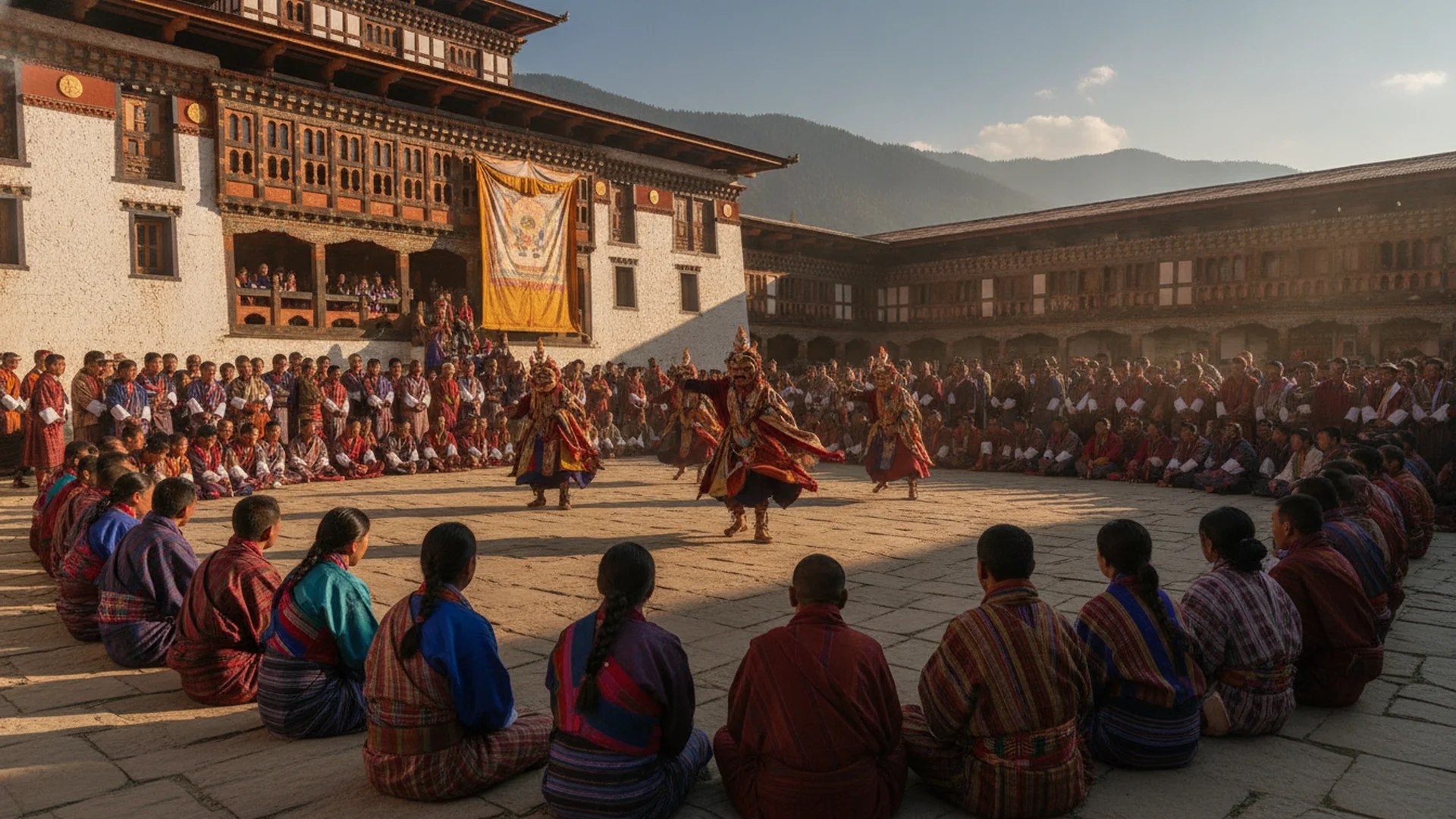
When the first golden rays of dawn touch the whitewashed granite walls of an ancient dzong, the resonant, deep-throated drone of long horns and the steady pulse of ceremonial drums begin to echo through the morning mist. Amidst swirling wisps of juniper incense, the Himalayan valleys awaken to Bhutan’s most magnificent cultural celebration. The Tshechu is far more than a standard cultural itinerary; it is a profound temporal threshold where sacred dimensions open, inviting the faithful to purify their spirits through devotion to Guru Rinpoche.
Yet, stepping into this sacred sphere as a discerning international traveler requires an essential shift in perspective—moving from a detached spectator behind a camera lens to a mindful, honored guest. The true beauty of Bhutan resides not merely in elaborate brocade garments or intricately carved masks, but in understanding the philosophy underpinning its unwavering traditions. Cultivating an appreciation for these subtle nuances is the master key to unlocking the genuine warmth and luminous smiles woven into the heart of Bhutanese society.
The Philosophy of the Cham Dance: Prayer Embodied as Sacred Art
Across the vast stone courtyards of ancient fortress-monasteries, the stirring rhythm of cymbals and long drums weaves an ancient sonic tapestry. Monks and sacred dancers, attired in brilliant hand-woven silks and formidable wooden masks depicting deities, wrathful protectors, and legendary beasts, move with a fierce grace charged with profound meaning. Within Vajrayana Buddhism, the sacred mask dance—known as Cham—is never staged for mere entertainment. Rather, it is a living visualization of pure realms and the subjugation of inner delusions. Bhutanese audiences believe that attending a Tshechu and contemplating these dances with a tranquil mind generates immense merit and dispels negative energies. Embracing this dimension allows the traveler to look past external spectacles and touch the quiet, enduring grace cultivated across centuries within the Bhutanese soul.
The Art of Refined Attire: Vestments of Honor and Reverence
Clothing serves as the primary language of respect when engaging with Bhutanese culture. Upon entering a dzong or sacred festival ground, dress codes are both rigorously observed and inherently elegant. Gentlemen don the traditional knee-length robe known as the Gho, secured neatly at the waist by a woven cloth belt, while ladies wear the Kira—an ankle-length rectangular piece of fabric wrapped gracefully alongside a coordinated silk jacket known as a Tertoeg. For international visitors without traditional attire, polished, conservative smart-casual wear is essential: long-sleeved collared shirts, full-length trousers or skirts that fall well below the knee, completely devoid of graphics or distressing. Crucially, open-toed sandals or flip-flops are strictly forbidden. Dressing with quiet sophistication ensures seamless harmony with the solemn surroundings while offering the ultimate tribute to sacred ground.
Mindful Photography: The Delicate Line Between Memory and Intrusion
Amidst a riot of crimson silks, gold brocades, and antique masks, the impulse to capture the scene is undeniable. Yet during a Tshechu, photography must be governed by mindfulness and deep respect for both individual privacy and sacred ritual. The absolute cardinal rule is the total prohibition of flash photography during ongoing ceremonies or dances, as abrupt flashes disrupt the profound meditative concentration of the practitioners and fracture the contemplative atmosphere. Furthermore, operating drones above festival grounds is strictly illegal and culturally offensive. Observers must never cross boundary lines or step into ritual arenas to secure a better vantage point, and interior photography within temples or inner sanctuaries is strictly forbidden. When photographing local attendees, a gentle smile and a silent request for permission—conveyed through respectful eye contact before pressing the shutter—is the hallmark of an enlightened global traveler.