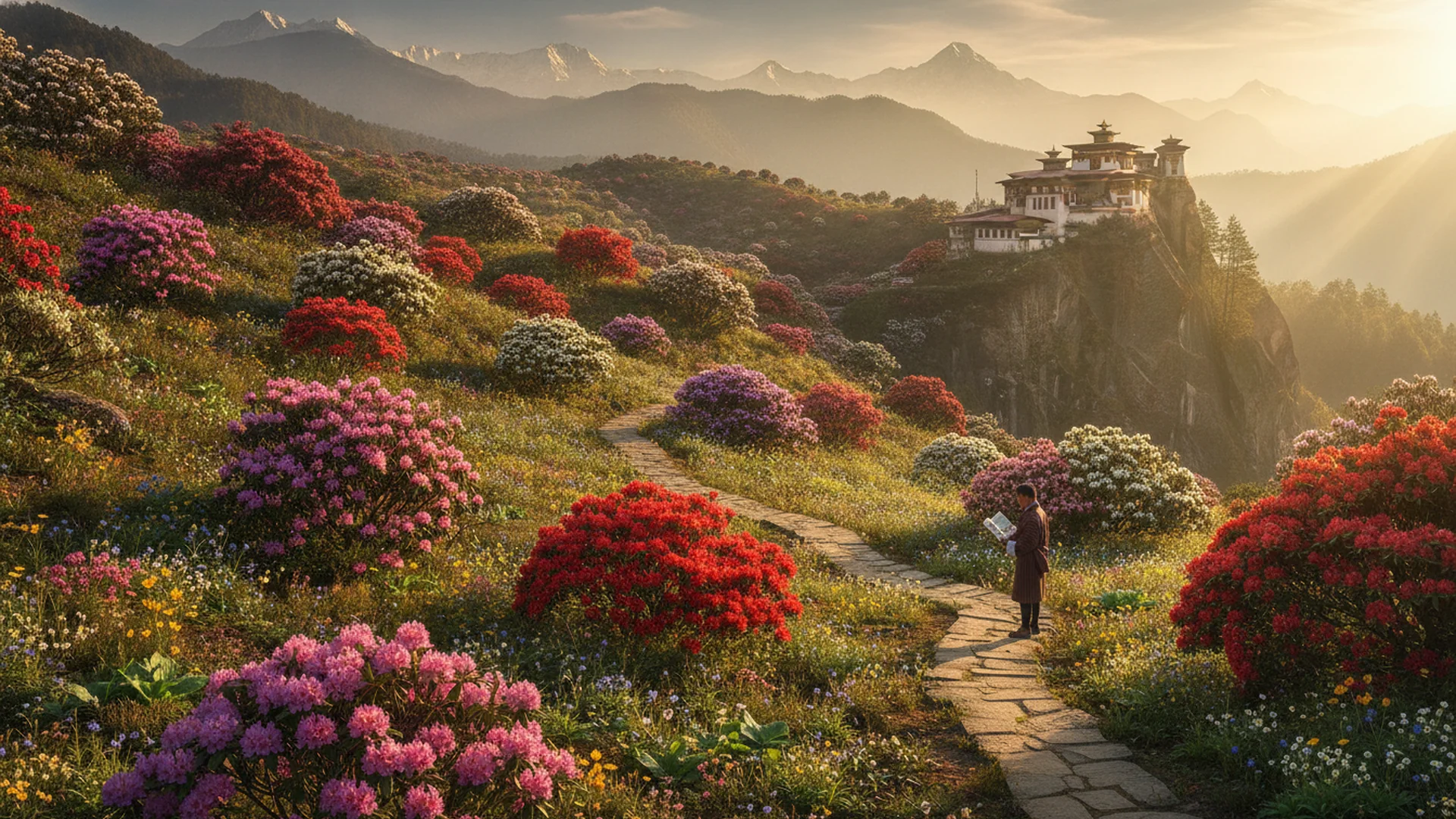
As the winter chill slowly surrenders, the steep mountain forests cradled by the Himalayas transform into an expansive canvas of natural pigments. From delicate blush pinks and deep ruby reds to pristine whites and violet-hues, Bhutan—a realm where time unfurls at a gentler pace and nature is revered above all—awakens its landscapes through the flowering of over 46 wild rhododendron species. These resilient blossoms breathe vibrant life into deep river gorges and towering alpine ridges.
This phenomenon transcends mere seasonal botany; it reads like a living poem woven directly into the nation’s founding philosophy of Gross National Happiness (GNH), where ancient, dense forests are fiercely safeguarded in their purest state. For discerning travelers and devoted naturalists seeking deep, soulful connection with the mountains, this botanical pilgrimage offers an unhurried doorway into sublime, sustainable beauty.
Botanical Heritage of the Himalayas: When Forests Dance in Living Color
The ecological marvel of Bhutan is rooted in its extraordinary topography, cascading seamlessly from warm broadleaf forests to towering alpine pine ecosystems. By constitutionally mandating that over sixty percent of the nation remain under forest cover, Bhutan maintains a pristine wilderness matched by few places on earth. Untamed rhododendrons thrive here, spreading ancient branches across sacred groves like meticulously curated woodland gardens crafted entirely by nature’s hand.
For international botanists, the crowning jewel of this landscape is Rhododendron kesangiae, a magnificent large-leafed species discovered and named in honor of Bhutan’s beloved Royal Grandmother. Its voluptuous blossoms—tinted in soft cream-pink—contrast magnificently against dark, glossy foliage. When these blooms awaken concurrently across entire hillsides against a backdrop of snow-capped Himalayan peaks, the resulting panorama commands quiet, breathless awe.
Premier Alpine Trails: Dochula Pass and the Royal Botanical Park
For travelers seeking seamless comfort paired with uncompromised wilderness immersion, Bhutan offers exceptionally curated and impeccably maintained nature sanctuaries. The journey begins at Dochula Pass, rising over 3,100 meters above sea level. Here, amidst the iconic silhouette of the 108 Druk Wangyal Chortens shrouded in ethereal mountain mists, the surrounding ridgelines erupt in wild rhododendron blooms greeting the dawn.
Just beyond lies the Royal Botanical Park at Lamperi, nestled within the Dochula sanctuary. Featuring sophisticated boardwalks designed to harmonize entirely with the delicate ecosystem, the park offers gentle to moderate walking trails well-suited for mindful travelers of all generations. Strolling through these vibrant corridors offers rare opportunities to spot the elusive Blue Poppy—the queen of Himalayan wildflowers—while botanizing alongside expert local naturalists.
The Rhododendron Festival: A Celebration of Community and Communion
Each April, as the rhododendron canopy reaches its absolute zenith, the Royal Botanical Park at Lamperi hosts the annual Rhododendron Festival. Rather than a commercialized tourism spectacle, this gathering is an intimate cultural dialogue where local highland communities assemble to honor the living forest.
Visitors are welcomed into a timeless atmosphere of communal reverence, marked by traditional folk dances, poetic mountain ballads, and the savoring of seasonal forest harvests and warm herbal infusions beneath a canopy of pink blossoms. The experience radiates quiet warmth, perfectly embodying the tangible spirit of Gross National Happiness in its most harmonious form.