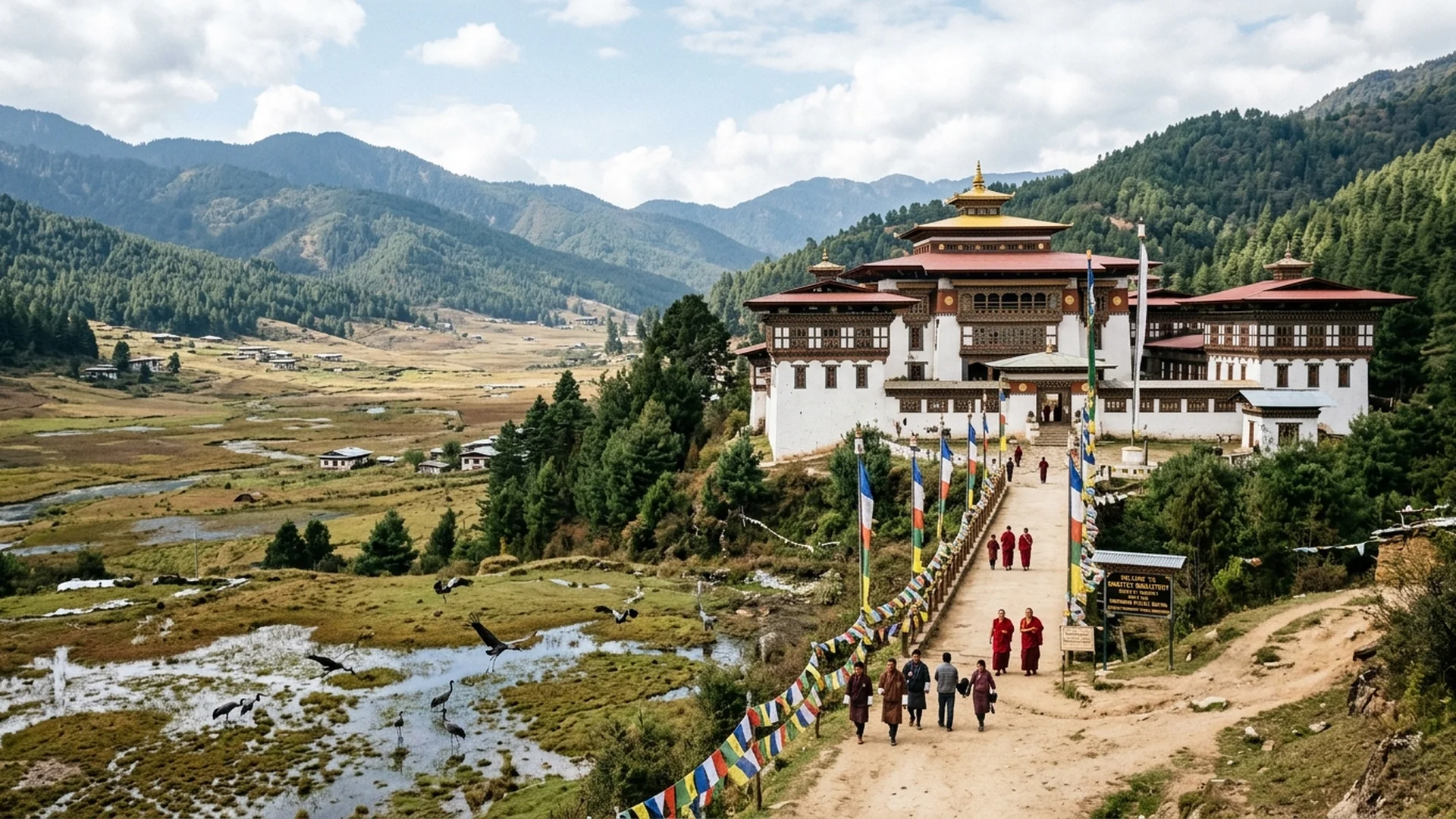
As morning mists gently unroll across the sweeping, bowl-shaped expanse of the Phobjikha Valley, the quiet rustle of wings heralds a timeless symphony of nature. Here, time seems to slow its relentless march, offering the weary traveler an invitation to quiet the mind and reconnect with profound stillness. Rising gracefully from a low ridge that embraces the glacial basin stands Gangtey Goemba, one of western Bhutan’s most sacred and historically profound Buddhist sanctuaries.
What elevates this monastery beyond a mere architectural marvel—where the boundary between the mundane and the celestial appears wonderfully porous—is the annual pilgrimage of the black-necked cranes. These endangered birds traverse the frigid Himalayan heights from the Tibetan Plateau each winter, descending into the valley below. In a display that has astonished generations of witnesses, these magnificent creatures circle the monastery three times upon arrival and three times before departure. They perform an innate, silent kora, as if circumambulating the sacred altars in an ancient rite of devotion where nature and Buddhist spirituality seamlessly entwine.
Seventeenth-Century Legacy and the Pema Lingpa Lineage
Perched with quiet majesty atop a forested spur commanding panoramic vistas of the Phobjikha Valley, Gangtey Monastery’s historical foundations reach deep into the prophecies of Terton Pema Lingpa, Bhutan’s legendary discoverer of spiritual treasures. The sanctuary was formally established in 1613 by Peling Gyaltsen, the grandson and spiritual heir of Pema Lingpa, and later expanded by his eldest son, who assumed the mantle of the first Gangtey Tulku—an unbroken lineage of reincarnate masters dedicated to preserving the Nyingma tradition.
The monastery’s architecture is a testament to traditional royal craftsmanship, harmonizing rugged stone masonry with the warm, delicate grain of indigenous blue pine. Following a comprehensive restoration at the turn of the 21st century that mobilized master artisans and painters from across the kingdom, the sanctuary regained its pristine spiritual radiance. The central assembly hall, or Tsugkhang, is anchored by eight towering timber pillars that gracefully support the ancient clerestory roof—a masterclass in traditional joinery rarely rivaled today. The interior walls glow with natural mineral pigments, depicting fierce protective deities and intricate mandalas of profound cosmic wisdom.
The Mystic Allure of Phobjikha Valley and the Black-Necked Cranes
The Phobjikha Valley is a picture-book U-shaped glacial valley resting at an elevation of approximately 3,000 meters above sea level. What renders this landscape internationally significant is its role as the primary winter sanctuary for the black-necked crane (Grus nigricollis). Escaping the severe, biting winters of the high Tibetan plateau, these elegant birds forage across the wide, dwarf-bamboo-carpeted wetlands from November until March.
The human inhabitants of Phobjikha share a profound spiritual and cultural symbiosis with the cranes, affectionately regarding them not merely as wildlife, but as celestial guests and heralds of prosperity. Local conservation ethics are remarkably stringent; notably, there are no overhead power lines crossing the valley floor, ensuring the birds’ flight paths remain entirely unobstructed. Every footstep here must be taken with mindful reverence for the prevailing silence, allowing the pristine ecosystem to cradle all forms of life in undisturbed harmony.
The Aesthetics of High-End Slow Travel
A pilgrimage to Gangtey Monastery and the Phobjikha Valley elevates the Bhutanese travel experience into an entirely new dimension. It offers a graceful escape from the frantic pace of modern life, inviting travelers to indulge in quiet sophistication. Leisurely nature trails meander through whispering pine forests and traditional farming hamlets, offering intimate glimpses into a pastoral way of life where ancient agricultural rhythms and hand-weaving traditions remain vibrantly intact.
For discerning travelers seeking sustainable eco-luxury, the region offers exceptional retreats such as Gangtey Lodge. Designed to blend seamlessly into the dramatic topography, expansive glass windows frame sweeping vistas of the valley floor and grazing yaks. Sitting beside a crackling bukhari stove with a warm cup of local herbal tea while mist rolls across the grasslands represents a rare, understated luxury found nowhere else on earth.