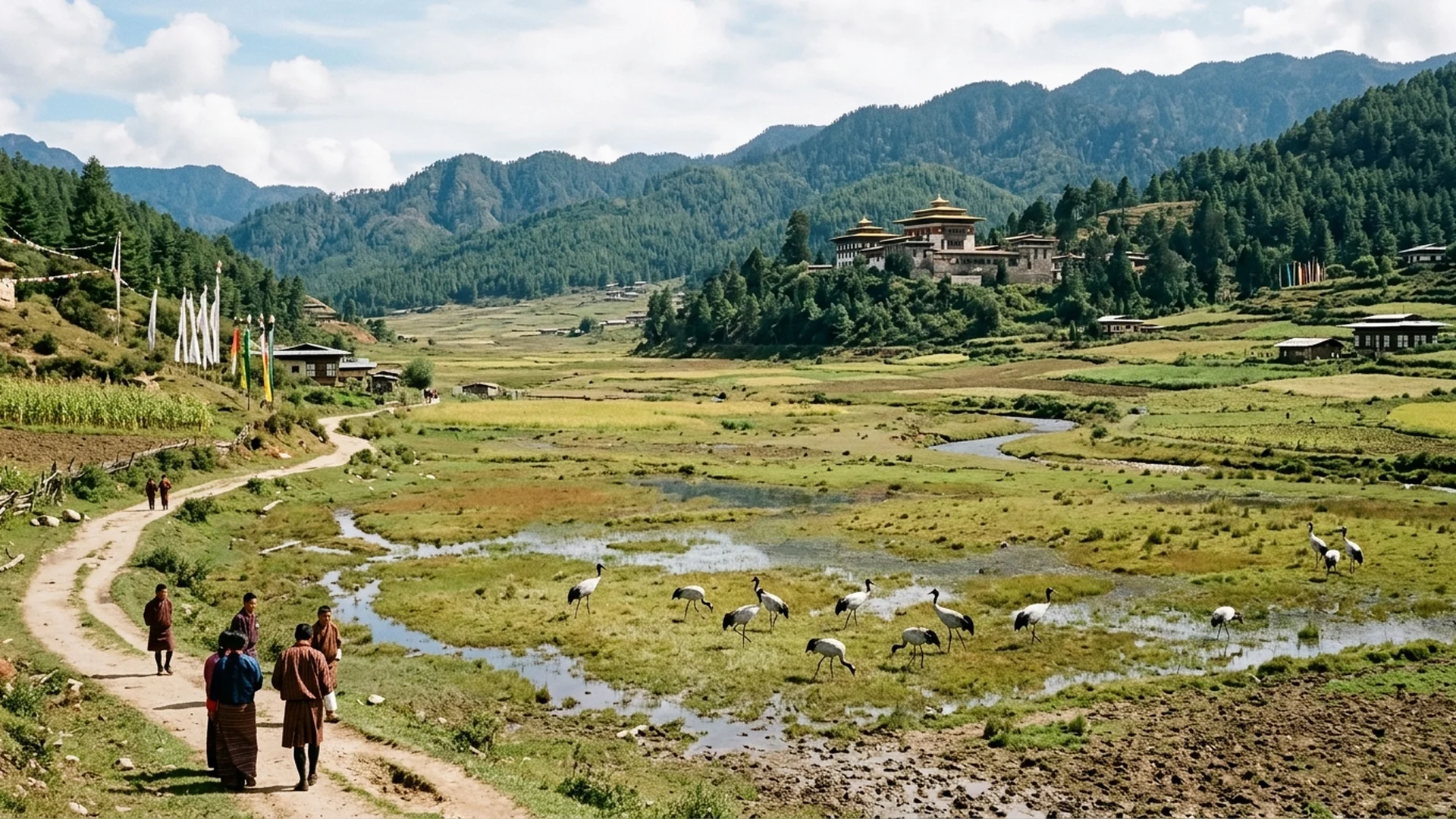
As the morning mist gradually lifts across the sprawling meadows embraced by undulating mountain ranges, what strikes the discerning eye is not architectural grandeur, but a powerful, profound emptiness—the complete absence of unsightly utility poles and tangled electrical wires marring the horizon. Every square inch of the Phobjikha Valley exists in a state of supreme reverence for the natural world. The decision to bury the entire valley’s electrical grid underground stands as a clear testament to Bhutan’s unwavering commitment to preserving not only scenic splendor, but also the fragile lives of the black-necked cranes that make their seasonal pilgrimage from the Tibetan plateau.
Nestled at an altitude exceeding 3,000 meters above sea level, Phobjikha is a U-shaped glacial valley quietly tucked away within the Wangdue Phodrang district. Here, time appears to slow down entirely, inviting the human spirit to reconnect with the very breath of nature amidst pristine mountain air, the rustle of rare wings, and traditional ways of life that remain virtually untouched by the passage of modern eras.
Glacial Sculptures and Green Vows: A Pole-Free Haven for Sacred Cranes
Geographically, Phobjikha was forged by ancient glacial carving, leaving behind a broad, sweeping valley floor free of dense forests, characterized instead by marshy wetlands and eco-friendly agrarian plots. What distinguishes this valley from all others is its uncompromising conservation mandate. The government and local communities are united in rejecting infrastructure that compromises the landscape, most notably through the visionary burial of all transmission lines beneath the earth to prevent the majestic black-necked cranes from colliding with cables during low-altitude flights through dense fog. Biologists recognize black-necked cranes as an endangered species, but the Bhutanese regard them as heavenly birds. Upon their arrival in late October, the cranes traditionally circle the sacred Gangtey Monastery three times before landing, and repeat the ritual upon their departure for Tibet the following March—a poignant demonstration of avian reverence for a hallowed realm.
The Spirit of Gangtey: Ancient Monasteries and Poetic Trails
Perched on a low spur overlooking the sweeping panorama of the valley sits the illustrious Gangtey Monastery, or Gangtey Goempa, a vital spiritual epicenter founded in the 17th century by Pema Thinley, the grandson of the second Guru Rinpoche, Padma Sambhava. Its traditional Tibetan architecture, adorned with intricate wood carvings, radiates profound devotion. Encircling the sanctuary is Gangtey village, where homesteads are fashioned from rammed earth and timber in time-honored architectural traditions. For those drawn to contemplative exploration, the 4-kilometer Gangtey Nature Trail winds gracefully through fragrant pine forests, open meadows, and rustic hamlets, delivering a sublime stillness unobtainable in the contemporary world. The whispering pines and the crisp scent of damp earth embody the absolute zenith of travel aesthetics.
The Aesthetics of Slow Living: Eco-Luxury and Traditional Wellness
Visiting Phobjikha today effortlessly marries natural simplicity with high-end, mindful comfort. Boutique lodges and luxury retreats within the valley are meticulously integrated into the surrounding topography, utilizing natural materials and expansive glass frames that allow guests to fully immerse themselves in misty dawn vistas and starlit night skies. Following an invigorating trek through the crisp mountain air, indulging in a traditional Bhutanese Dotsho—a hot stone bath—offers the ultimate restorative ritual. River stones, heated intensely over a wood fire, are dropped into wooden tubs infused with aromatic mountain herbs, easing muscular tension while guests sip local herbal tea amidst the profound silence of the Himalayas.