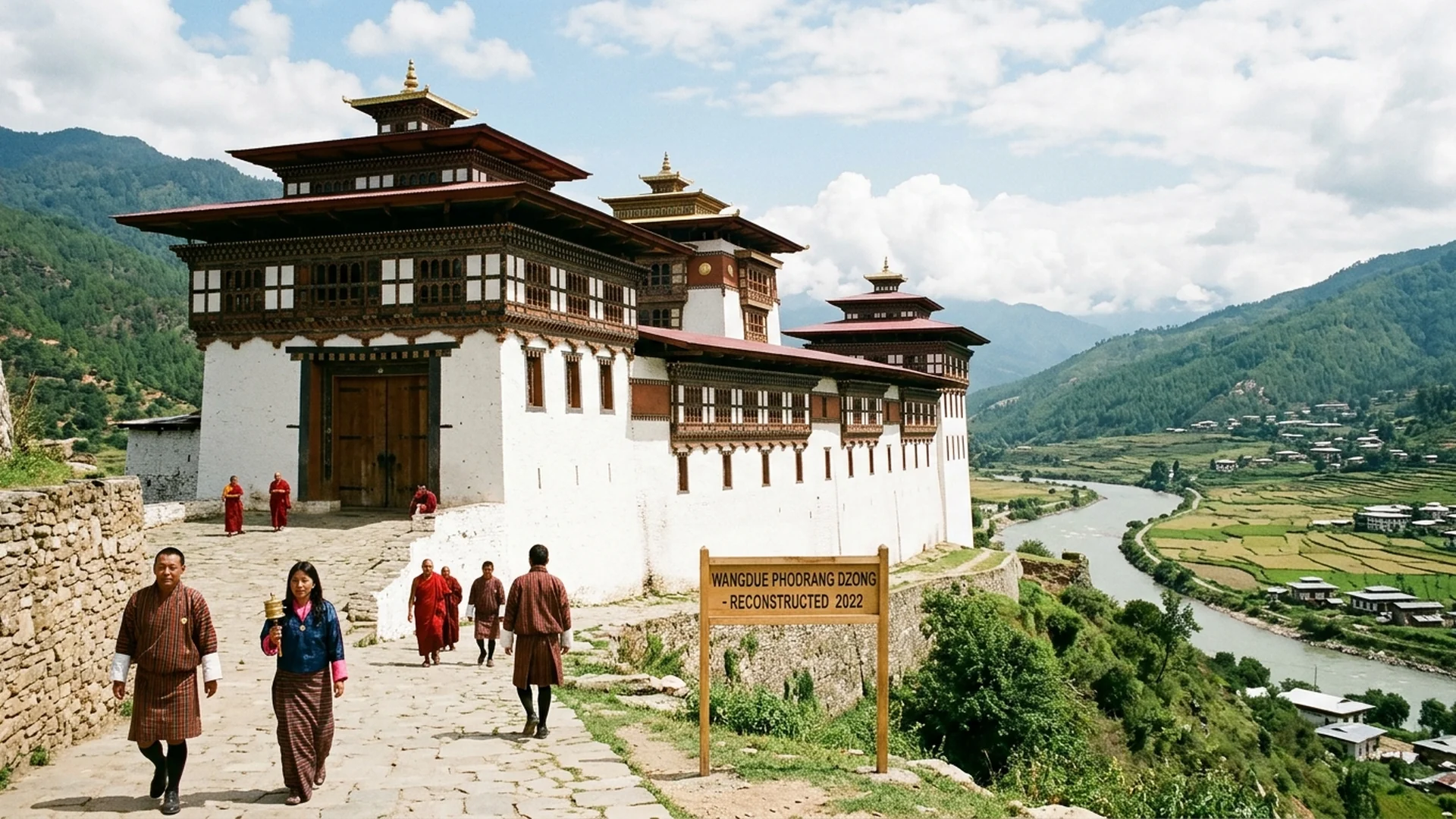
As the morning mists gently lift above the sacred confluence of the Puna Tsang Chu and Dang Chu rivers, the striking silhouette of a ridge shaped like a sleeping elephant materializes against the Himalayan sky. Upon this hallowed vantage point, Wangdue Phodrang Dzong stands resolute against the passage of time, resembling a great falcon extending its wings to protect the valleys below. Though history records the profound scar of a devastating fire that reduced its ancient timber structures to ash in 2012, this architectural masterpiece has risen anew with majestic grace. It is a triumphant testament to resilience, seamlessly weaving ancient artisan wisdom with modern structural engineering.
To visit Wangdue Phodrang today is to bear living witness to a decade-long miracle of faith. Every footstep along its fortified stone ramparts and vibrant carved wooden verandas echoes the unwavering dedication of the Bhutanese people to safeguard their spiritual heritage for generations to come.
Strategic Genesis: The Sleeping Elephant Ridge and the Shabdrung’s Vision
In 1638, Shabdrung Ngawang Namgyal, the visionary unifier of Bhutan, recognized the supreme tactical advantage of the central valleys. He selected a long, curving ridge resembling a crouching elephant—giving rise to the name Wangdue Phodrang—to construct this imposing fortress. It was designed to serve simultaneously as a military bulwark against external incursions and as an administrative anchor for the surrounding regions. Choosing the confluence of two rivers not only secured military dominance but also harmonized flawlessly with traditional geomancy and elemental balance rooted in Vajrayana Buddhist cosmology.
From Embers to Miraculous Rebirth: A Decade of Restoring an Ancient Dzong
A tragic night in June 2012 cast a heavy shadow over the entire kingdom when a fierce blaze consumed the ancient timber framework of Wangdue Phodrang Dzong. Fortunately, principal statues and sacred relics were rescued in time. A monumental restoration effort was immediately championed under royal guidance, mobilizing traditional master craftsmen from the Zorig Chusum alongside modern fire-safety and structural engineers. Completed in 2022, the painstaking reconstruction restored the dzong’s former glory, returning a vital pillar of identity to the valley.
Sacred Architecture and the Fourteen Inner Lhakhangs
Crossing the grand threshold reveals the breathtaking purity of traditional Bhutanese dzong architecture, constructed entirely without the use of a single iron nail. Pine timbers interlock with consummate precision, while stark white masonry walls contrast sharply against crimson-and-gold carved window frames and balconies. Within the sacred interior, fourteen distinct Lhakhangs (temples) house profound statues and narrative murals depicting Buddhist sutras and Jataka tales. Local master painters utilized natural mineral pigments, imparting a luminous, devotional glow throughout the quiet sanctuaries.