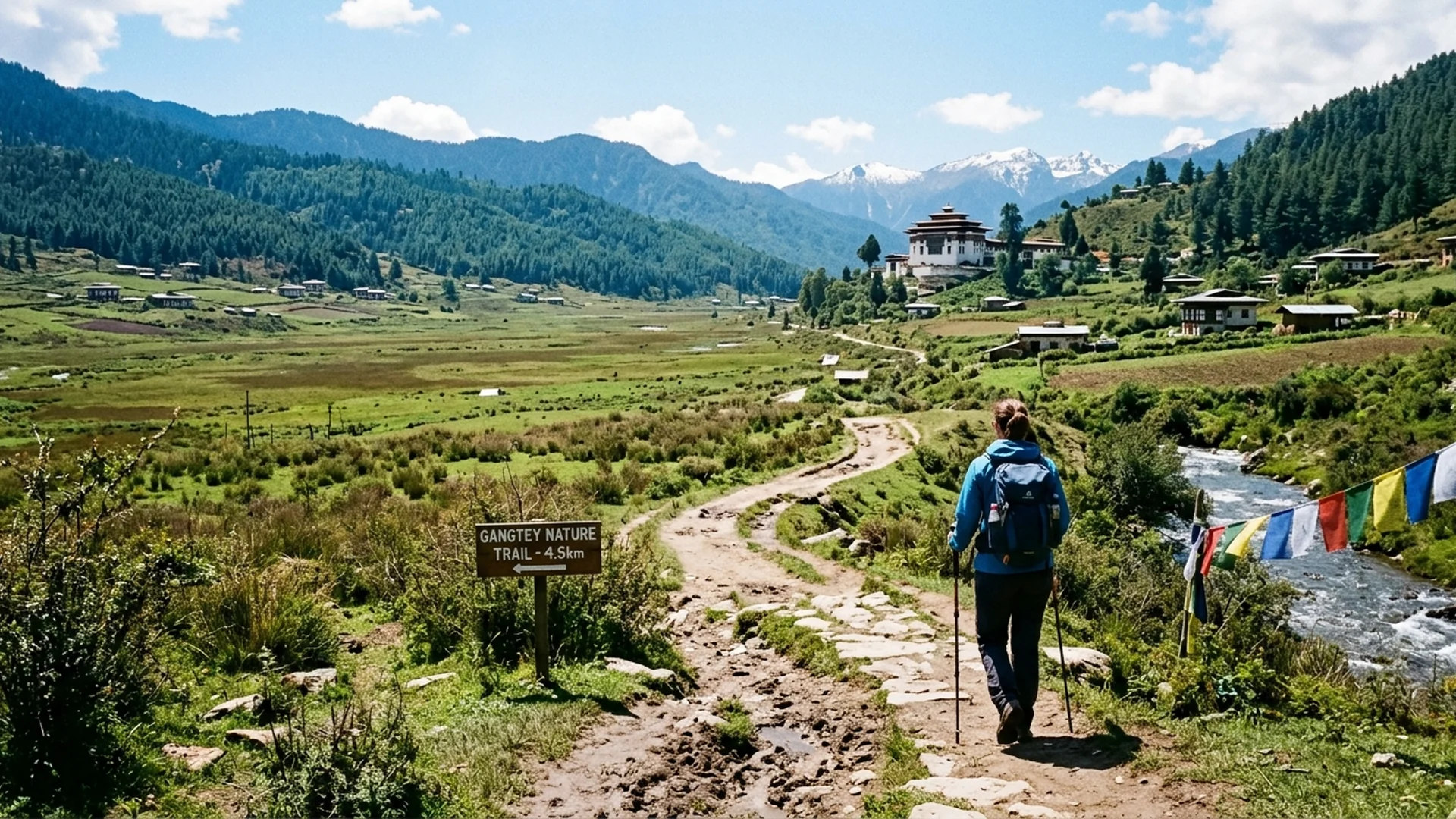
In a world that spins faster than the heart can comfortably follow, the Phobjikha Valley in the Kingdom of Bhutan preserves a dreamlike rhythm of absolute stillness. The Gangtey Nature Trail stands as one of the most sublime and gentle walking paths in the country, where crisp mountain breezes whisper through blue pine forests, accompanied by the distant, resonant chanting from the ancient sanctuary monastery of Gangtey Goempa perched upon the ridge.
This brief four-kilometer journey transcends mere outdoor exercise, offering instead an immersive ritual of nature wellness. As you slowly descend the ridge, passing through ancient pine groves, dwarf bamboo thickets, and expansive meadows blanketed in morning mist, you step into a landscape where traditional village life harmonizes effortlessly with pristine wilderness, entirely untouched by the discord of modern civilization.
From the Ridge of Faith to Ancient Pine Forests: The Genesis of the Trail
The Gangtey Nature Trail commences beside the carved mani walls flanking Gangtey Goempa, a 17th-century Nyingma monastery of profound spiritual significance. From this elevated vantage point, expansive vistas of the sprawling Phobjikha Valley unfold below. The path gently descends, guiding you through aromatic blue pine forests where resin scents fill the crisp air and soft wisps of mist cling to the upper branches, weaving an atmosphere of timeless enchantment.
Over the course of this 1.5 to 2-hour walk, your breath naturally synchronizes with the quietude of the surroundings. The shaded pine canopy gradually gives way to thickets of dwarf bamboo (Yushania microphylla), an essential forage plant for local wildlife and a clear indication that you are entering the heart of an ancient glacial valley—one of the most meticulously preserved sanctuaries in the Himalayas.
The Allure of Phobjikha Valley and the Sacred Pact of the Cranes
As the trail emerges from the forest cover, the landscape opens wide into the vast grasslands and semi-wetlands of the Phobjikha Valley. Herds of domestic yaks graze peacefully while traditional Bhutanese homesteads dot the distant horizon, painting a picture of pastoral serenity. Yet, the supreme wonder of this valley reveals itself in the winter months—from late October through February—when the revered black-necked cranes migrate across the Himalayas to winter in these protected wetlands.
Bhutanese tradition holds these graceful birds as sacred emissaries bringing blessings and prosperity to the valley. Local folklore recounts that upon arrival and departure, the flocks invariably circle Gangtey Goempa three times in silent homage. This deep ecological kinship inspires extraordinary conservation measures: the local community willingly foregoes overhead power lines, burying all electrical infrastructure underground to ensure the unobstructed flight and safety of the cranes.
Bridging Spiritual Serenity with Premium Slow Travel
The conclusion of the Gangtey Nature Trail brings travelers near Khewa Lhakhang, a modest yet ancient temple resting amidst the meadows. Pausing here to sip steaming butter tea (suja) or hot water infused with local honey while watching the late afternoon light wash over the valley epitomizes Gross National Happiness made tangible.
For the discerning global traveler, Phobjikha is home to premier eco-luxury sanctuaries—including Gangtey Lodge, Six Senses Gangtey, and Amankora Gangtey—thoughtfully designed to merge seamlessly with the terrain. Following your trek, indulge in a traditional Bhutanese stone-bath (dotsho) infused with mountain herbs, looking out over the vast expanse to complete a journey that profoundly rejuvenates both body and spirit.