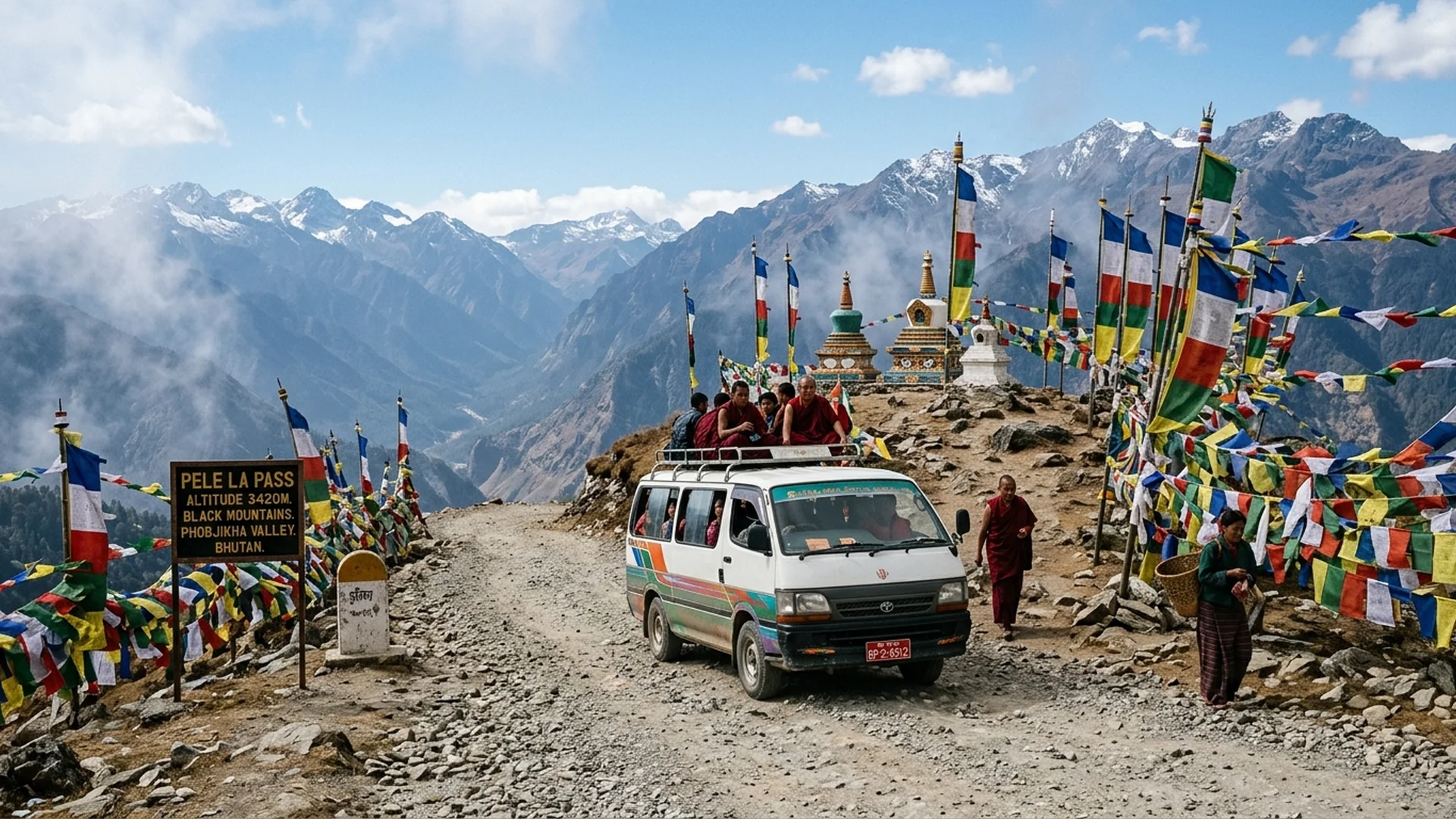
Along the arterial highway winding through the corrugated folds of the Bhutanese Himalaya, travelers often dismiss mountain passes—known locally as ‘la’—as mere transitional corridors between valleys. Yet Pele La Pass, soaring at 3,420 meters above sea level, is far more than a cartographic waypoint. It is a breathtaking demarcation line that demarcates the cultural and geographical frontier between familiar western Bhutan and the deeply mystical central highlands, where time itself moves with unhurried grace.
The moment vehicle tires pierce the dense, rolling mountain mists to emerge upon the crest, a rare and profound quietude envelops the senses. Before you lies the majestic expanse of the Black Mountain Range, an ancient ecological rampart safeguarding centuries of biodiversity and spiritual heritage. Here, high Himalayan winds carry whispered prayers across undulating fields of multihued prayer flags, inviting the mindful traveler to pause, leave haste behind, and immerse in raw, unvarnished wilderness.
A Topography of the Spirit: The Black Mountain Divide
Geographically and anthropologically, Pele La is far more than the highest summit along the strategic geopolitical highway linking Wangdue Phodrang and Trongsa. It is the watershed spine and natural rampart of the Black Mountain Range, cleanly dividing the distinct cultural idioms, dialects, and lifestyles of Bhutan’s diverse regions. The western flank of the mountain is forged by deeply rooted traditional civilization, whereas the eastern and central approaches welcome the wanderer into sanctuaries of Tantric Buddhism and archaic valleys untouched by modernity. Crossing Pele La thus feels akin to traversing temporal dimensions through moss-draped cloud forests that gradually transition from broadleaf woodland to alpine scrub and cold-tolerant high-altitude flora.
Sacred Stupas and Prayer Flags: Sentinels in the High Winds
At the windswept zenith of the pass, travelers are greeted by the Pele La Chorten, a traditional Bhutanese reliquary stupa standing resolutely amidst drifting fog. Hundreds of prayer flags flutter vigorously in the currents, snapping against the crisp mountain air. In traditional Bhutanese cosmology, these vibrant banners act as tireless conduits of benevolent prayer; with every gust of wind, sacred syllables are dispersed to grant safe passage and invite peace upon all sentient beings. When the atmospheric veil parts to reveal pristine blue skies, distant glaciated peaks like Jomolhari and Jichu Drake trace razor-sharp silhouettes against the horizon.
Nomadic Rhythms and Park Ecosystems
The enduring allure of Pele La is magnified by its singular ecology, marking the western boundary of Jigme Singye Wangchuck National Park, one of the nation’s most expansive conservation sanctuaries. Surrounding forests teem with elusive wildlife and pristine botanical specimens. High-altitude meadows occasionally play host to semi-nomadic yak herders tending their thick-fenced herds, alongside local artisans offering hand-woven textiles and spun wool products with gentle, welcoming smiles—embodying the harmonious symbiosis between humanity and extreme altitude wilderness.