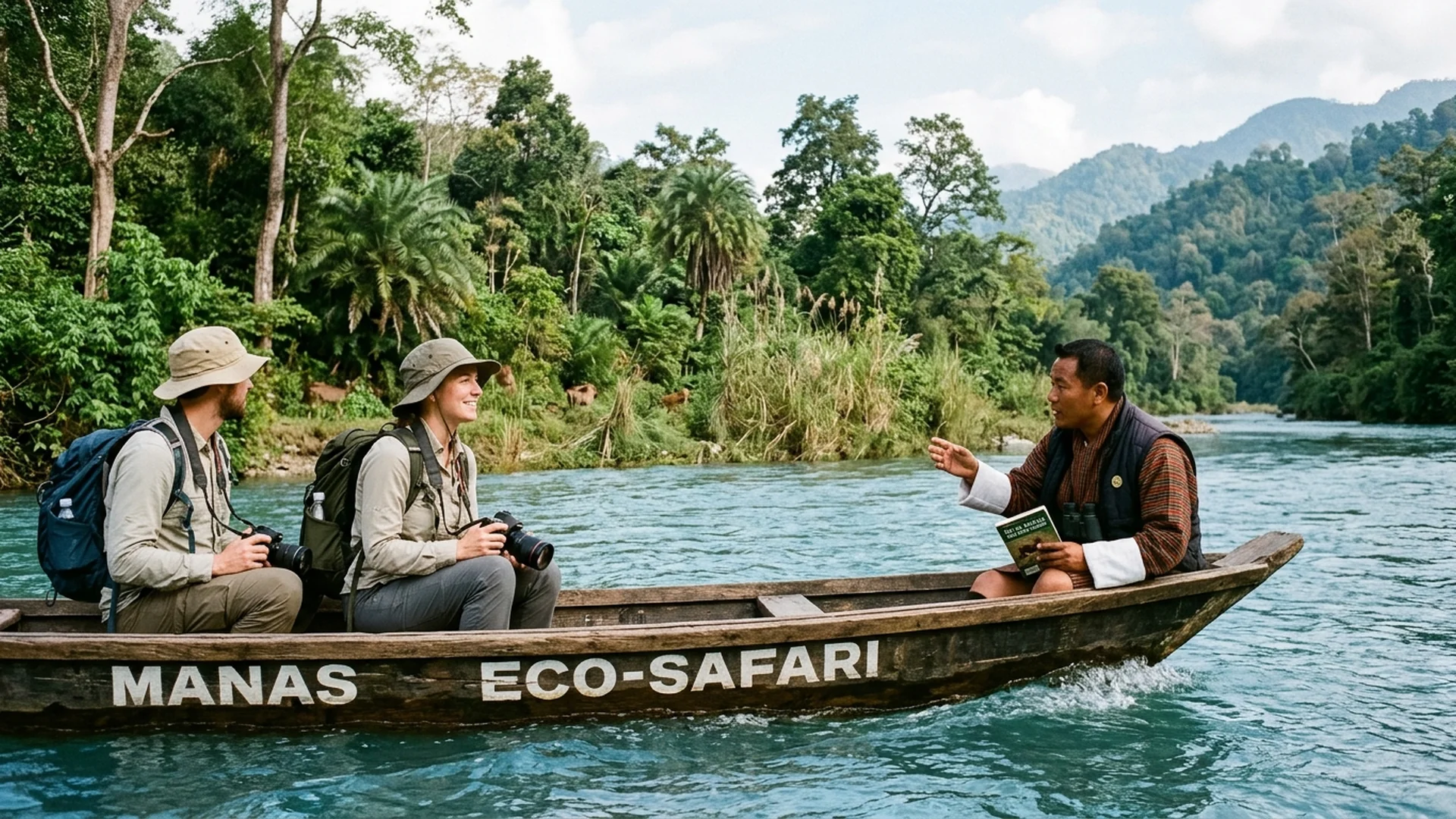
When conjuring the Kingdom of Bhutan, the mind instinctively drifts to snow-clad Himalayan pinnacles, precipitous cliffside monasteries, and the resonant cadence of temple bells drifting through alpine mist. Yet, far to the south, where the precipitous mountains gently yield to fertile lowlands, a hidden wild frontier unfurls in emerald hues and ancient subtropical rhythms. The Royal Manas National Park buffer zone reveals an entirely unexpected facet of Bhutan—a vibrant, untamed ecosystem widely revered as the Serengeti of the Himalayas, where biological diversity pulses with fierce vitality.
As the nation’s oldest protected reserve, Royal Manas serves as a vital ecological cornerstone connecting expansive South Asian conservation corridors. Cascading from misty ridges down to fertile river valleys, this sanctuary provides a refuge for numerous globally endangered species. To traverse these southern lowlands is to transcend ordinary adventure, embarking instead on a profound pilgrimage into the delicate equilibrium between humanity and pristine wilderness, guarded under one of the world’s most rigorous conservation philosophies.
A Himalayan Genetic Reservoir: Bhutan’s Oldest Natural Heritage
Royal Manas National Park is far more than an expansive expanse of dense timber; it is the vital ecological foundation of a continuous, pristine corridor linking directly with Manas National Park in India—a designated UNESCO World Heritage Site. The extraordinary brilliance of Royal Manas lies in its dramatic altitudinal gradient, which compresses diverse ecosystems into a relatively compact area, ranging from lush tropical rainforests and moist deciduous zones to sprawling lowland grasslands.
This ecological abundance operates as a vital genetic reservoir for the entire South Asian region. The majestic Manas River, the largest tributary of the mighty Brahmaputra, carves directly through the heart of the sanctuary, sustaining countless life forms and sculpting breathtaking vistas. Moss-draped cliffs, crystalline morning mists suspended above ancient canopies, and rich, fertile soils unite to form an unblemished habitat for thousands of indigenous species.
Kingdom of the Wild: Tracking Bengal Tigers and Amber Golden Langurs
For wildlife enthusiasts and natural history photographers, Royal Manas is the realization of a lifelong reverie. This protected realm remains one of the rare places on Earth where the elusive Bengal tiger and the Asian elephant roam freely across ancient, instinctual migratory paths. Furthermore, the canopy and forest floor are home to dense populations of the golden langur—an arboreal primate distinguished by its radiant, amber-gold coat, found exclusively in this delicate trans-border zone between Bhutan and India.
The auditory tapestry of the park is equally mesmerizing. The upper branches resound with the powerful wingbeats and resonant calls of multiple hornbill species, including the great hornbill and the wreathed hornbill, alongside upwards of four hundred documented avian varieties. Hearing the resonant chorus of the morning forest awaken creates an immersive sensory memory that lingers long after departure.
Slow Travel in the Wild: River Expeditions and Khengpa Heritage
To engage with Royal Manas on a deeper level is to embrace a philosophy of travel rooted entirely in acoustic and environmental harmony. Floating silently down the crystalline waters of the Manas River aboard traditional bamboo rafts or soft-inflated watercraft permits intimate observation of waterbirds, freshwater gharials, and playful river otters navigating their natural domain entirely undisturbed by engine noise.
Culturally, the outlying settlements and buffer communities are home to the Khengpa people, an indigenous ethnic group whose ancestral lineage is inextricably bound to the forest. Engaging with village elders offers invaluable insights into sustainable coexistence with nature—a living embodiment of Bhutan’s foundational philosophy of Gross National Happiness.