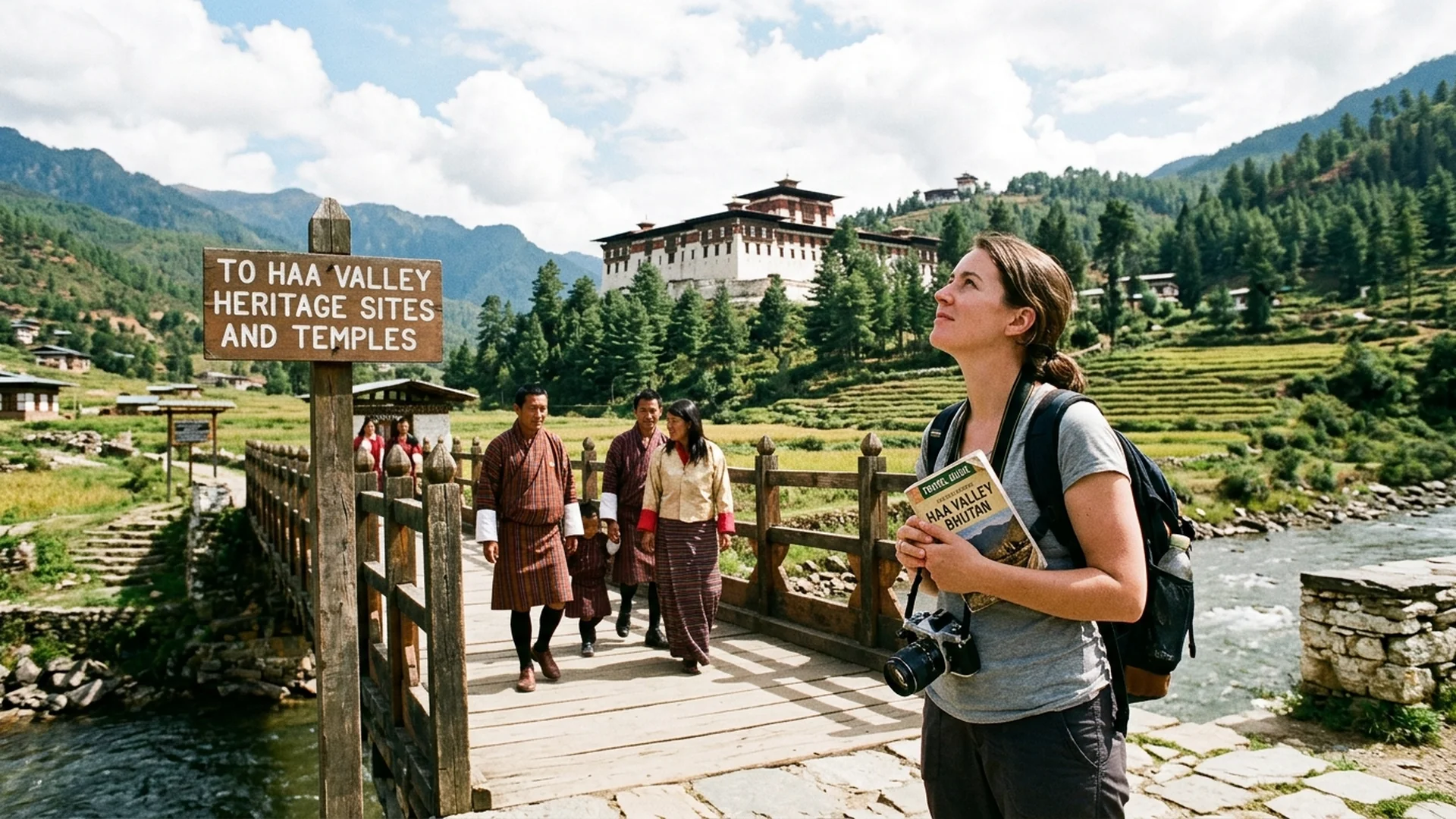
Ascending through the atmospheric veil of Chele La Pass—where colorful prayer flags snap against the thin Himalayan wind at nearly 4,000 meters—feels less like an alpine drive and more like a passage through time. As the mountain road winds down into the quiet basin below, the serene expanse of Haa Valley unfolds in dramatic isolation. Shielded by towering ridges and dense blue pine forests, this southwestern enclave remains one of Bhutan’s most pristine frontiers, largely undisturbed by the frantic pace of modern life. For the discerning traveler seeking profound stillness, Haa offers an understated luxury: the priceless luxury of space, silence, and untouched wilderness. Here, among timbered farmhouses and centuries-old sanctuaries, ancient folklore and agrarian traditions endure as living culture.
1. The High Himalayan Threshold: Chele La Pass
The journey into Haa begins with a thrilling ascent to Chele La Pass, which crowns the ridge at almost 4,000 meters above sea level as Bhutan’s highest motorable pass. Fluttering prayer flags in blue, white, red, green, and yellow catch the bitter alpine winds, scattering blessings across the valley floors. On clear mornings, the serrated, snow-capped peaks of Mount Jomolhari and Jichu Drakey pierce the azure horizon in brilliant contrast. Pausing at this lofty threshold is more than a scenic respite; it is a transformative pause—cleansing the senses and preparing the spirit for the contemplative calm that awaits in the valley below.
2. The Sacred Twin Temples: Lhakhang Karpo and Lhakhang Nagpo
Nestled at the base of the sacred Meri Puensum—three majestic ridges symbolizing the Bodhisattvas of Wisdom, Compassion, and Power—lie Haa’s spiritual epicenters: Lhakhang Karpo (the White Temple) and Lhakhang Nagpo (the Black Temple). Local lore traces their founding to the 7th century when Songtsen Gampo, the Tibetan Emperor, released two mystically guided pigeons—one white, one black—to mark divine ground for monastic construction. The white pigeon alighted upon the gentle slopes where Lhakhang Karpo stands today. Within its whitewashed stone walls lie priceless ancient murals and intricate gilded statues, echoing centuries of devotion and meticulously preserved Dzongkha craftsmanship.
3. Timeless Villages and the Shadow of Guardian Deities
Beyond its monastic architecture, Haa retains an authentic agrarian tempo rare in the contemporary world. Terraced plots of buckwheat, barley, and root crops frame traditional wooden homesteads adorned with elaborate hand-carved eaves. Life here is deeply interwoven with local animist heritage and veneration for Ap Chundu, the fierce protective deity of the Haa Valley. Annual festivals and solemn rituals honor his watchfulness over the valley’s livestock and harvests. Furthermore, Haa is acclaimed for producing some of Bhutan’s finest woven textiles, created on traditional backstrap looms by master artisans whose techniques have been passed down through generations.