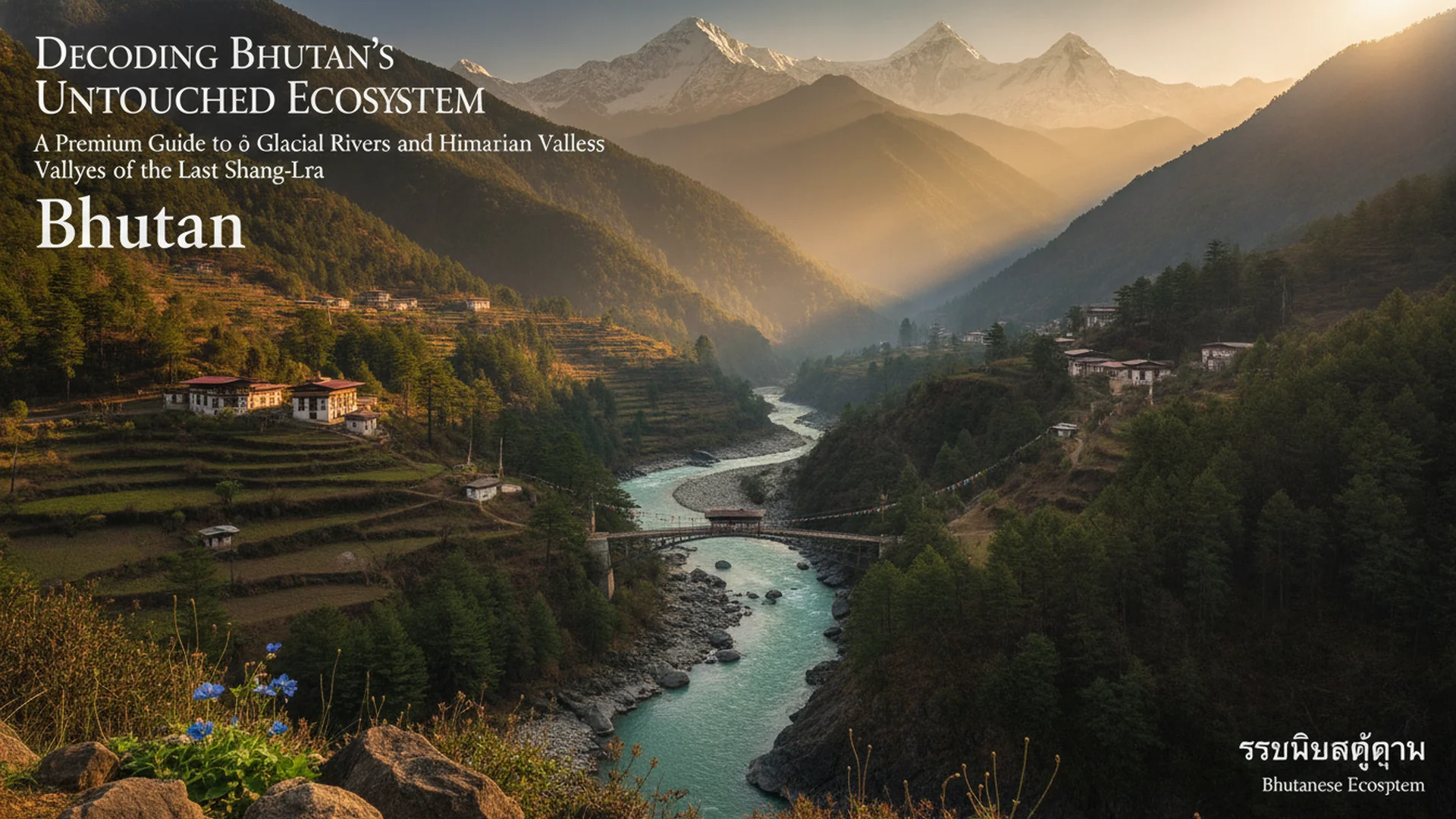
As the crisp Himalayan wind sweeps across snow-crowned peaks, the ancient whisper of primeval forests and the gentle roar of glacial rivers tell the story of a realm where time itself moves at a deliberate, unhurried pace. This is Bhutan, the Kingdom of Gross National Happiness (GNH)—not merely a coveted destination for the discerning traveler, but a living ecological laboratory proving that economic vitality and environmental preservation can exist in exquisite balance. Enveloped by pristine mountain air and dense woodlands covering more than seventy percent of the terrain, nature here is never a mere backdrop. It is the beating heart that sustains the spirit and breath of every living being in these sacred valleys.
Journeying into this carbon-negative sanctuary is an invitation to step beyond the frenetic pace of the modern world and enter a realm of genuine sustainable luxury. Bhutan’s astonishing natural beauty is not curated for transient tourism; rather, it is the resolute commitment of both state and citizenry to protect an exceptionally fragile ecosystem in its purest form. From high-altitude glaciers melting into crystalline rivers to lush temperate forests sheltering rare wildlife, every square inch of Bhutan reflects a philosophy of supreme reverence for the earth, offering profound intellectual awakening to those seeking deeper meaning far beyond conventional leisure.
The Emerald Rampart and Himalayan Breath: The Architecture of a Carbon-Negative Realm
The wonder of Bhutan’s ecosystem begins with the complex topography of the Himalayas, which act simultaneously as a natural fortress and a pristine watershed. The kingdom’s vast forests boast extraordinary biodiversity, sweeping from arctic alpine heights down to subtropical lowlands. These forests function as colossal ecological sponges, sequestering carbon dioxide at levels far exceeding the nation’s total output, creating an environmental equilibrium found almost nowhere else in the modern world.
This triumph is no accident of geography; it is rooted deeply in Buddhist philosophy, which teaches humanity to recognize the interconnected web of all living things. Every tree, river, and animal possesses an inherent right to exist. Consequently, environmental conservation in Bhutan is not merely a top-down regulatory decree, but an internalized daily ethos woven into the fabric of community life. Through intentional visitor caps and rigorous industrial controls, the kingdom ensures that natural legacies remain untouched by chaotic, unbridled development.
The Dual Rivers and the Warm Embrace of Punakha Valley: The Arteries of the Himalayas
Deep within the sheltered warmth of the interior lies the Punakha Valley, appearing much like a vision from a classical master’s canvas. Serving as the nation’s historic winter capital, this fertile basin is defined by the dramatic confluence of two vital waterways: the Pochu (Father River), plunging swiftly and powerfully from glacial heights, and the Mochu (Mother River), meandering gently through the valley floor. Where these currents converge directly beneath the majestic Punakha Dzong—the monumental fortified monastery-fortress—they create not only a breathtaking visual tableau, but also the vital lifeblood supporting local agriculture and riparian woodlands.
Following the winding banks of the Punakha river reveals water so crystalline it mirrors the infinite blue of the sky and the sharp contours of the surrounding peaks. This riverside habitat supports myriad aquatic birds and rare riparian flora, enveloping travelers in a profound stillness that slows the urban pulse. Here, every sense is invited to absorb the whisper of the water and the crisp mountain air carrying the cool breath of distant glaciers.
Phobjikha Valley and the Sanctuary of the Black-Necked Cranes: The Ethos of Coexistence
Another ecological crown jewel is the Phobjikha Valley, a sweeping, glacial bowl resting at high elevation, completely unmarred by utility poles or overhead power lines. Local residents famously collaborated to place all electrical grids underground to safeguard the endangered black-necked cranes that migrate south from the Tibetan Plateau every autumn. To the local communities, these elegant birds are cherished heralds of peace and auspicious fortune.
When the flocks descend into the valley’s marshlands, their resonant calls echo across the basin, signaling the faithful turning of the seasonal wheel. The valley’s residents share their ancestral home with these rare visitors through deep understanding and gentle stewardship, offering a masterclass in how human civilization and wildlife can seamlessly share space without mutual encroachment.
Premium Ecological Immersion: Harmonious Living in Himalayan Sanctuaries
Engaging with Bhutan’s natural world on a deeper level often involves retreating to luxury eco-lodges whose architecture merges seamlessly with the sweeping topography. Built using regional materials, clean energy systems, and advanced waste management protocols, these sanctuaries allow travelers to absorb panoramic views of jagged Himalayan peaks through expansive glass without compromising the surrounding wilderness.
Complementing this is the quintessential wellness ritual of the traditional Hot Stone Bath (Dotsho). Utilizing pure mountain stream water infused with medicinal wild herbs, the bath is heated by river rocks roasted over open flames according to ancient ancestral wisdom. This therapeutic immersion melts away physical tension and clears the mind amidst crisp evening air, perfectly uniting the four foundational elements of nature within the human body.