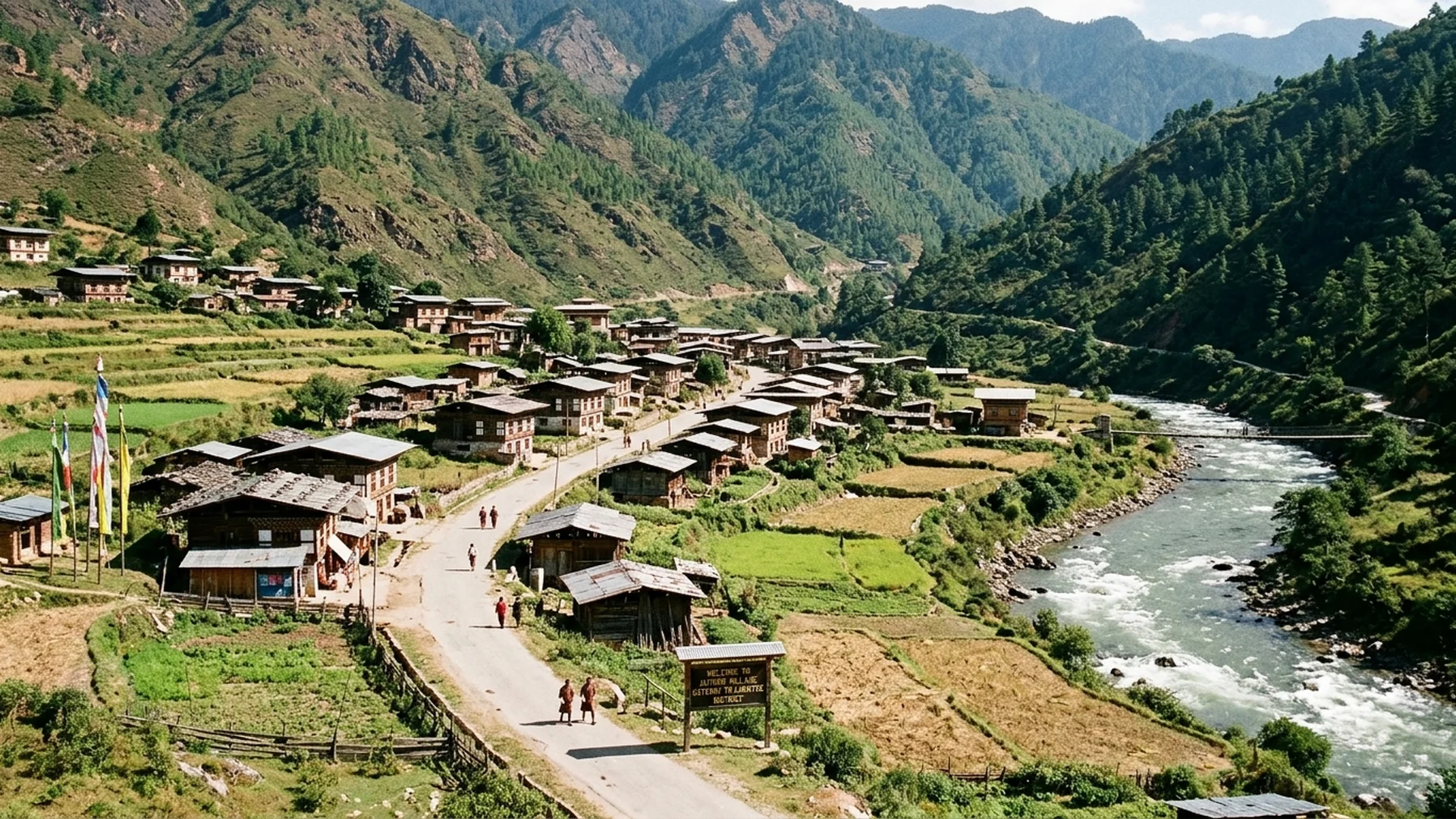
As the morning mist slowly dissolves above the emerald waters of the Kuri Chhu, the valley below awakens in a profound stillness distinct from the more frequented western reaches of the Himalayan kingdom. This is Autsho Village, a warm, low-lying sanctuary that serves as an inviting portal for travelers seeking a deeper, more contemplative resonance in Bhutan’s remote eastern frontier.
Encircled by verdant peaks, Autsho is far more than a mere resting point along the winding road to Lhuentse. It represents the quiet heartbeat of local life, where a milder climate and the gentle cadence of flowing water cultivate an atmosphere of unhurried grace. Here, time seems to slow its pace, allowing discerning wanderers to absorb an authentic landscape largely untouched by the modern rush.
A Geography of Water and Valley Resilience
The Kuri Chhu flows like an emerald lifeline through this sheltered valley, carving intricate pathways through rugged terrain and creating fertile riparian terraces that have sustained generations of agrarian communities. The atmosphere in Autsho is defined by a serene acoustics: the soft murmur of the current mingling with gentle breezes rustling through pine stands. Because Eastern Bhutan enjoys a more temperate climate than its high-altitude western counterparts, Autsho fosters a lush, semi-tropical flora that adds vibrant shades of green to the mountain canvas.
Crossing into Cultural Depth: From Autsho to Lhuentse
As the threshold to Lhuentse—the ancestral cradle of Bhutan’s royal dynasty and a peerless center of traditional craftsmanship—Autsho opens the gateway to a rich tapestry of history. From this riverside settlement, travelers venture further north toward Khoma Village, renowned across the kingdom for producing the finest Kishuthara silk textiles. Journeys extending upward into the surrounding ridges reveal the monumental Takila Guru Statue, its golden form radiating compassion across the eastern highlands.
The Quiet Elegance of Everyday Life
Daily life in Autsho unfolds with unpretentious rhythm, rooted in traditional farming and artisanal fishing. Traditional Bhutanese homesteads, crafted from rammed earth and timber with intricate woodwork, scatter gracefully along the terraced hillsides. To stroll past these stepped agricultural fields, or to exchange quiet smiles and greetings with local residents, is to encounter an unpretentious grace that speaks directly to the core philosophy of the kingdom.