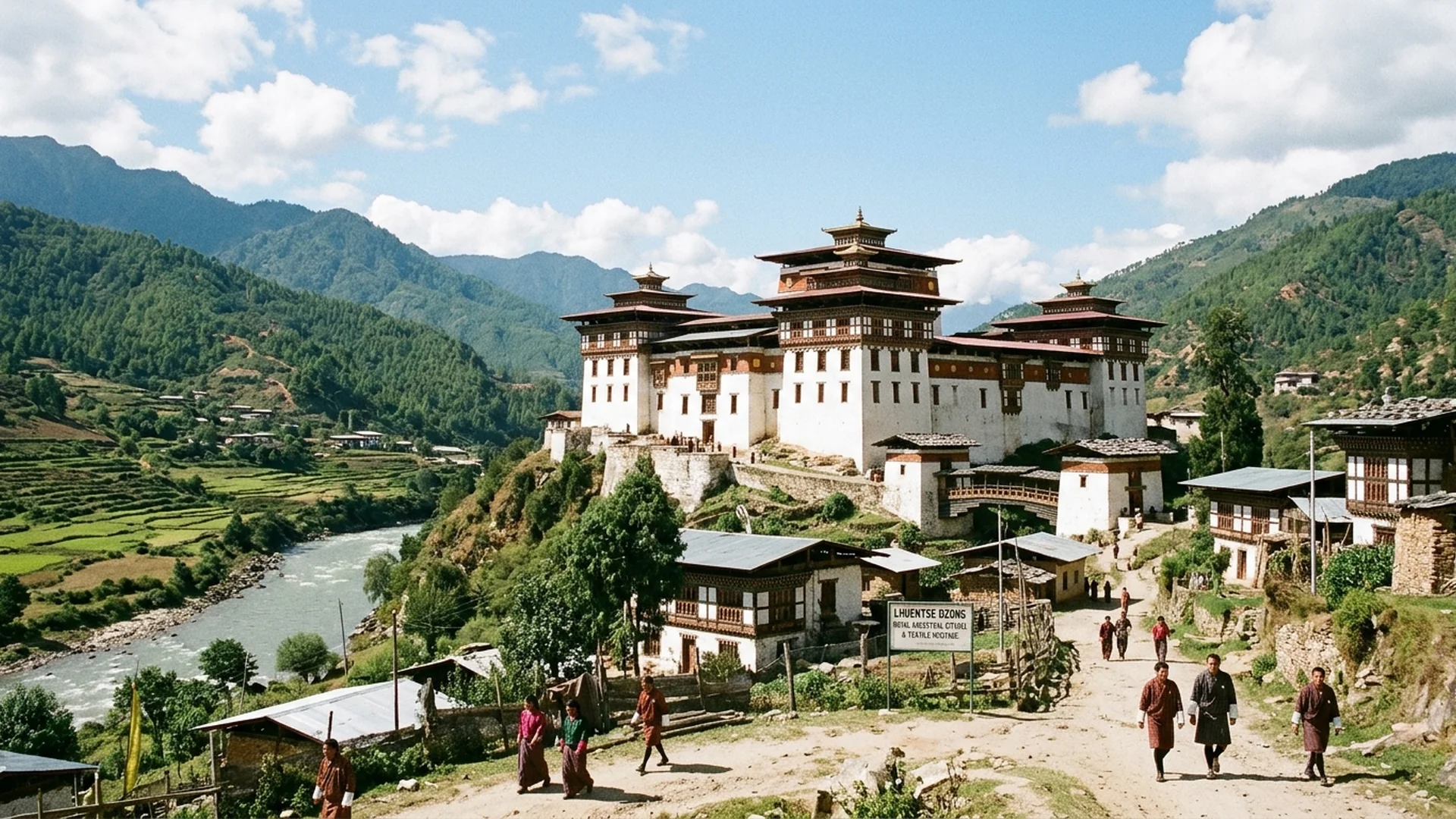
As the morning mists gently lift from the vast valley below, the striking silhouette of whitewashed walls and crimson friezes emerges along the ridge of the Kuri Chhu river—resembling an antique painting untouched by the passing of centuries. Lhuentse Dzong rests quietly in the remote embrace of eastern Bhutan, far removed from the more frequented tourist corridors. It is far more than a venerable monastery-fortress and administrative seat; it is a profound spiritual anchor linking the history of the Wangchuck dynasty with the intricate artistry of hand-woven silk, encapsulating the true essence of cultural luxury in the Thunder Dragon Kingdom.
Ancestral Roots: The Noble Heritage Etched Upon Lhuentse’s Soil
To truly comprehend the spiritual fabric of contemporary Bhutan, one must retrace the journey back to its origins at Lhuentse. This terrain holds an intimate, enduring bond with the Wangchuck dynasty, serving as the ancestral homeland of the first monarch before the unification of Bhutan in the early twentieth century. An aura of quiet devotion and ancient lore lingers within every corner of this historic dzong. Every footstep upon its weathered stone pathways feels akin to turning the pages of an invaluable chronicle, preserved steadfastly by nature and by local communities dedicated to their timeless traditions.
Timeless Architecture: The Striking Majesty Along the Kuri Chhu Gorge
Originally known as Kurtoe Dzong, Lhuentse Dzong was established in the seventeenth century to commemorate peace and triumph. The fortress commands a narrow spur plunging gracefully toward the Kuri Chhu river. Its traditional Bhutanese architectural grammar—comprising thick rammed-earth walls, intricately carved wooden window frames, and immaculate courtyards—reflects the profound wisdom of ancient master builders who integrated monumental structures seamlessly into steep topography. When afternoon sunlight strikes the dzong, the brilliant white and deep crimson hues contrast sharply against the verdant slopes and rushing waters below, casting an arresting spell of sublime tranquility upon every traveler.
The Heart of Craftsmanship: The Enchantment of Kishuthara Weaving in Khoma Village
A short journey from the dzong lies Khoma Village, a legendary valley devoted to the creation of Kishuthara silk textiles, widely celebrated as the most complex, refined, and prized hand-woven fabrics in Bhutan. The rhythmic clacking of wooden looms echoing from traditional timber homes forms a rustic symphony honoring consummate artistry. Female weavers in Lhuentse dedicate months, and occasionally over a year, to delicately interlace individual silk threads into mesmerizing geometric motifs and vibrant, striking palettes. A pilgrimage to this valley transcends simple sightseeing; it offers a rare window into the patience, soul, and profound pride woven into every square inch of fabric.