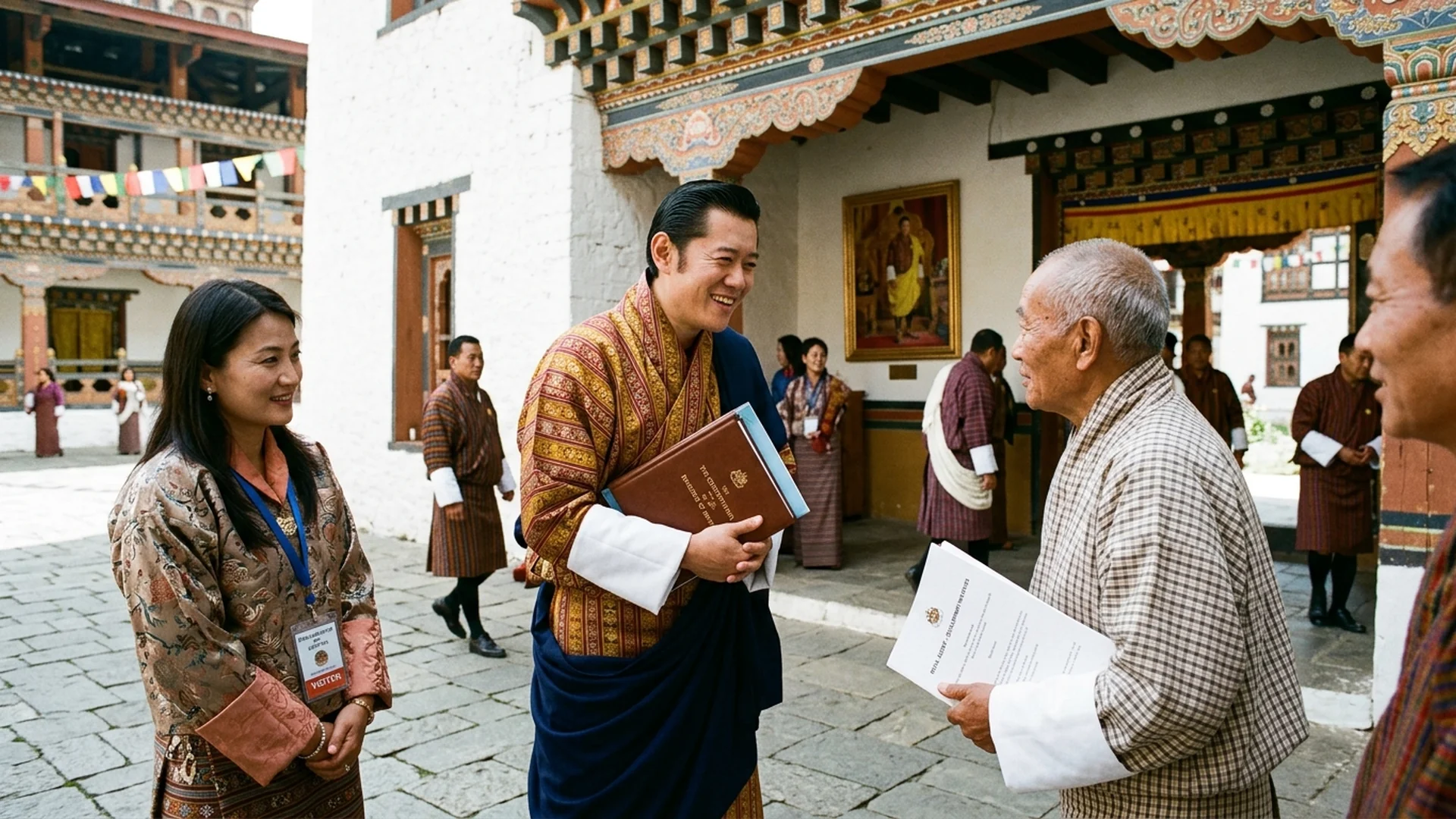
Amidst the low-hanging mists shrouding the towering summits of the Himalayas, the Kingdom of Bhutan stands peerless as a sovereign realm untouched by Western colonization, charting a path into modernity entirely its own. Behind this resolute cultural preservation, paired with a society rich in spiritual wealth, lies not the whim of fortune, but the visionary foresight of the House of Wangchuck, the guardians of the Thunder Dragon Kingdom since 1907.
What elevates the narrative of the Wangchuck Dynasty above all other monarchies is the phenomenon of ‘The Gentle Reform’—an enlightened and graceful social transition. The monarchs of Bhutan did not merely listen to the sovereign will of their people; they proactively bestowed modern governance, democratic empowerment, and state-of-the-art infrastructure before external pressures ever forced their hand.
For the discerning luxury traveler, stepping into Bhutan is far more than an escape into dramatic landscapes or secluded sanctuaries that merge effortlessly with untamed wilderness. It is an immersion into the tangible fruits of a royal vision that pioneered the ‘High Value, Low Volume’ tourism model—a philosophy that translates pristine forests, sacred heritage, and profound tranquility into an enduring, profoundly meaningful journey.
From Trongsa Fortress to Punakha Dzong: The Genesis of Thunder Dragon Unity
In the late 19th century, Bhutan was a fractured realm divided by feuds among regional lords known as Penlops. This era of fragmentation ended when Sir Ugyen Wangchuck, the Trongsa Penlop who commanded vital trade routes between the east and the west, deployed masterful diplomacy and strategic acumen to unify the fractured valleys.
In 1907, within the sacred sanctum of Punakha Dzong—the majestic fortress situated at the confluence of the Pho Chhu and Mo Chhu rivers—monastics, civil servants, and representatives of the populace convened to sign a historic compact establishing Ugyen Wangchuck as the Druk Gyalpo, or Dragon King, of Bhutan. This historic coronation not only restored enduring peace to the land but also firmly established Bhutan upon the geopolitical map of the world.
Today, Trongsa Dzong, perched dramatically upon a sheer cliffside in the geographic heart of the kingdom, continues to serve as a vital symbol of royal lineage. By longstanding tradition, every Crown Prince of Bhutan must serve as the Trongsa Penlop before ascending the Golden Throne.
Decoding the Intellectual Legacy: Five Reigns of Progressive Monarchy
The historical lineage of the Wangchuck Dynasty is widely celebrated as one of the most enlightened and forward-thinking royal institutions in global history, with successive sovereigns systematically guiding the nation through profound evolutions:
- The First and Second Kings (King Ugyen Wangchuck and King Jigme Wangchuck): Focused heavily on internal stabilization, centralizing administrative structures, and forging steady diplomatic relations with British India and neighboring powers to secure national sovereignty.
- The Third King (King Jigme Dorji Wangchuck - The Father of Modern Bhutan): Safely guided Bhutan out of self-imposed isolation, abolishing serfdom, establishing the National Assembly and judiciary, and leading the kingdom into United Nations membership in 1971.
- The Fourth King (King Jigme Singye Wangchuck): Revolutionary architect of the Gross National Happiness (GNH) philosophy, prioritizing psychological well-being, ecological preservation, and cultural integrity over sheer GDP. In 2008, he voluntarily devolved absolute power to establish a constitutional democracy.
- The Fifth King (King Jigme Khesar Namgyel Wangchuck): The reigning monarch and spiritual anchor of the Bhutanese people, who is successfully expanding GNH into the digital age while spearheading the Gelephu Mindful City—an ambitious regional hub merging mindfulness, sustainable economics, and ecological sanctuary.
Tracing Royal Landmarks: From Administrative Seats to Spiritual Chortens
An authentic exploration of Bhutanese history remains incomplete without visiting the architectural cornerstones deeply intertwined with the Wangchuck Dynasty:
- Tashichho Dzong (Thimphu): This majestic fortress along the Wang Chhu river serves as the seat of government, the King’s official workspace, and the summer residence of the central monastic body. Its intricate woodwork, assembled entirely without iron nails, reflects serene authority and immaculate design.
- Punakha Dzong (Punakha): Widely regarded as the most picturesque fortress in Bhutan, framed by cascading purple jacaranda blossoms each spring. This is the birthplace of the monarchy and the site of the royal wedding of the fifth King and Queen Jetsun Pema in 2011.
- National Memorial Chorten (Thimphu): A striking whitewashed stupa adorned with golden spires in the capital’s heart, erected in 1974 in honor of the third King. It serves as a living spiritual anchor where locals and members of the royal family alike gather for dawn and dusk circumambulations.
The Philosophy of High Value, Low Volume: When Solitude Becomes Sustainable Luxury
The immaculate preservation of Bhutan’s pristine environment and tranquil lifestyle is no accident; it is the deliberate realization of a national tourism blueprint forged by the visionary Wangchuck monarchs.
Choosing to reject the pressures of mass tourism, Bhutan instituted the High Value, Low Volume policy, anchored by the Sustainable Development Fee (SDF) levied upon international visitors. These contributions directly fund free nationwide healthcare and public education while maintaining forest cover across more than 70 percent of the kingdom, preserving Bhutan’s status as the world’s only carbon-negative nation.
For discerning global travelers, this deliberate framework transforms every journey into an exclusive privilege. You are granted unbroken tranquility, pristine mountain air, and unadorned access to a living indigenous culture completely insulated from overcrowding.