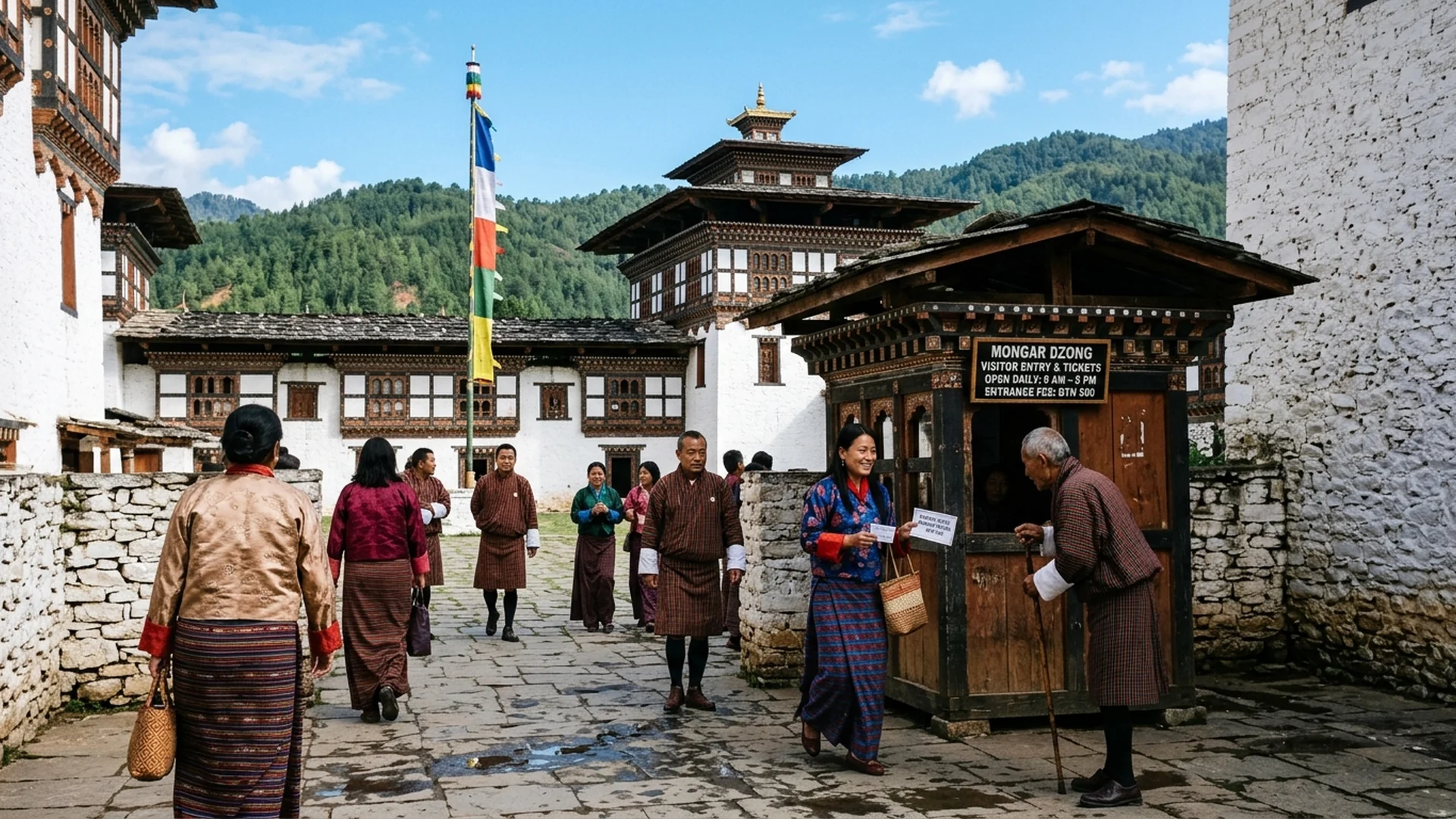
Crossing the threshold beyond the well-trodden valleys of western Bhutan leads one deep into the heart of the east, to Mongar. Perched dramatically along steep mountain ridges rather than nestled within flat valley floors, this town offers an atmosphere of profound stillness, enveloped by pristine wilderness and enveloped in the timeless rhythms of the Eastern Himalayas.
Unlike its western counterparts, Mongar’s topography is defined by cascading hillsides where traditional timber and stone dwellings mingle with eucalyptus groves. Here, the pace of life slows appreciably, inviting discerning travelers to tune into the ancient cadence of Himalayan culture and the quiet majesty of untouched natural landscapes.
Timeless Architecture: The Legacy of Mongar Dzong and Hidden Sanctuaries
Though Mongar Dzong is among the younger monastic fortresses in the kingdom—having been established in the 1930s—its construction rigorously adhered to ancient lineage practices. Built without the aid of blueprints or a single metal nail, the fortress commands the landscape with quiet dignity, serving as both the secular and spiritual heartbeat of the district.
Not far from the town center rests Yakgang Lhakhang, a 16th-century temple founded by the son of Tertoen Pema Lingpa. Within this sanctuary, sacred ritual masks and priceless holy relics endure, acting as the spiritual bedrock of eastern Bhutan. Visiting these sacred sites offers a tangible, deeply resonant connection to the nation’s living history.
Ascending the Peaks: The Wonder of ThrumshingLa Pass and Ancient Forests
The overland journey into Mongar from central Bhutan is counted among the most visually arresting drives in the entire Himalayan range. The route steadily ascends toward the ThrumshingLa Pass, a high-altitude mountain crossing resting at more than 3,780 meters above sea level within the boundaries of Thrumshingla National Park.
Along the winding ascent, the ecosystem transforms dramatically from dense coniferous forests to seasonal alpine meadows and ancient trees shrouded in drifting mountain mists. The solemn quiet of these elevated passes, contrasting against the sweeping green valleys far below, delivers an intensely powerful and unforgettable travel experience.
The Art of Weaving: Exploring Mongar’s Indigenous Craftsmanship
Eastern Bhutan is widely celebrated as the epicentre of the kingdom’s most refined handicrafts and textiles. The artisans of Mongar possess exceptional mastery in the intricate craft of backstrap loom weaving, utilizing complex geometric patterns and brilliant natural dyes passed down through generations.
A quiet stroll through the local markets and neighboring agrarian communities reveals a lifestyle defined by meticulous grace. From traditional wooden containers and mask carving to indigenous instruments, every handcrafted element speaks of an enduring, harmonious relationship between humanity and the Himalayan environment.