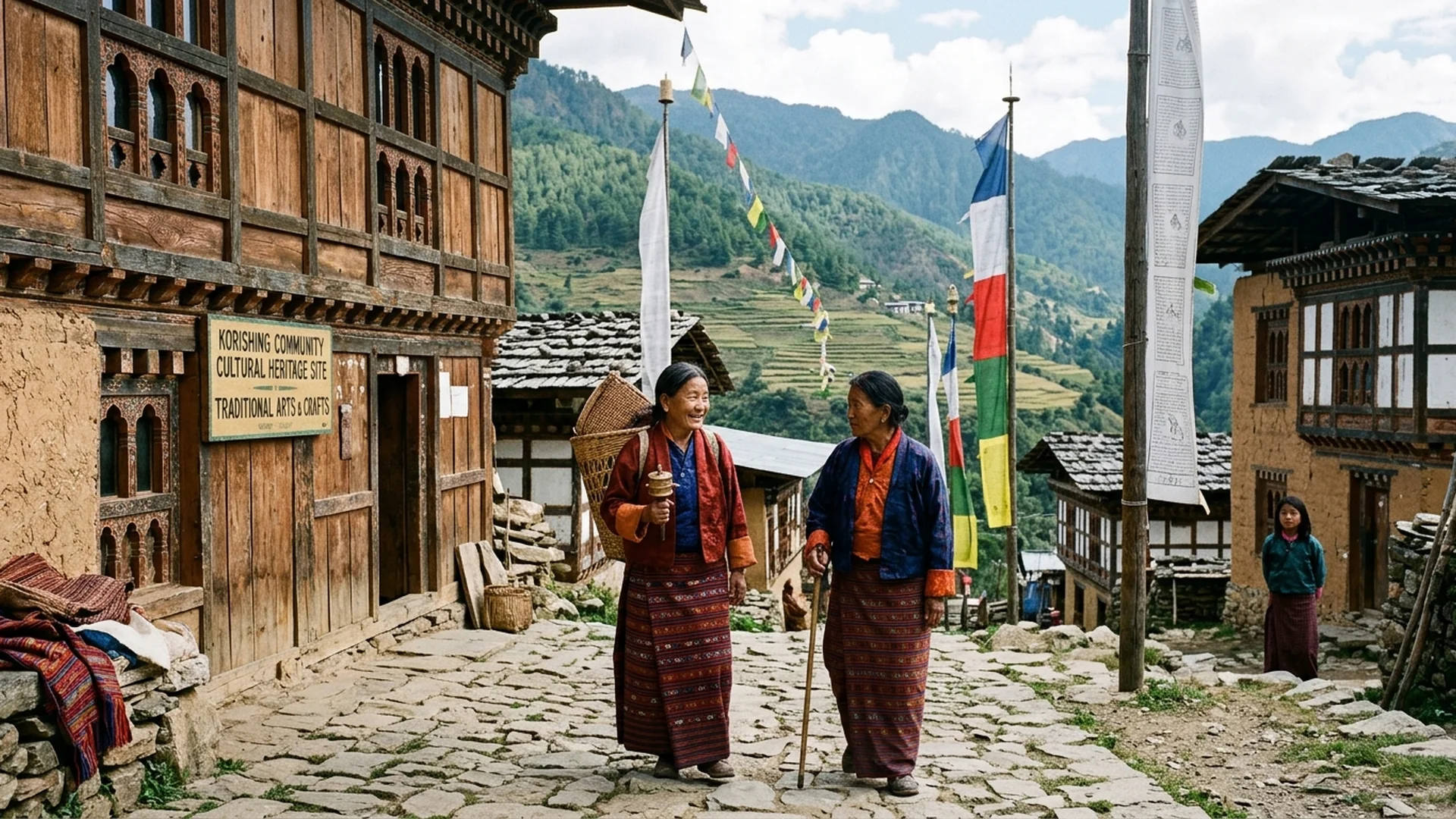
As the morning mist gently rolls across the precipitous ridges of the eastern Himalayas, this remote corner of the kingdom unveils a raw, untouched beauty that time has quietly bypassed. Leaving behind the well-trodden western trails, one arrives at Korishing Village, a tranquil ancestral settlement nestled within the Mongar district. Here, the rhythm of daily existence is dictated solely by the breath of the mountains and the whispers of high-altitude winds.
In this sanctuary, modernity is nothing more than a distant fable. Traditional timber and stone dwellings cascade down the verdant hillsides, bearing silent witness to an innate architectural harmony with the surrounding topography. Korishing is far more than a mere coordinate on a map; it is a living museum, offering discerning travelers an intimate glimpse into the profound depths of Himalayan culture through enduring agricultural traditions and craftsmanship passed down across generations.
Architecture and Spirit in Mongar: The Deep Roots of Korishing
The Mongar district is celebrated as the geographical and historical heartbeat of eastern Bhutan. Defined by an intricate labyrinth of plunging valleys and sheer precipices, the terrain has forged a community of remarkable resilience and profound reverence for the natural world. The homes within Korishing Village are masterclasses in traditional Bhutanese vernacular architecture: the ground tier serves as a granary and shelter for livestock, while the upper level provides light-filled living quarters and sacred family spaces. Elaborately carved wooden window frames and structural pillars whisper tales of Buddhist devotion and ancient folklore. Every homestead radiates a meticulous craftsmanship that is increasingly rare in the contemporary world.
Living Handicrafts: Heritage Woven by Hand
What elevates Korishing into an essential pilgrimage for cultural connoisseurs is its dedication to preserving ancient folk arts. The rhythmic clack of wooden backstrap looms echoes from beneath traditional eaves, bearing testimony to the women who perpetuate complex textile traditions using natural dyes extracted from tree bark and roots. Alongside weaving, intricate bamboo basketry and handcrafted agrarian implements underscore a profound ethos of self-reliance. These creations are never mere commodities for mass tourism; rather, they are functional instruments of daily life and a tangible cultural lexicon chronicling the lineage of eastern Bhutanese ancestors.
The Art of Slow Living: Philosophy Made Tangible
A journey to Korishing is an invitation to recalibrate one’s internal clock, far removed from the clamor of the modern world. The soundtrack here is composed entirely of birdsong, rushing glacial streams, and the gentle rustle of pine forests. Travelers may spend unhurried hours exploring terraced agricultural fields, exchanging quiet smiles and warm hospitality with local residents. To sit with a steaming cup of butter tea while watching the golden evening light paint the pine-clad peaks is an irreplaceable luxury—a true restoration of the spirit found solely through radical simplicity.