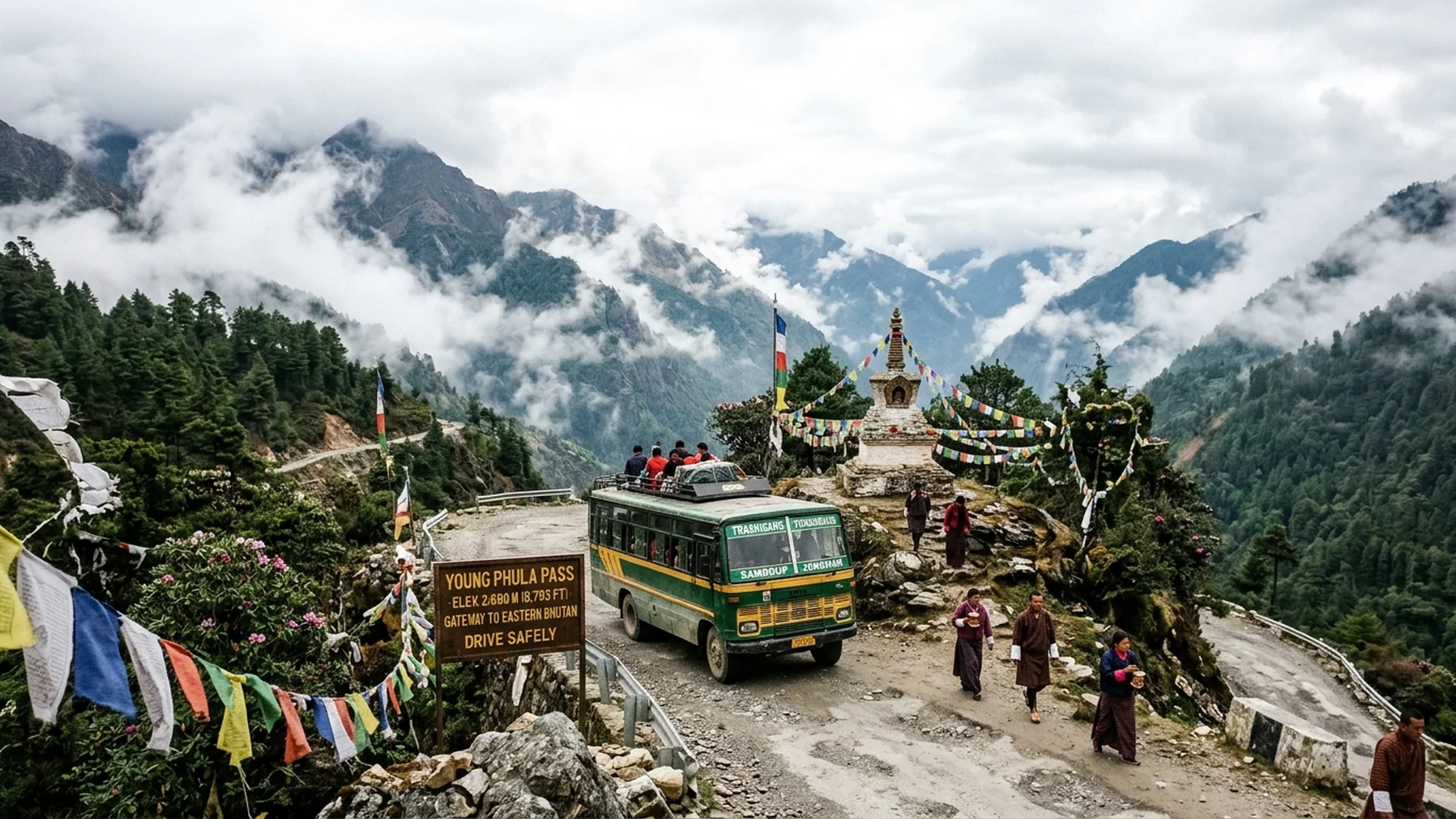
When conjuring the Land of the Thunder Dragon, the imagination instinctively drifts toward the majestic fortress-monasteries of Paro or the vertiginous cliffside aerie of Tiger’s Nest in the country’s western reaches. Yet, far beyond the complex folds of mist-shrouded ranges to the east, a profound stillness and a more pristine ancient spirit await at Young Phula Pass. Perched at soaring altitudes, this strategic mountain crossing serves as both a corridor of drifting clouds and a magnificent threshold into the beating heart of Eastern Bhutan.
To journey here is not merely to alter coordinates on a map, but to step across the threshold of time itself—moving from familiar tourist trails into an unadorned, sweeping wilderness. Here, heavy mists routinely descend to brush the tops of Himalayan pines, and the mountain winds whisper tales centuries old. Young Phula stands as a sublime destination for discerning travelers seeking the true, contemplative meaning of authentic exploration.
A Geography of the Heavens: Where Mist Meets the Himalayan Crests
Young Phula Pass defies gravity at an elevation that commands breathless, uninterrupted panoramas. In the stillness of dawn, the earliest amber rays of sunlight pierce through dense blankets of drifting cloud cover, pooling across the valleys below in a vast, ocean-like sea of mist. The alpine climate here is mercurial; thick fog can envelop pine forests and alpine meadows in a fleeting instant, casting an ethereal, deeply secluded atmosphere over the landscape. Unburdened by the relentless clamor of the modern world, Young Phula is an invitation to stillness—a place to quiet the mind and commune with elemental nature.
Spiritual Heritage: Sacred Monasteries and Echoes of Ancient Devotion
Beyond its striking physical topography, Eastern Bhutan remains a realm where the living roots of Tantric Buddhism pulse vibrantly through daily life. Near the pass, venerable sanctuaries and old monasteries serve as spiritual anchors for outlying farming hamlets. During sacred festivals, these heights resonate with the resonant beat of long drums, clashing cymbals, and elaborate mask dances (Cham) that enact the subjugation of negative forces and convey timeless moral philosophies. Observing the unhurried devotion of monks and villagers here offers profound insight into an inner contentment born of simplicity.
Strategic Horizons: The Aerial Bridge to Trashigang
Historically, reaching Eastern Bhutan served as an ultimate test of endurance, demanding days of grueling vehicular transit along tortuous mountain switchbacks from the capital or Paro. Today, the strategic opening of Yongphula Airport near the pass has elevated the journey into an effortless, high-end experience. Domestic flights skim across towering snow-capped ridges, offering peerless aerial perspectives before setting down where crisp mountain air greets arriving guests. From the tarmac, private chauffeured vehicles wind downward along forested ridges toward Trashigang, the historic cultural and trading epicenter of the east.