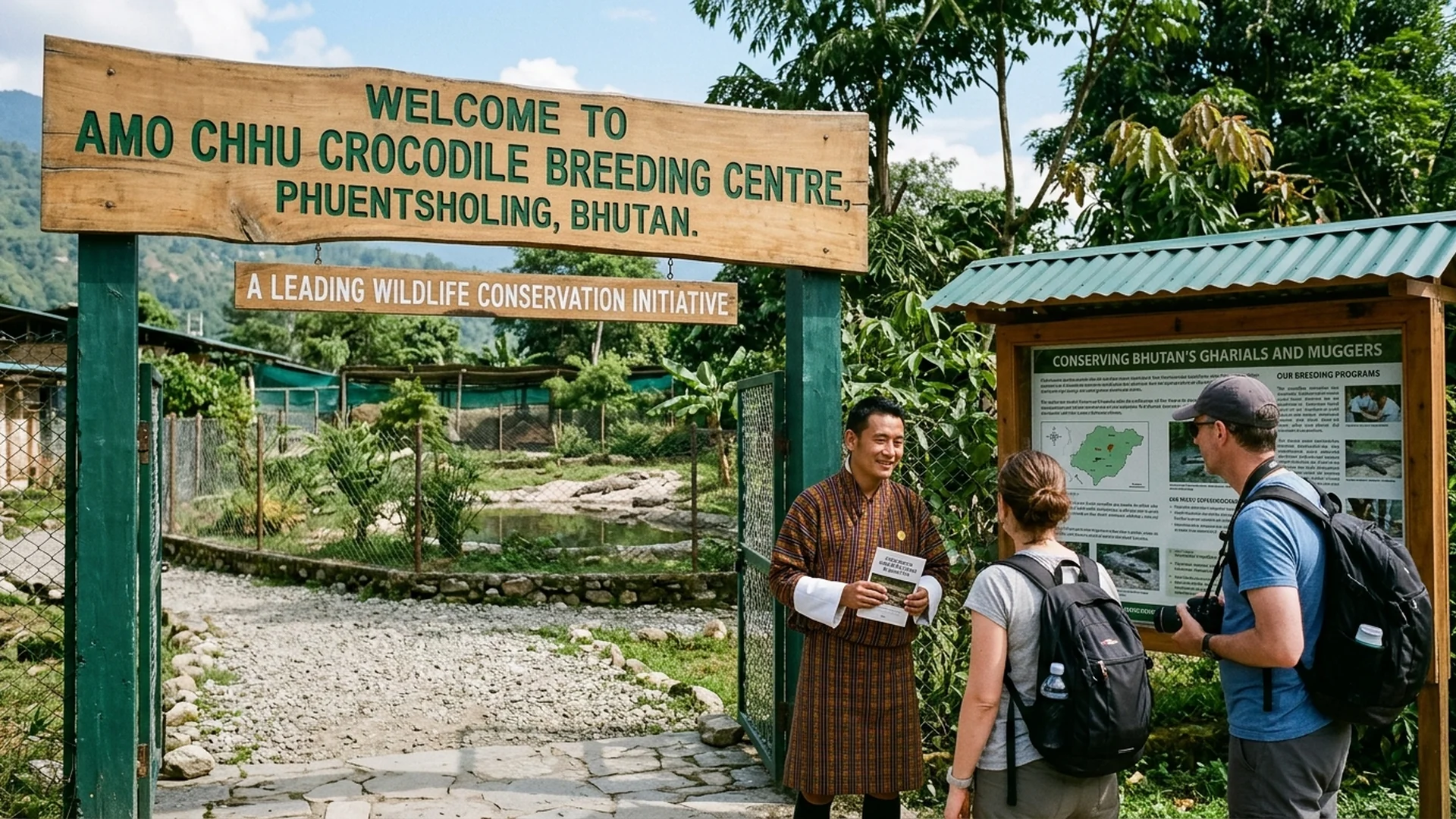
When conjuring the Kingdom of Bhutan, the mind instinctively drifts toward snow-crowned summits, cliff-hiding sanctuaries, and the resonant philosophy of Gross National Happiness echoing through mountain pines. Yet, at the southern frontier town of Phuentsholing—the primary overland gateway into the realm—an entirely different narrative unfolds in quiet contrast. Alongside the rushing currents of the Amo Chhu river lies a tranquil wildlife sanctuary that serves as an unexpected bastion of subtropical biodiversity in the high Himalayas. This is far more than a conventional nature station; it stands as a subtle yet resolute testament to Bhutan’s unwavering commitment to safeguarding vulnerable aquatic species.
Crossing into the Amo Chhu Crocodile Breeding Centre is akin to turning a fresh page in Bhutan’s ecological storybook, revealing a dimension far beyond traditional mountain itineraries. Here, conservation philosophy extends beyond grand landscapes to embrace every living creature, including ancient reptiles vital to maintaining the delicate balance of riparian ecosystems amid a rapidly modernizing world.
Roots of Conservation: From Riverbanks to Dedicated Stewardship
In 1976, the Amo Chhu Crocodile Breeding Centre emerged in response to declining wild crocodile populations caused by shifting habitats and human encroachment. Recognizing the urgency, the Royal Government of Bhutan, in collaboration with wildlife authorities, established this riverside refuge along the Amo Chhu to function simultaneously as a breeding sanctuary and an educational hub for frontier aquatic ecosystems.
The atmosphere within the centre is defined by the gentle rustle of subtropical foliage, the constant murmur of flowing water, and meticulously designed enclosures that mirror natural habitats. Devoid of commercial fanfare or theatrical animal shows, the environment encourages a profound reverence for the natural world. The quiet ripple of water and the amber gaze of a submerged reptile breaking the surface speak volumes about the quiet tenacity of ancient lineages surviving against the odds.
Companions of the Current: The Gharial and the Mugger Crocodile
The primary draw for naturalists and wildlife enthusiasts is the opportunity to observe two extraordinary and rare crocodilian species: the Indian gharial (Gavialis gangeticus), instantly recognizable by its slender, elongated snout evolved specifically for piscivorous feeding, and the mugger crocodile (Crocodylus palustris), a robust apex predator well-adapted to freshwater habitats.
Observing these magnificent creatures from secure viewing perimeters allows discerning travelers to appreciate the intricate dynamics of the southern Himalayan river webs. The gharial, currently classified as Critically Endangered on a global scale, receives meticulous, hands-on care from local wardens—from incubation stages until the juveniles are robust enough for release back into the wild or transfer to designated reserves. This effort highlights the quiet triumphs of ex-situ conservation within Bhutan.
Phuentsholing: Beyond a Border Town into Unique Rhythms
An excursion to the Amo Chhu breeding centre is naturally intertwined with the broader character of Phuentsholing. As a cultural crossroads where Indian and Bhutanese influences gently intersect, the town is far more than a mere administrative checkpoint for travel documents. It possesses a distinctive rhythm that pairs bustling commercial lanes with serene Buddhist devotion.
Spending time exploring the environs of the Amo Chhu river allows travelers to downshift their pace, breathe in the crisp foothill air, and witness a facet of Bhutan driven by deep environmental mindfulness. It serves as an ideal psychological and physical transition before ascending winding mountain highways toward the legendary valleys above.