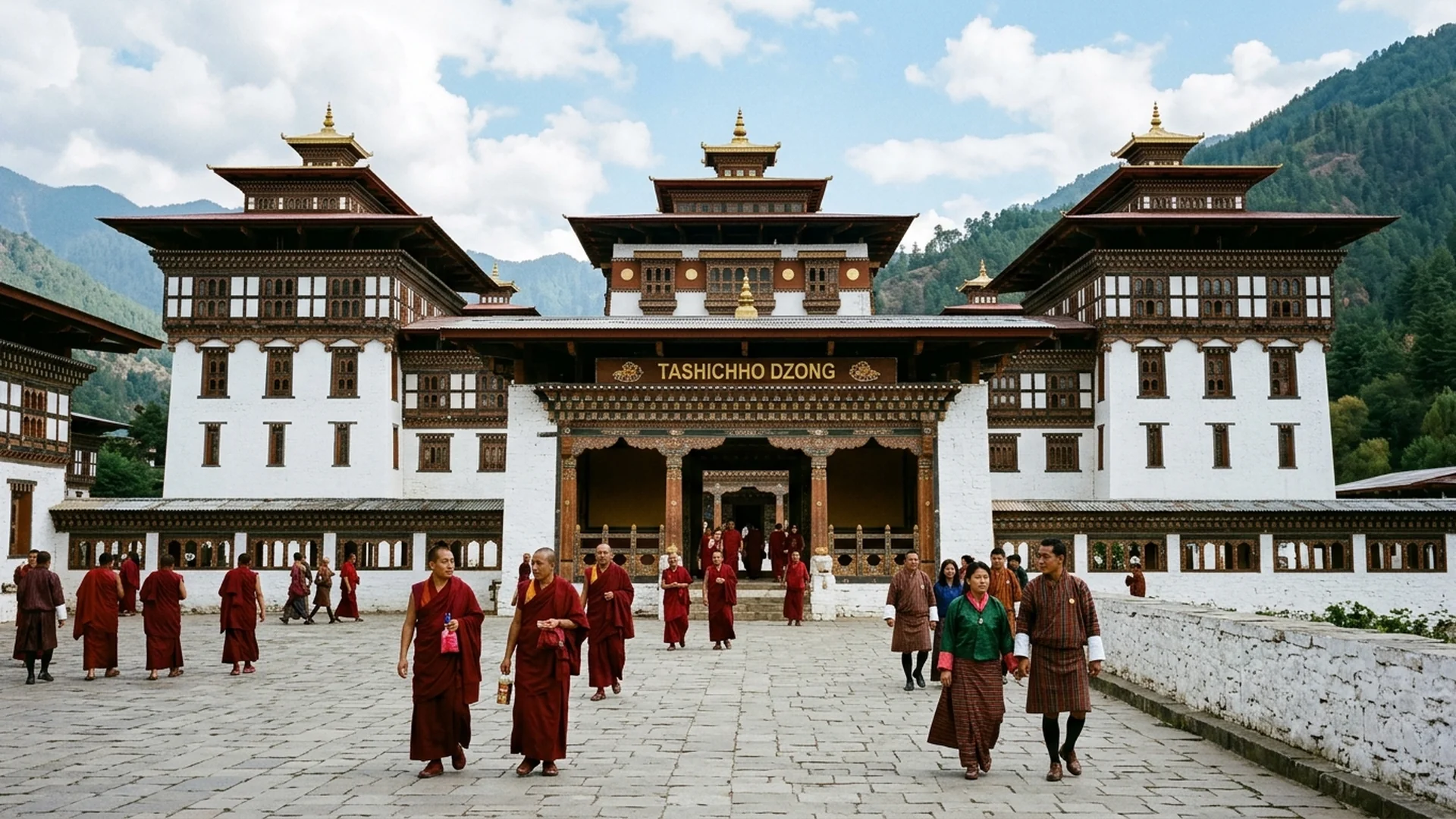
As evening mist rolls softly down the enclosing ridges of the Thimphu valley, a luminous golden illumination begins to wash over the pristine white masonry and intricately carved timber galleries of Tashichho Dzong. Often revered as the Tashichoeling Palace, this magnificent citadel transcends the definition of a mere historic monument. It stands resolutely as the beating heart of Bhutanese sovereignty, spiritual life, and state administration—a sanctuary where the secular and the sacred exist in seamless, eternal dialogue.
Behind towering stone ramparts and across the quiet courtyards bordering the Wangchu Chhu (river), lies an unhurried legacy forged without a single iron nail. To cross its threshold is to step backward into the living roots of Himalayan civilization, where monarchs and revered prelates continually guide the nation through the profound philosophy of Gross National Happiness (GNH), enveloped in the perennial scent of burning juniper and distant, resonant chanting.
Nail-Less Mastery: The Pinnacle of Himalayan Carpentry
The primary marvel of Tashichho Dzong lies in its adherence to Zorig Chusum, the traditional arts and crafts of Bhutan. The entire imposing structure was engineered through an intuitive mastery of the natural landscape. Gleaming white granite blocks are stacked with sublime precision, historically bound without the aid of modern cement, while every timber beam, column, and winged lintel utilizes ancient mortise-and-tenon joinery entirely devoid of iron nails. The erection of such monumental architecture relied not on paper blueprints, but on generational wisdom, profound faith, and sacred proportions passed down from master builders known as ‘Ponta’. This ingenious methodology endows the fortress with remarkable seismic flexibility, allowing it to weather the natural tremors of the Himalayan tectonic plate with timeless grace.
The Dual Governance of Throne and Altar
Within the sprawling confines of the fortress, spatial organization strictly mirrors Bhutan’s traditional dual system of governance. One wing houses the grand assembly halls, state administrative offices, the monarch’s office, and key ministerial chambers. The opposing wing forms the sacred monastic zone, where hundreds of senior monks reside under the spiritual leadership of the Je Khenpo (Chief Abbot of Bhutan). This deliberate architectural arrangement embodies a philosophy wherein temporal authority and spiritual wisdom must walk side by side, ensuring that material development never outpaces moral and ethical grounding.
The Twilight Elegance of Thimphu and Sacred Festivities
As the sun dips below the horizon and the capital settles into a hushed calm, Tashichho Dzong is bathed in golden amber floodlights, creating a striking silhouette against the nocturnal alpine sky. Strolling along the banks of the Wangchu Chhu during this hour offers a contemplative contrast to the bustling activity of the daytime hours. Furthermore, during the annual Thimphu Tshechu, the inner courtyards transform into a vibrant stage for sacred mask dances (Cham) performed by monks and laymen alike to dispel negative energies and bless the realm—representing Bhutanese culture at its most vivid and spiritually potent.