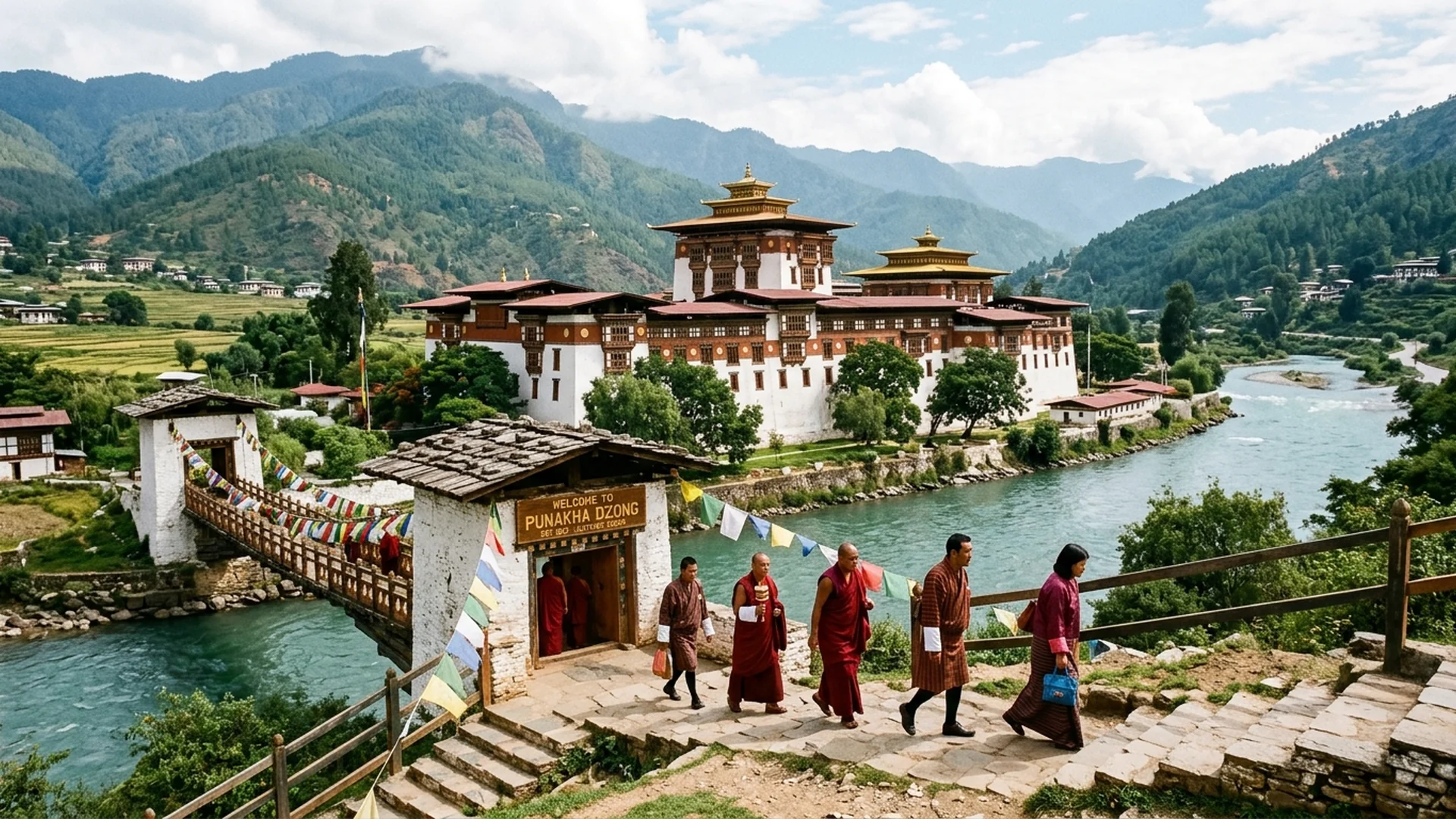
As the winding mountain road descends from the dizzying heights of the Dochula Pass, the crisp, snow-kissed grandeur of the high Himalayas gives way to the gentle, sun-warmed embrace of the Punakha Valley. Revered as the agricultural bowl and the architectural heartbeat of the Bhutanese kingdom, this lush enclave unfurls in a tapestry of emerald terraced rice fields and flowering jacaranda trees that trace the contours of converging rivers. Here lies a landscape of timeless serenity that once served as the nation’s proud political and spiritual throne.
More than a mere haven of mist and memory, Punakha remains a vibrant sanctuary of living faith. Resting at a comfortable altitude of roughly 1,200 meters above sea level, its mild subtropical climate has made it the cherished winter residence of the Je Khenpo, the Chief Abbot of Bhutan, and the monastic body since the 17th century. This seasonal migration embodies a delicate, seamless choreography between pristine nature, formidable fortress-monasteries, and enduring ancestral traditions.
To journey into Punakha is to transcend the ordinary boundaries of sightseeing. It is an invitation to enter an intellectual and spiritual realm where every fort-monastery, swinging suspension bridge, and auspicious mural whispers ancient wisdom. It reveals the profound soul of the Thunder Dragon Kingdom through the eyes of unhurried, contemplative exploration.
Punakha Dzong: The Palace of Great Happiness at the Waters’ Convergence
At the sacred confluence of two rivers—the roaring Pho Chhu, embodying masculine vigor born from the Lunana glaciers, and the gentle Mo Chhu, representing feminine grace—stands Punakha Dzong, formally named Pungthang Dewa Chhenbi Phodrang, or the ‘Palace of Great Happiness.’ Commissioned in 1637 by Zhabdrung Ngawang Namgyal, the unifier of Bhutan, this architectural masterpiece serves simultaneously as a fortress, administrative hub, and monastic sanctuary, constructed entirely without the use of a single iron nail.
The dzong’s aesthetic brilliance is deepened by its rare three-tiered courtyard layout, setting it apart from standard fortresses that typically feature two. The outer courtyard hosts administrative affairs and grand monastic festivals, the central courtyard houses the quarters of the clergy, and the innermost sacred sanctuary safeguards priceless relics and historical treasures. In the early morning light, the sun illuminates whitewashed walls and crimson-lacquered timberwork, casting gentle reflections upon the merging waters of the Puna Tsang Chhu river and imbuing the atmosphere with a profound, meditative stillness.
Chimi Lhakhang and Sopsokha Village: Tales of Fertility and Ingenious Artistry
A gentle stroll through the emerald terraced fields of Sopsokha Village, where the crisp air carries the scent of damp earth and ripening grains, leads to a low green hill crowned by Chimi Lhakhang, widely celebrated as the ‘Fertility Temple.’ Established in 1499, the sanctuary honors Drukpa Kunley, the unorthodox Tibetan saint affectionately known as the ‘Divine Madman,’ who employed humor, unconventional antics, and satire to shatter rigid dogmas and point seekers toward ultimate truth.
Throughout Sopsokha, traditional whitewashed farmhouses are adorned with intricate phallic murals upon their wooden facades. Far from being mere provocations, these symbols are revered ancient talismans meant to ward off malice and envy while invoking prosperity, harmony, and agricultural abundance. Pilgrims journey from across the globe to seek blessings for parenthood within the temple walls, leaving behind photo albums of cherished newborns as enduring testaments to faith.
The Punakha Suspension Bridge: Spanning Waters in Slow Motion
Draped gracefully across the wide expanse of the Pho Chhu river, the Punakha Suspension Bridge stretches over 160 meters, ranking among the longest suspension footbridges in Bhutan. Serving as a vital cultural artery connecting the dzong to farming communities such as Shengana, it offers a passage steeped in rustic charm.
Traversing the bridge delivers an evocative blend of tranquility and gentle adrenaline. The rhythmic flutter of five-colored prayer flags, the roar of glacial waters rushing over polished stones below, and the faint chime of distant cattle bells create an immersive sensory tapestry. Framed by panoramic mountain vistas, it stands as an ideal resting point to pause, breathe in the pristine air, and embrace the unhurried rhythm of the valley.