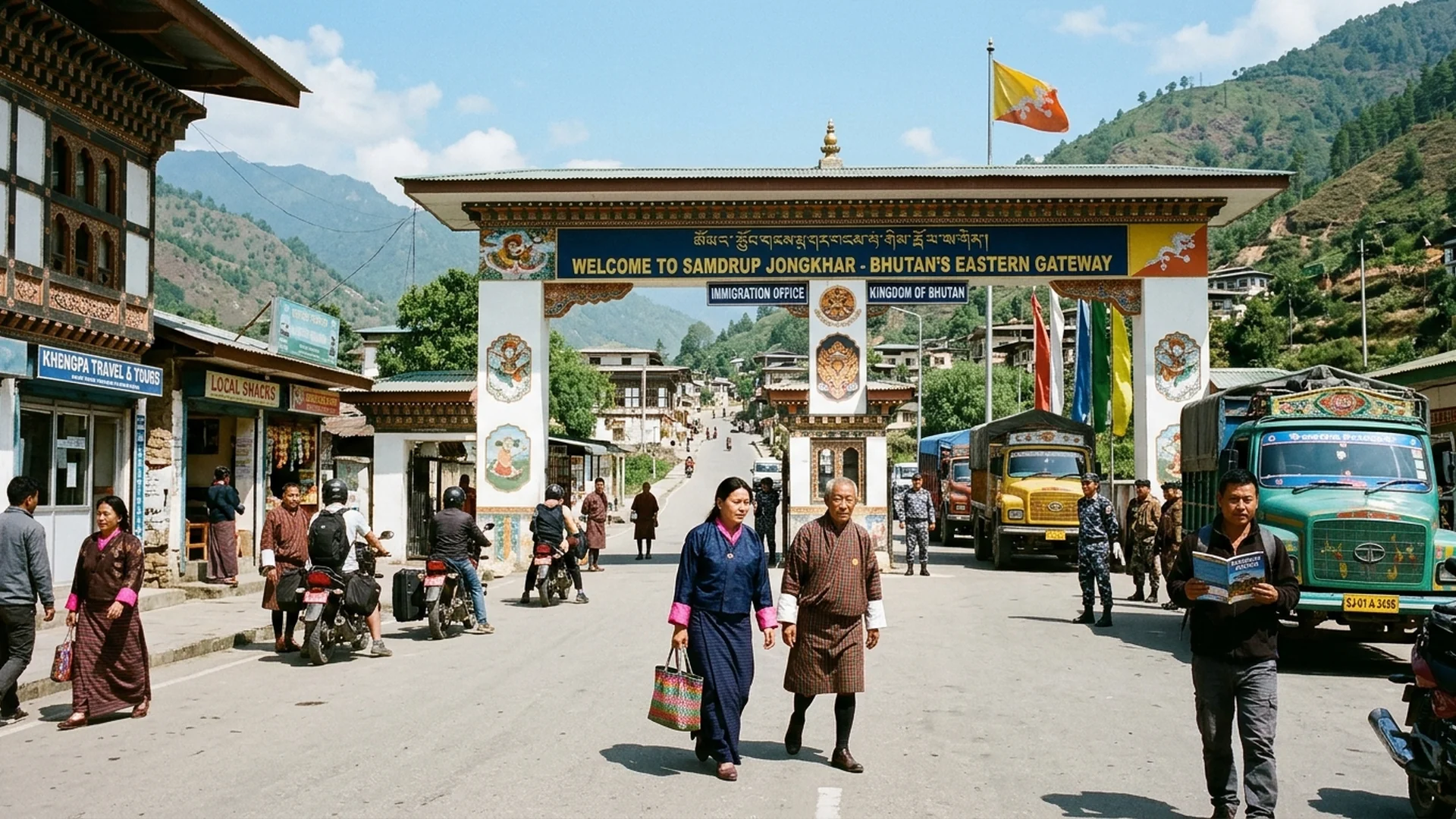
As the heavy morning mists over the subtropical foothills of the southern Himalayas gradually lift, a border town of unique vibrancy and profound stillness reveals itself. Samdrup Jongkhar is far more than a mere crossing point on a geographical map; it serves as a grand, clandestine portal linking the opulent plains of Assam, India, with the Gross National Happiness realm of eastern Bhutan.
Stepping into Samdrup Jongkhar offers an experience entirely distinct from the familiar allure of the capital Thimphu or the iconic Paro Valley. Here lies a cultural suture where untamed nature intertwines with unpretentious daily life. The soft chanting of distant monasteries blends seamlessly with the warm hospitality of the locals, set against a landscape brimming with rich biodiversity and deep historical resonance that invites discerning travelers to decode the eastern Himalayas with an open heart.
Borderland Pluralism and Lowland Fortress Architecture
While the vast majority of fortified monastery-fortresses, or dzongs, across Bhutan are dramatically perched upon dizzying crags and mountain ledges for historic defense, the Samdrup Jongkhar Dzong offers a striking departure. Situated deliberately on the flat expanse of the foothills, it mirrors the town’s distinct role as a vibrant nexus of commerce, cross-cultural exchange, and peaceful coexistence among diverse communities. The dzong is meticulously crafted in classical Bhutanese architectural idioms, adorned with profound Buddhist mural artistry enveloped in an atmosphere of serene devotion. Nearby, the Zangto Pelri Lhakhang temple serves as a terrestrial reflection of the celestial pure land of Avalokiteshvara, providing a tranquil sanctuary where locals and mindful travelers alike pause to absorb the quiet majesty of sacred local craftsmanship.
The Echoes of Dewathang and the Breath of the Wild
Venturing slightly deeper into the rolling embrace of the surrounding hills brings one to Dewathang, a historic settlement of immense gravity in Bhutan’s political and military chronicles. Once a fiercely contested terrain and strategic outpost, its storied past endures silently through the collective memory of village elders and the ruggedly resilient landscape. Beyond the town, the winding highway traversing Narphungla unfurls as one of South Asia’s most pristine birdwatching and ecological corridors. The fertile subtropical forests teem with rare avian species and diverse flora that flourish rhythmically with the turning seasons, offering an immersive pilgrimage into the raw heart of Himalayan nature.