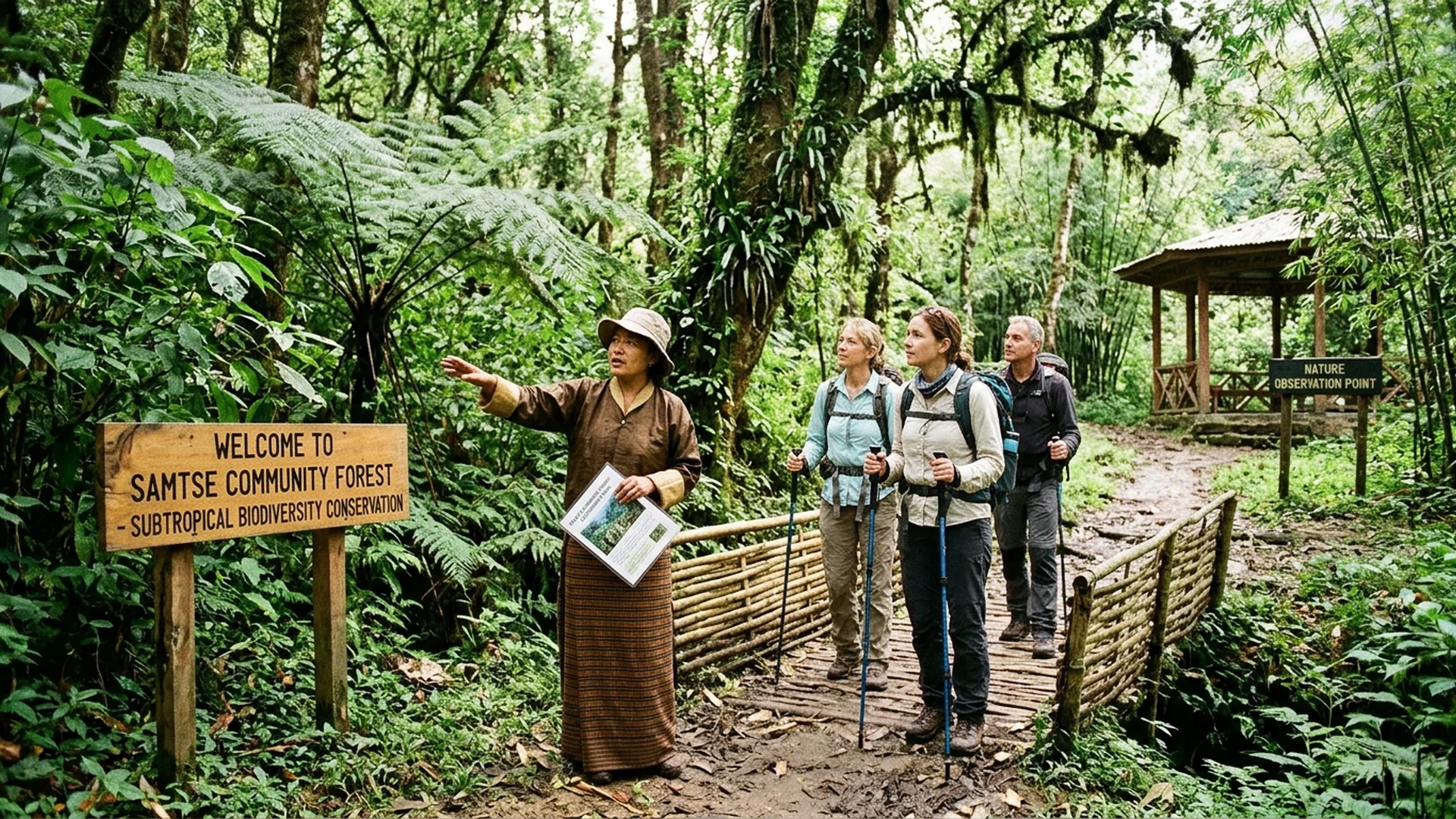
When conjuring the Kingdom of Bhutan, the mind instinctively wanders to snow-draped Himalayan crests, ancient monastic fortresses clinging to sheer precipices, and fragrant pine forests wrapped in northern mist. Yet far to the south, where quiet natural borders meet the plains, an entirely different narrative unfolds. Here lies Samtse, a borderland where rugged mountains soften into subtropical valleys, sheltering a vibrant, verdant sanctuary known as the Samtse Community Forest.
Stepping across the threshold of the Samtse Community Forest is akin to entering another dimension of Bhutan—one driven entirely by the quiet, resolute guardianship of local villagers operating under the guiding philosophy of Gross National Happiness (GNH). In this sanctuary, nature is never treated merely as a scenic backdrop for transient visitors; rather, it is the very breath and hearth of a community that tends to its boundaries with meticulous devotion, embodying the purest ideals of authentic ecotourism.
For the discerning traveler seeking to step beyond heavily trodden itineraries, a pilgrimage to Samtse offers an invaluable reward. It is a rare opportunity to witness the biodiverse splendor of Bhutan’s subtropical ecosystems while absorbing the deep-rooted conservation ethos that anchors the lives of southern Bhutanese communities.
1. The Hearth of Conservation: When the Community Becomes the Guardian
Community forestry in Bhutan is far more than a standard environmental initiative; it is the foundational expression of an unbroken kinship between humankind and the natural world. Within the Samtse district, local villagers assume the full mantle of ownership and stewardship over their ancestral woodlands. Working in seamless tandem with government authorities, they formulate rigorous, sustainable protocols for forest utilization, ranging from the mindful harvesting of non-timber forest products to proactive ecological defense. This governance model rests on the profound premise that human communities and wild forests can thrive in mutual harmony without resorting to exploitation, forming the bedrock of sustainability that has sustained this landscape for generations.
2. Subtropical Abundance: The Hidden Biodiverse Splendor of the South
If the alpine pine forests of northern Bhutan exude a solemn, majestic quietude, the subtropical woodlands of Samtse pulse with a dynamic, multifaceted vitality. The humid subtropical climate nurtures an exceptionally dense ecosystem, where towering canopy trees draped in ancient lianas interlace with verdant undergrowth and wild orchids of extraordinary variety. This flourishing habitat also sustains a remarkable wealth of resident avian and wildlife species. To walk quietly along these forest paths, accompanied by the chorus of unseen birds and rustling leaves, is to cultivate an intimate communion with pristine nature—an experience distinct from any found elsewhere in the kingdom.
3. The Tapestry of Life and Multi-Ethnic Heritage in Samtse
Beyond its natural grandeur, Samtse possesses a distinctive cultural tapestry shaped by its southern borderland identity, where diverse communities weave together in harmonious coexistence. The daily rhythm of village life here is imbued with a quiet, generous warmth. Travelers are invited to engage with living traditions, artisanal crafts, and agricultural practices that remain delicately attuned to the surrounding landscape. Conversing with local residents offers a profound revelation: true prosperity within a Bhutanese community is measured not by material accumulation, but by relational grace and inner tranquility.