As the morning mist gradually lifts from the fertile contours of the Punakha Valley, a vision of pristine white architecture emerges, framed by ancient pines and fluttering prayer flags. Perched high upon a windswept ridge, Sangchhen Dorji Lhuendrup Lhakhang is far more than an extraordinary vantage point for panoramic Himalayan vistas; it is a profound sanctuary of the sacred, where the living traditions of Vajrayana Buddhism intersect with the empowerment of women in the Dragon Kingdom.
Following the winding mountain roads through dense pine forests and terraced agricultural fields reveals a dimension of Bhutanese travel defined by quiet contemplation. Here, intricate sacred architecture harmonizes with the daily devotion of resident nuns who dedicate their lives to scriptural study, meditation, and the preservation of ancestral heritage.
The Sanctuary of Scholarship and Devotion
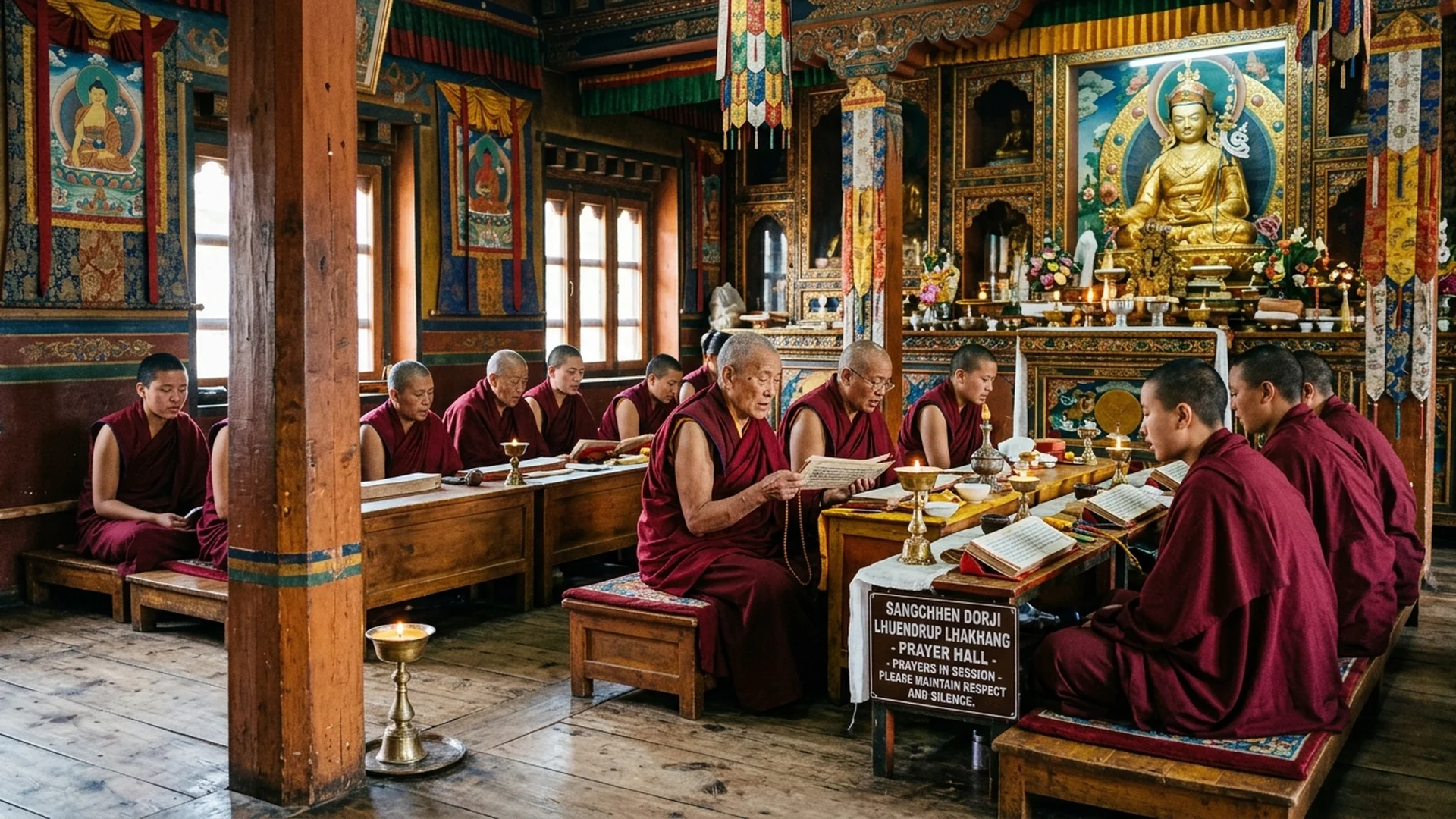
Often referred to as the temple symbolizing the fulfillment of sacred wishes, Sangchhen Dorji Lhuendrup Lhakhang occupies a commanding ridge that overlooks the dramatic confluence of river valleys below. Conceived as a comprehensive center for female monastic education, the institution provides its resident nuns with rigorous training in Buddhist philosophy, advanced meditation, and traditional sacred arts such as thangka painting and ritual needlework. This vibrant scholastic community serves as a testament to the elevating and vital role of women within contemporary Bhutanese spiritual life.
Timeless Sacred Art and Architectural Mastery
The temple complex is an architectural masterpiece defined by meticulous woodwork, hand-carved floral motifs, and auspicious symbols drawn from Buddhist cosmology. Inside, the sanctuary walls are draped in vibrant, natural-pigment murals depicting lineage masters and pivotal moments in Buddhist history. The undisputed centerpiece of the main hall is a fourteen-foot bronze statue of Chenrezig, whose serene gaze and exquisite craftsmanship evoke boundless compassion. Encircling the main sanctuary are pristine stupas that echo architectural influences from the Kathmandu Valley, grounding the entire complex in an atmosphere of absolute tranquility.
High-Altitude Perspectives: Where Nature Meets Architecture
The elevated ridge setting transforms the nunnery into one of the most sublime viewpoints in the Punakha region. From the peaceful stone courtyards, travelers gaze down upon the distant, braided channels of the Pho Chhu and Mo Chhu rivers as they wind through emerald landscapes. The crisp mountain air carries the scent of pine resin and the faint, rhythmic hum of devotional chanting from the prayer halls. In this rarefied space, time slows perceptibly, offering discerning travelers a rare opportunity for profound introspection.