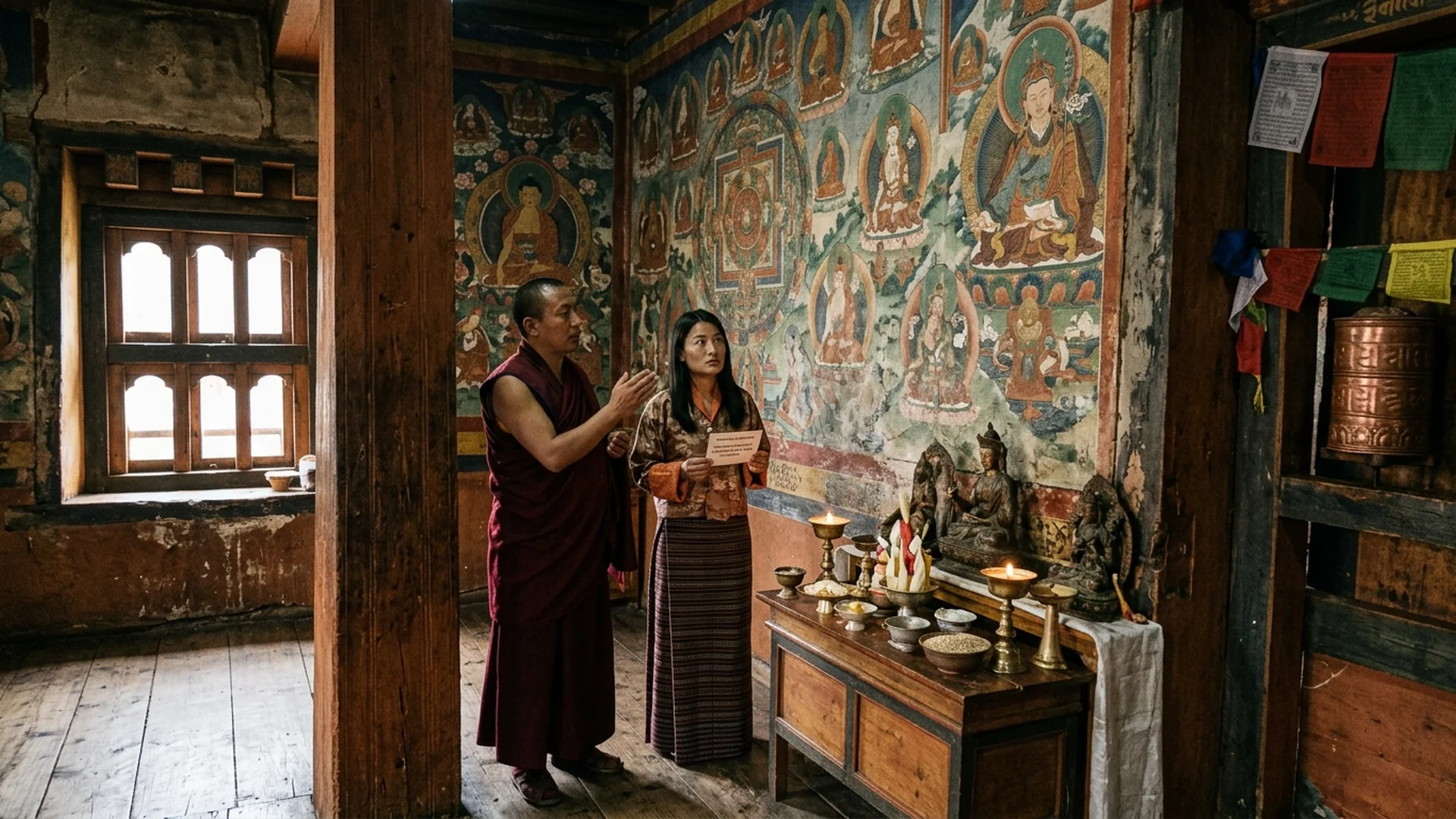
Step beyond conventional travel itineraries and into the profound spiritual heartbeat of Bhutan at Tamshing Lhakhang. Nestled within the tranquil expanse of the Bumthang valley—the historical and cultural soul of the kingdom—this sacred sanctuary invites discerning travelers to stand before some of the country’s most pristine, unadorned medieval murals and test their devotion by carrying an ancient, sacred iron armor.
Amidst the gentle mist and expansive pastures of Bumthang, the temple functions far beyond a mere historical landmark. It operates as a living museum, weaving threads of faith, artistry, and esoteric legend across more than five centuries. For the contemplative traveler seeking the true essence of sacred geography, Tamshing offers an unhurried sanctuary of deep introspection and quiet reverence.
Pema Lingpa: Visionary Master, Artisan, and Master Blacksmith
The narrative of Tamshing Lhakhang—formally known as Tamshing Nguedup Choeling, meaning the Temple of the Good Message of the Auspicious Accomplishment—is inextricably bound to the life of the treasure revealer, Terton Pema Lingpa. In the year 1501, he emerged not only as a profound spiritual prelate and ancestral forebear of the present Bhutanese royal house, but equally as an accomplished painter, sculptor, and master metallurgist.
Pema Lingpa personally conceived and engineered the architecture of this sacred enclave to serve as a pivotal anchor for disseminating the profound wisdom and esoteric teachings of the Nyingma tradition. Every architectural nuance breathes a quiet authenticity and structural integrity, deliberately eschewing the monumental scale of later regional administrative fortresses in favor of intimate spiritual devotion.
Sixteenth-Century Murals: Unretouched Masterpieces of Himalayan Art
The paramount treasure residing within the central sanctum comprises the original mural paintings executed during the temple’s inception. These masterworks hold extraordinary distinction for having entirely escaped the heavy hand of modern overpainting, allowing their authentic lines, organic mineral pigments, and subtle earthen hues to endure across generations. They chronicle pantheons of deities, foundational Buddhist narratives, and protective dharmapalas upon weathered clay plaster.
When afternoon sunlight filters through carved wooden lattice windows, golden illumination catches the ancient mineral grains upon the walls, conjuring an exquisite, hushed dimensionality. Art connoisseurs and cultural historians will immediately recognize the profound privilege of witnessing a sacred site left untouched by restorative vanity, allowing time itself to leave its authentic patina.
Rituals of Devotion: Bridging Spirit and Ancient Iron
Beyond its architectural and pictorial heritage, Tamshing Lhakhang houses an extraordinary tangible relic that beckons personal engagement: a heavy chain mail armor weighing approximately 25 kilograms, forged directly by the hands of Pema Lingpa himself.
In accordance with ancient tradition, pilgrims who hoist this formidable iron garment upon their shoulders and complete three clockwise circumambulations (kora) of the inner sanctuary are believed to unburden past misdeeds, cleanse karmic imprints, and cultivate vast spiritual merit. The soft, rhythmic clinking of iron links echoing through the monastic stillness, mingled with the earthy scent of traditional incense, engenders a deeply visceral moment of self-reflection that lingers long after departure.