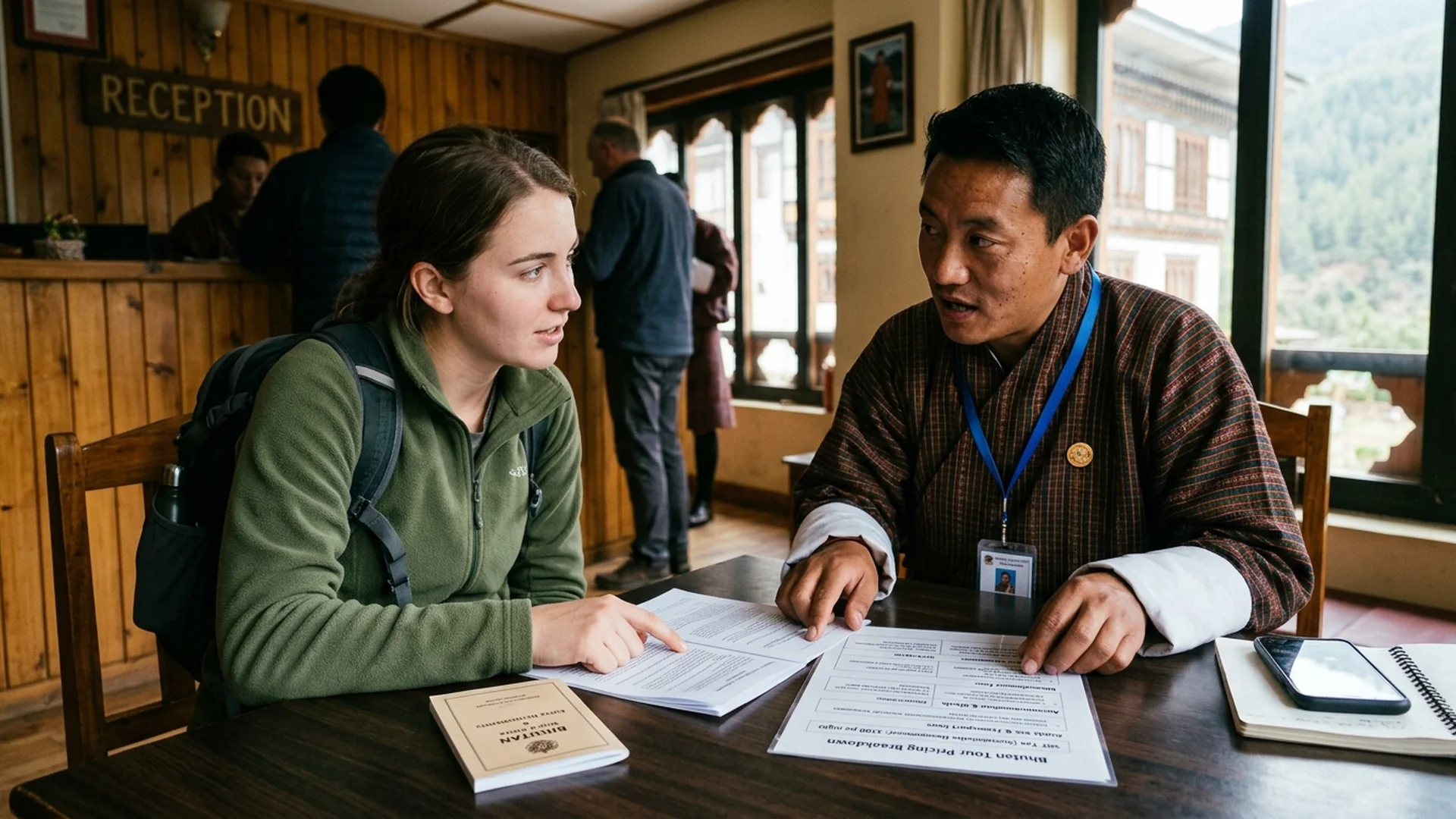
When contemplating the Kingdom of the Thunder Dragon, Bhutan is far more than a mere destination on a global map; it serves as a living crucible for mindful, conservation-led tourism. Many travelers encounter headline figures that appear steep compared to neighboring South Asian locales, yet few grasp the sophisticated national policies and economic machinery underpinning those numbers. Stepping into this fiercely preserved Himalayan sanctuary begins with understanding a pricing structure meticulously engineered to safeguard cultural integrity over mass volume.
Beneath the serene Himalayan peaks, Bhutan operates under a guiding philosophy of ‘High Value, Low Volume.’ This commitment materializes through mandatory fees and regulated tour packages designed to protect its sacred geography. Overlooking the finer financial details can easily disrupt a carefully curated itinerary with unexpected budgetary creep. This journal article dissects Bhutan’s tour pricing architecture in its entirety—from unyielding state levies to subtle on-the-ground expenses—ensuring your contemplative voyage is as transparent as it is rewarding.
Decoding the Pricing Architecture: The SDF and Land Packages
The cornerstone of any Bhutanese travel budget is the Sustainable Development Fee (SDF), levied by the Royal Government at a rate of 100 US dollars per person, per night for adults, with concessionary rates for children. These funds do not subsidize commercial tour operators; rather, they directly support national infrastructure, free public education and healthcare, and environmental initiatives that maintain the nation’s carbon-negative status.
Beyond the SDF, tour pricing is comprised of the ‘Land Package,’ which encompasses accommodations, all daily meals, a licensed private chauffeured vehicle, and the services of an expert local guide well-versed in the nation’s spiritual history. Travelers should meticulously verify whether their quoted package includes the 40 US dollar visa fee and necessary administrative coordination to ensure absolute clarity upon initial remittance.
Contrasting Realms: Standard Itineraries Versus Ultra-Luxury Sanctuaries
When evaluating a five-day, four-night itinerary—or an extended sojourn across multiple valleys—the variance in pricing between operators typically mirrors the caliber of your temporary lifestyle while traversing the kingdom.
Standard journeys generally utilize charming three-star properties featuring traditional Bhutanese vernacular architecture, accompanied by hotel buffets or vetted local eateries. Conversely, luxury Bhutan tours elevate the experience through secluded sanctuaries managed by world-renowned hospitality brands—such as Amankora, Six Senses, or COMO Uma. Nestled deep within mystical river valleys, these havens offer indigenous herbal spa therapies, contemporary fine dining infused with hyper-local ingredients, and late-model luxury vehicles equipped with superior suspension designed for winding mountain passes.
Overlooked On-the-Ground Expenditures
Calculating an itinerary strictly around base tour packages and the SDF seldom covers the entirety of a live journey. Bhutan features subtle nuances on the ground that frequently manifest as incidental expenses. Travelers are advised to carry adequate cash—ideally in pristine US dollar banknotes or local Ngultrum—to accommodate these finer points.
Foremost among these is gratitude gratuities for your guide and driver, an essential cultural convention acknowledging their attentive care throughout the expedition. Additionally, consider incidental activities such as equestrian ascents up to the cliffside sanctuary of Taktsang Lhakhang (Tiger’s Nest) for those opting out of the rigorous walking trail, traditional hot stone herbal baths (Dotsho), and specific museum or monastic festival entry contributions not listed within foundational packages.